

If you’re new to the world of golf or simply curious about golf carts, you might be wondering, “Is driving a golf cart like driving a car?” While there are some similarities, there are also distinct differences between the two. In this article, we’ll explore the various aspects of driving a golf cart and compare them to driving a car to help you gain a better understanding.
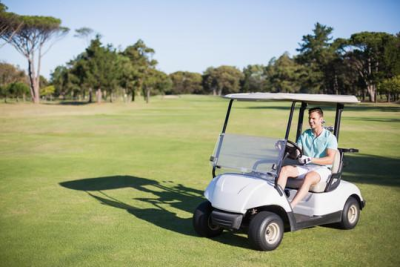
1. Operational Similarities
1.1 Basic Controls
At first glance, the basic controls of a golf cart and a car share some resemblances. Just like in a car, a golf cart is typically equipped with a steering wheel. Turning the steering wheel in a golf cart works in a similar way to a car, allowing you to change the direction of the vehicle. For example, if you want to turn right, you turn the steering wheel clockwise.
Both also have pedals for controlling speed. The accelerator pedal in a golf cart, like in a car, is used to increase the speed. Pressing it gently makes the golf cart move forward at a slow pace, and pressing it more firmly increases the speed. Similarly, the brake pedal in a golf cart is used to slow down or stop the vehicle, just as it is in a car. When you need to stop the golf cart, you press the brake pedal, and the cart gradually comes to a halt.
1.2 Starting the Vehicle
In terms of starting, many modern golf carts and cars have a key – start mechanism. You insert the key into the ignition in a golf cart, just like in a car, and turn it to start the engine. However, it’s important to note that some golf carts, especially electric ones, may also have alternative starting methods such as push – button starts. But overall, the concept of using a key to initiate the starting process is a commonality.
2. Operational Differences
2.1 Speed and Power
One of the most obvious differences between driving a golf cart and a car is the speed and power capabilities. Golf carts are designed for relatively slow – speed operation. The top speed of a typical golf cart is usually in the range of 12 – 15 miles per hour (19 – 24 kilometers per hour). In contrast, cars can reach much higher speeds, with most regular cars having a top speed well over 60 miles per hour (97 kilometers per hour) and some high – performance cars capable of speeds in excess of 200 miles per hour (322 kilometers per hour).
The power source also differs. Golf carts are often powered by electric motors, which provide smooth but limited acceleration. Some may be powered by small gasoline engines, but these are still much less powerful than the engines found in cars. Cars, on the other hand, have a wide range of engine sizes and types, from small, fuel – efficient four – cylinder engines to large, high – performance V8 or even more advanced hybrid and electric powertrains.
2.2 Maneuverability
Golf carts are generally more maneuverable in tight spaces compared to cars. Their smaller size and relatively short wheelbase allow them to make sharp turns more easily. For instance, on a golf course, where there are narrow paths and tight corners around the greens and bunkers, a golf cart can navigate these areas with greater ease. Cars, especially larger sedans or SUVs, may require more space to turn around or make sharp turns due to their larger dimensions.
3. Safety Considerations
3.1 Safety Features
Cars are equipped with a comprehensive set of safety features. They typically have multiple airbags, including frontal, side, and curtain airbags, which deploy in the event of a collision to protect the occupants. Anti – lock braking systems (ABS) are also standard in most cars, preventing the wheels from locking up during hard braking and allowing the driver to maintain steering control. Electronic stability control (ESC) helps keep the car stable in challenging driving conditions, such as on wet or slippery roads.
In contrast, golf carts usually have fewer safety features. While some may have seat belts, they are not as common as in cars. Airbags and advanced braking and stability systems are rarely found in golf carts. This means that in the event of an accident, the risk of injury to the occupants of a golf cart may be higher compared to those in a car.
3.2 Safety Precautions
When driving a golf cart, special safety precautions need to be taken. Since golf carts often operate in areas where there are golfers walking around, it’s crucial to be vigilant and drive at a safe speed. Always yield to pedestrians on the golf course. Also, because golf carts may not be as visible as cars, especially in low – light conditions, it’s important to use any available lights (if equipped) and drive with extra caution. In cars, while pedestrian safety is also important, the driving environment is generally more structured, with designated crosswalks and traffic signals in most areas.
4. Legal and Regulatory Differences
4.1 Licensing Requirements
In most places, driving a car requires a valid driver’s license. The licensing process involves passing a written test, a driving test, and meeting certain age requirements. Different types of vehicles, such as cars, trucks, and motorcycles, may require different classes of licenses.
However, the requirements for driving a golf cart vary widely. In some areas, especially on private golf courses, no license is required to operate a golf cart. In other places, if the golf cart is being used on public roads or in certain off – road areas, a driver’s license may be necessary. Some regions may also have specific golf cart – related licenses or permits that can be obtained with less stringent requirements compared to a full – fledged driver’s license.
4.2 Insurance and Registration
Cars are required to be insured in almost all jurisdictions. Insurance policies for cars cover a wide range of risks, including liability for damages to other vehicles and property, as well as injuries to other people in the event of an accident. Registration of cars is also mandatory, and it involves providing proof of ownership, passing safety inspections (in some areas), and paying registration fees.
Golf carts, on the other hand, may not always require insurance or registration. On private golf courses, insurance may not be necessary. But if you plan to use a golf cart on public roads or in areas where it is considered a motor vehicle, insurance and registration requirements may apply, although they are often less strict compared to cars. For example, the insurance coverage for a golf cart used on public roads may be more basic and less expensive than that for a car.
In conclusion, while there are some similarities in the basic operation of a golf cart and a car, such as the use of a steering wheel and pedals, there are significant differences in terms of speed, power, safety features, and legal requirements. Whether you’re a first – time golf cart driver or just curious, understanding these differences is essential for safe and legal operation. So, the next time you’re about to hop into a golf cart, keep these factors in mind to ensure a smooth and enjoyable experience.


