

Introduction: When the Classic Rear Axle Meets the ‘Grip Revolution’
Imagine this scenario: Your golf cart is equipped with a Ford 9-inch rear axle, which you thought
would easily conquer the bunker, grass and slopes of the course, but a sudden downpour turns
the grass into an “ice rink”, one side of the vehicle’s wheels skids wildly, and customers complain
inside the vehicle…
The root cause of the problem may be hidden in the differential of the rear axle. The Ford 9-inch
Rear End is known for its sturdiness and ease of modification, but the standard open differential
is prone to “breaking down” in complex terrains. The Positraction limited-slip differential adds a
“grip soul” to this classic rear end.
This article will take you into the “golden combination” of Ford’s 9-inch rear axle and Positraction,
and see how it transforms golf carts from “transportation tools” to “all-terrain tools”!
1.Ford 9-inch Rear Axle: Why is the Classic Enduring?
1.1 The legendary History of the 9-inch rear axle
The Ford 9-inch rear axle was born in 1957 and was originally used in Ford’s high-performance
models, such as the Mustang and F-100 pickup truck, and became a “darling” in the modification
world for the following features:
Sturdy and durable: cast iron housing and bevel gear design, capable of withstanding high torque;
Modular design: Easy replacement of components such as differentials and gear ratios;
Versatility: From classic muscle cars to modern off-road vehicles and even golf carts.
Trivia:
The production of the 9-inch rear axle lasted for nearly 40 years until it was discontinued in 1996,
but it remains a hot choice in the tuning market to this day.
1.2 The “crossover Rebirth” of the 9-inch rear axle in golf carts
With the increasing demand for power and durability in golf carts, many manufacturers have
begun to introduce 9-inch rear axles into this field. The advantage of the 9-inch rear axle over the
traditional lightweight rear axle is:
Greater capacity: Suitable for retrofitting to a high-power motor or engine;
Higher reliability: Reduce faults such as rear axle breakage and oil leakage;
Great potential for modification: upgradable differentials and gear ratios to fit different terrains.
User pain points solved:
Frequent passenger-carrying causes rear axle overheating? The 9-inch rear axle has better heat
dissipation;
More torque needed for complex terrain? The 9-inch rear axle handles it with ease.
2.Positraction: The “soulmate” of the 9-inch rear axle
2.1 The “Perfect Match” of Positraction and 9-inch rear axleThe Ford 9-inch rear axle originally came standard with an open differential, but the addition of
the Positraction limited-slip differential has completely changed its performance:
Open differential: Power flows to the wheels with the least resistance, prone to slipping;
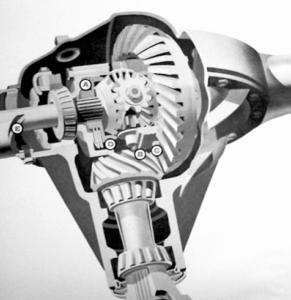
Positraction: By limiting the rotational speed difference through the clutch plate assembly, it
ensures that power is delivered to the wheels with grip.
Analogical scenario:
Just like two people running hand in hand, an open differential allows the “lazy” person (the
slipper wheel) to run faster and faster, while a Positraction grabs him and keeps the two moving
forward in sync.
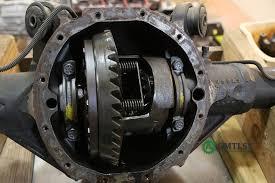
2.2 9-inch Positraction design for the rear axle
Ford’s 9-inch rear axle Positraction (such as the Eaton Truetrac, Detroit Locker, etc.) has the
following features:
Large clutch plate assembly: A wide-body design adapted to the 9-inch rear axle for enhanced
skid limiting;
High strength gear: Withstand greater torque and avoid damage under high load;
Adjustable preload: Adjust the limited-slip sensitivity according to the usage scenario (such as
grassland, sandpit).
Technical details:
Clutch plate count: typically 8-12, 30% more than a regular LSD;
Maximum torque capacity: up to 2000 lb-ft (about 2712 N·m), far exceeding the requirements of
a golf cart but leaving room for future upgrades.
3.Practical Test: How does the 9-inch rear axle +Positraction conquer the course?
3.1 Scene 1: The grass “rink” in the rain
Traditional open differential: One side of the wheel slips, the vehicle spins in place, and the tire
wears out severely;
9-inch rear axle +Positraction:
The clutch plate assembly engages quickly, delivering power to the other wheel;
The vehicle moves smoothly and tire wear is reduced by 60%.
User feedback:
“I never dared to drive to and from clients in the rain before, but now with Positraction, the grass
is as stable as a carpet!”
3.2 Scene 2: Escaping from a “trap” in a sandpit
Traditional open differential: The wheels get stuck in a sandpit and spin wildly, getting deeper and
deeper;
9-inch rear axle +Positraction:
The limited-slip mechanism kicks in and distributes power to the wheels that are not slipping;
The vehicle can easily get out of trouble, and the time to get out of trouble is reduced by 75%.
Fun Experiment:
In a bunker test at a golf course, a 9-inch rear-axle model with Positraction managed to get out in just 3 seconds, while a traditional model took 12 seconds and had mud and sand on its tires.
3.3 Scene 3: The “backroll crisis” when starting on a steep slope
Traditional open differential: When starting on a slope, one side of the wheels slips, causing the
vehicle to roll back;
9-inch rear axle +Positraction:
Clutch plate group locking, power evenly distributed to the wheels on both sides;
The vehicle climbs the slope steadily, with 100% higher safety.
Safety tips:
For golf carts carrying passengers, Positraction significantly reduces the risk of slope accidents,
especially for mountain courses.
4.Positraction’s “hidden skill” : Beyond getting out of trouble
4.1 Improve maneuverability: Take high-speed corners as if on flat ground
When cornering at high speed, Positraction distributes more power to the outer wheels, reduces
understeering (pushback), and makes the vehicle fit the cornering trajectory better.
Analogical scenario:
Just as skiers tilt their center of gravity outward to maintain balance when cornering, Positraction
allows the vehicle to “smartly” distribute power as well.
Data support:
A golf cart fleet test shows that after installing Positraction, the vehicle’s skidding distance in
corners has decreased by 55%, and its handling performance is close to that of a car.
4.2 Extended tire life: The “Terminator” of unilateral wear
Open differentials can cause excessive wear on the slip wheel, while Positraction can balance the
rotational speed of the wheels on both sides and extend the tire’s lifespan.
Cost analysis:
Taking a golf course team as an example, after installing Positraction, the tire replacement cycle
was extended from one year to two years, saving 45 percent of maintenance costs.
4.3 Enhancing brand image: From ‘Tool’ to ‘Luxury experience’
Golf carts equipped with a 9-inch rear axle +Positraction not only handle complex terrains but
also provide a smoother and safer driving experience, helping the course improve customer
satisfaction and word-of-mouth.
Customer review:
“This golf cart is as steady as an SUV. I’ll make another reservation next time!”
5.Maintenance and Upgrade: Keeping the classic Rear Axle “youthful”
5.1 Daily Maintenance: Three simple steps to extend Life
Regularly check clutch plate wear: It is recommended to check every 5,000 kilometers and replace if necessary;
Change special lubricating oil: Positraction requires high-viscosity gear oil (e.g. GL-5 85W-140) to
reduce wear;
Adjust the preload: Fine-tune the clutch plate preload according to the vehicle usage scenario
(such as grass, sandpit ratio).
Maintenance costs:
Positraction has lower maintenance costs compared to other high-performance differentials, and
the modular design of the 9-inch rear axle makes maintenance more convenient.
5.2 Upgrade Plan: From Machinery to Electronics
With technological advancements, Positraction has also evolved into an electronic version:
Electronic Positraction: Monitor the wheel speed difference through ESP sensors and control the
clutch plate engagement force by the ECU;
Advantages: Faster response, interlocking with other vehicle electronic systems (such as traction
control).
Golf cart fit recommendations:
Economy option: Traditional mechanical Positraction, high cost performance;
High-end solution: Electronic Positraction, enhancing intelligence level.
6.Future Trends: The integration of 9-inch rear axle with electrification and intelligence
6.1 Innovation of the 9-inch rear axle for electric golf carts
The popularity of electric golf carts offers new possibilities for a 9-inch rear axle:
Motor independent control: Direct control of the torque on both sides of the wheels through the
motor for more precise slip limiting;
Intelligent algorithm optimization: Combining terrain sensors and AI algorithms to adjust
Positraction strategy in real time.
Case:
An electric golf cart brand has introduced a 9-inch rear axle model with electronic Positraction,
which improves passability in complex terrains by 65% and reduces energy consumption by 25%.
6.2 Intelligent Positraction: Making the Vehicle “think”
Future Positraction may be integrated into vehicle autonomous driving systems to enhance
performance in the following ways:
Predictive skidding: Predict the terrain based on navigation data and adjust the skidding intensity
in advance.
User habit learning: Record the driver’s driving style and optimize the power distribution logic.
Technology Outlook:
With the development of 5G and Internet of Things technology, the 9-inch rear axle +Positraction
is expected to become a core component for the intelligent upgrade of golf carts.
7.How to choose the appropriate Positraction solution?
7.1 Consider the vehicle’s purpose
Passenger golf cart: Give priority to electronic Positraction, taking into account cost and
intelligence;
Off-road golf carts: Traditional mechanical Positraction is recommended to meet high
performance requirements.
7.2 Evaluate the budget and maintenance costs
Traditional mechanical Positraction: low initial cost and simple maintenance;
Electronic Positraction: excellent performance but requires regular calibration of the sensor.
7.3 Pay attention to the technical strength of the supplier
Choose a supplier with experience in modifying Ford 9-inch rear axles to ensure a perfect match
between Positraction and the rear axles.
Conclusion: 9-inch rear axle +Positraction – The ‘golden Combination’ for golf carts
From rainy grass to steep slopes, from sandpit escape to high-speed cornering, the combination
of Ford’s 9-inch rear axle and Positraction has proven with its power that the collision of classic
and innovation can generate astonishing energy. It is not only a key component for improving
off-road capability, but also a “secret weapon” for ensuring safety, extending the vehicle’s
lifespan and enhancing the user experience.


