
When it comes to golf carts, many people who have never used one always wonder: “It looks so small. Will it be very complicated to operate?” “Can someone who has never touched a steering wheel drive it directly?” In fact, whether it’s the caddies on the golf course, the residents in the community, or beginners having their first try, almost everyone who has tried it will say, “It’s much simpler than expected.” What kind of “easy – to – operate secrets” does this seemingly “niche” means of transportation actually hide? This article will provide a practical guide friendly to beginners, covering aspects from driving experience, operational differences to safety details.

Is the driving feeling of a golf cart the same as that of a car? The difference lies in “simplicity”
Many people, when they first sit in a golf cart, will subconsciously look for the “clutch” and “gear lever”, only to find that the console is clean. This is exactly the biggest difference between it and a car: the “minimalist operation” designed for the specific scenario.
Let’s first look at the core differences:
Size and flexibility:
An ordinary family car is about 1.8 meters wide, while a golf cart is only 1.2 – 1.5 meters wide, and its length is nearly 2 meters shorter. The turning radius is usually ≤ 3 meters (most cars have a turning radius of over 5 meters). When passing through the narrow fairways on the golf course or the stone – paved roads in the community, there’s no need to repeatedly adjust the direction like when driving a car. You can make a right – angle turn in one go, and beginners won’t feel that “the car is too big to control”.
Speed and power:
The maximum speed of most golf carts is ≤ 20 km/h, a bit faster than a bicycle and slightly slower than an electric bike. Beginners can easily control the pace. In terms of power, most golf carts use “continuously variable transmission” – there is no gear – shifting jerk. Just like riding an electric bicycle, you can start smoothly by twisting the accelerator pedal, and it will slow down naturally when you release it. There’s no need to worry about “when to shift gears”.
Control system:
A golf cart only has three core control components: “forward/reverse gear”, “accelerator”, and “brake”. Even the steering wheel is lighter than that of a car (the power steering is softer), so it’s not strenuous for women or the elderly to turn it.
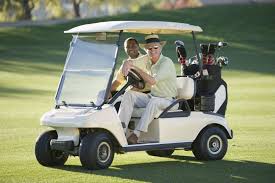
Can someone who has never driven a car drive a golf cart directly? The answer is “absolutely yes”
The original design concept of a golf cart is “to make it easy for everyone to use” – whether it’s the caddies on the golf course, the staff in the resorts, or the elderly in the community, as long as they get a simple 3 – minute familiarization, they can basically drive independently.
Why is it so “user – friendly”?
Operation logic without a threshold:
There’s no need to remember “semi – linkage of the clutch” or “gear – shifting rotation speed”, and there’s no need to take a “reverse parking test”. The core involves only three actions: “start – accelerate – brake”.
Built – in “safety buffer”:
Even if a beginner accidentally steps on the accelerator instead of the brake, there’s no need to worry about “rushing out” – most golf carts have “speed – limit protection”. Even if the accelerator is fully pressed, the speed is locked within 20 km/h. The electromagnetic brake also provides “automatic assistance”. When going downhill, even if you don’t step on the brake, the speed won’t keep increasing but will gradually slow down.
High fault – tolerance rate in the usage scenario:
Golf carts are mostly used in “closed areas” (golf courses, communities, scenic spots), and there are almost no public vehicles. Even if a beginner drives slowly or steers a bit off – course occasionally, there is enough time to make adjustments, and they won’t be as “nervous and sweaty” as when driving on the road.
Of course, “being able to drive” doesn’t mean “not needing to learn”. Before driving for the first time, you must have someone who is familiar with it teach you these 3 points:
- Distinguish between the “forward (F)/reverse (R)” gears;
- Feel the braking force;
- Know where the “parking brake” is. Once you master these, beginners can drive with confidence.
Is a golf cart prone to roll – overs? Do these 3 things, and its safety factor is even higher than that of an electric bike
“Will such a small car roll over as soon as it turns?” This is the most common concern among beginners. In fact, as long as you drive normally, the stability of a golf cart is better than expected.
Let’s first look at the reasons why it’s “not prone to roll – overs”:
Low – center – of – gravity design:
The battery pack (weighing about 200 – 300 kg) of an electric golf cart is installed in the middle of the chassis, and the overall center – of – gravity height of the vehicle is only 0.5 – 0.6 meters.
Wide wheelbase + anti – slip tires:
The wide wheelbase makes the left – right balance more stable. Coupled with the “patterned tires” commonly used on golf carts, it’s not easy to skid when turning.
Speed – limit protection:
With a maximum speed of 20 km/h, a golf cart is even slower than a bicycle.
However, the following two situations may increase the risk, and beginners should avoid them:
Excessive speed + sharp turn:
If you drive fast (over 15 km/h) on a slope or a gravel road and then turn the steering wheel sharply, the vehicle body may tilt.
Over – loading on one side:
For example, if you only put two heavy golf bags on the left side and leave the right side empty, the center of gravity of the vehicle body will shift, and it may shake when passing over bumpy roads.

Choose the right golf cart, and beginners will have an easier time: These configurations make driving more effortless
Choosing the right configurations can double the experience for beginners. Pay attention to these three “user – friendly designs”:
Electromagnetic brake + automatic parking:
For electric golf carts, it’s better to choose those with an electromagnetic brake. It will automatically slow down when you release the accelerator pedal and can even maintain a constant speed when going downhill. It’s even better if it has “automatic parking” – you don’t need to manually pull the handbrake after stopping. It will automatically unlock when you step on the accelerator to start, so beginners don’t have to worry about “forgetting to pull the handbrake”.
Rear – view camera + warning sound:
Beginners tend to get nervous when reversing. Choose a golf cart with a small – sized rear – view camera so that you can see the situation behind the vehicle. The reversing warning sound can alert people around to avoid collisions.
Continuously variable transmission + lightweight steering:
Make sure it has “continuously variable transmission”, so you’ll feel like “gliding” when accelerating. Choose a “adjustable” power – steering system, so women or the elderly can adjust it to be lighter and drive without much effort.
Summary;GMT golf carts are worth a try, and you’ll have a different experience
In fact, these user – friendly configurations that allow beginners to “become proficient right from the start” are exactly one of the design concepts of GMT low – speed vehicles.
From the core configurations to the detailed adjustments, GMT always prioritizes “easy to drive, safe, and durable”. When choosing a golf cart that makes beginners feel at ease and veterans worry – free, quality is the most reliable guarantee. If you’re in need of a golf cart that “has no threshold for getting started and makes you feel more at ease when using”, you might as well try GMT. Contact us, and our professional team will introduce more suitable solutions for you. Choosing the right golf cart starts more hassle – free with GMT.

