

For many buyers, importing golf carts from China starts with a simple motivation: better pricing and wider customization options than what is available locally. But once the initial research begins, the process quickly becomes confusing. Questions about compliance, shipping costs, documentation, and after-sales risk often surface long before an order is placed.
This guide is written for buyers who are seriously considering importing golf carts from China and want to understand the process clearly—before money changes hands.
Why Buyers Import Golf Carts from China
China has become one of the largest manufacturing hubs for electric golf carts and low-speed vehicles. Buyers are drawn not only by lower unit prices but also by the ability to customize seating capacity, battery type, body design, and accessories.
For fleet buyers, resort operators, distributors, and project contractors, importing directly from China often makes sense once quantities exceed a certain threshold. At that point, the savings are no longer marginal—they can be strategic.
However, lower factory prices do not automatically mean lower total cost.
Can Golf Carts Be Legally Imported?
Before focusing on pricing, buyers must confirm whether golf carts can be legally imported into their country.
In most regions, electric golf carts are classified as low-speed vehicles or off-road utility vehicles. This classification determines whether road certification is required, what safety standards apply, and which documents customs will request.
Common requirements may include:
- Manufacturer documentation
- Electrical and battery specifications
- Safety declarations
- Import permits depending on destination country
This step is often underestimated. Many import delays occur not because of the product itself, but because the buyer did not clarify local import regulations early enough.

Understanding the Real Cost of Importing Golf Carts from China
One of the most searched questions related to importing golf carts from China is cost. The factory price is only the starting point.
Total landed cost usually includes:
- Product cost (based on configuration)
- Export packaging
- Inland transport in China
- Ocean freight or container shipping
- Destination port charges
- Customs duties and taxes
- Local delivery
Battery selection alone can significantly impact cost. Lithium batteries increase the unit price but reduce long-term maintenance. Lead-acid batteries lower upfront cost but add weight and shipping complexity.
Buyers who compare only FOB prices often underestimate their final budget by a wide margin.
Shipping Methods and What Buyers Should Expect
Most golf carts are shipped by sea, either fully assembled or partially knocked down to optimize container space. The choice affects both cost and arrival condition.
Fully assembled units simplify local setup but reduce container efficiency. Knock-down shipping reduces freight cost per unit but requires reassembly upon arrival.
Transit times vary by destination, but buyers should also factor in port congestion, customs clearance time, and inland delivery schedules. Planning for buffer time is essential, especially for project-based deliveries.
Common Risks When Importing Golf Carts from China
The biggest risks are rarely related to product appearance. They usually involve assumptions.
Some buyers assume all golf carts meet the same standards. Others assume after-sales support will be similar to local purchases. In reality, responsibility for spare parts, troubleshooting, and long-term maintenance must be clarified before ordering.
Another common risk is ordering based on samples or photos without confirming production specifications in writing. Small differences in motor rating, controller configuration, or battery brand can lead to large performance gaps.
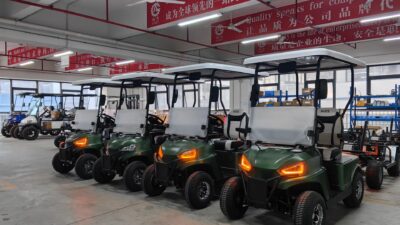
Who Should Consider Importing Golf Carts from China
Importing golf carts from China is not ideal for everyone.
It makes sense for buyers who:
- Purchase in volume
- Have experience with international logistics
- Can manage lead times
- Need customization or private labeling
For buyers needing one or two units urgently, local sourcing is often more practical despite higher unit prices.
Understanding where you fall on this spectrum prevents costly mistakes.
How Buyers Reduce Risk Before Ordering
Experienced importers focus on clarity rather than speed.
They confirm specifications line by line, understand packaging methods, request documentation samples in advance, and factor in post-arrival responsibilities. The goal is not just to receive the shipment, but to deploy the vehicles without operational disruption.
Clear communication and realistic expectations do more to protect an import project than aggressive price negotiation.
Final Thoughts on Importing Golf Carts from China
Importing golf carts from China can be a cost-effective and scalable solution when done correctly. The key is understanding that the process is not just about purchasing a product—it is about managing compliance, logistics, and long-term usability.
Buyers who approach the process methodically often find that importing directly gives them more control, better customization, and predictable cost structures. Those who rush the decision based on price alone often face delays, unexpected expenses, or operational headaches.
The difference lies in preparation.


