

Searching for club car factory or club car manufacturing plant usually means one thing—you are not looking for a brochure or distributor contact page. You want to understand the industrial foundation behind one of the most recognized names in golf cart manufacturing.
Whether you are a fleet buyer, distributor, or industry analyst, understanding how Club Car builds its vehicles reveals far more than product specifications. Manufacturing capability determines durability, scalability, quality consistency, and long-term reliability.
This guide explores where Club Car manufactures its vehicles, how its production system works, and why its factory strategy continues to shape its leadership position in the global golf cart market.
The Heart of Production: Club Car’s Primary Manufacturing Hub
Evans, Georgia — The Flagship Club Car Manufacturing Plant
The centerpiece of Club Car’s manufacturing network is its flagship facility located in Evans, Georgia. This plant has served as the company’s primary production base for decades and represents the operational core of the brand’s engineering and assembly capabilities.
The Evans factory plays a strategic role beyond assembly. It integrates engineering development, testing, and manufacturing under one roof, allowing rapid iteration of product designs and strict control over quality standards. Its location also provides logistical advantages for serving North American markets efficiently.
Historically, this facility has evolved from a traditional assembly plant into a vertically integrated manufacturing center responsible for frame construction, body fabrication, finishing, and final vehicle testing.
A Virtual Walk Through the Production Line
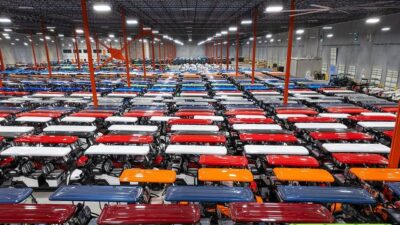
To understand what differentiates a premium manufacturing plant, it helps to visualize the production flow.
The process begins with structural frame preparation, where precision-cut components are assembled to create the vehicle’s foundational architecture. This stage determines long-term durability and load-bearing performance.
Next comes body fabrication and finishing, including surface treatment and paint processes designed to protect against corrosion and environmental wear. Advanced coating systems are used to ensure consistent finish quality across production batches.
Final assembly integrates powertrain components, electrical systems, seating modules, and safety features. Vehicles then move through inspection stations where functional testing validates braking, steering, battery performance, and system calibration before release.
This layered workflow illustrates why manufacturing quality is determined long before a vehicle reaches the showroom.
Beyond Georgia: Club Car’s Global Manufacturing and Assembly Footprint
While Evans serves as the central hub, Club Car’s manufacturing strategy extends globally through regional assembly operations and distribution-linked facilities.
These international sites focus on adapting vehicles for local regulations, climate conditions, and customer preferences. This hybrid model allows the brand to maintain centralized engineering control while achieving regional flexibility in final assembly.
The approach reflects a broader industry trend: core engineering remains centralized, while assembly moves closer to end markets to reduce lead time and logistics complexity.

What Sets Club Car’s Manufacturing Apart?
Engineering and Quality Control Discipline
A defining feature of Club Car’s manufacturing system is its emphasis on durability testing and lifecycle validation. Rather than relying solely on post-production inspection, testing protocols are embedded early in product development.
This includes stress testing structural components, evaluating drivetrain endurance, and validating battery performance across extended usage cycles. Such practices reduce failure rates and increase long-term reliability for commercial fleet customers.
Technology and Innovation on the Factory Floor
Club Car’s factories are not just assembly lines—they function as engineering laboratories. Investments in lightweight materials, advanced battery integration, and precision machining reflect a long-term commitment to innovation.
One notable focus area is material engineering, particularly in body construction techniques designed to balance strength and weight efficiency. This directly affects vehicle efficiency, handling, and maintenance cost.
Automation also plays a growing role, especially in repeatable processes such as welding and coating, improving consistency while reducing human variability.
Workforce and the Role of “Made in USA” Craftsmanship
Manufacturing quality ultimately depends on human expertise. Club Car’s production workforce benefits from structured training programs emphasizing assembly accuracy, safety compliance, and continuous improvement.
The “Made in USA” identity is not just branding—it reflects a manufacturing philosophy centered on accountability, traceability, and disciplined process management. For many buyers, this translates into higher confidence in product consistency across large orders.
Comparative Perspective: Club Car vs. Industry Peers
To better understand Club Car’s manufacturing position, it helps to compare it with other major players such as E-Z-GO and Yamaha.
| Brand | Primary Manufacturing Base | Production Focus | Manufacturing Philosophy |
|---|---|---|---|
| Club Car | Evans, Georgia (USA) | Premium durability and engineering integration | Vertical integration and lifecycle testing |
| E-Z-GO | Augusta, Georgia (USA) | High-volume commercial carts | Lean manufacturing and modular design |
| Yamaha | Japan and regional facilities | Precision engineering and reliability | Automotive-grade quality systems |
This comparison highlights how each manufacturer aligns factory strategy with brand positioning rather than competing purely on price.
Frequently Asked Questions from Industry Professionals
Can buyers visit the Club Car manufacturing plant in Georgia?
Factory tours may be available depending on scheduling and corporate policy. Industry buyers and partners typically need to arrange visits through official channels and provide advance notice for security and safety compliance.
How does Club Car’s vertical integration compare with competitors?
Club Car maintains a strong level of vertical integration by combining engineering, testing, and assembly within its primary facility. This approach improves quality consistency and shortens feedback loops between design and production teams.
What is the typical production capacity and lead time from the main plant?
Production capacity varies depending on model mix and demand cycles. Lead times generally depend on order volume, configuration complexity, and seasonal demand. Standard configurations typically move faster than heavily customized builds.

Strategic Insights: Why Club Car’s Factory Model Matters for the Future
Club Car’s manufacturing structure reflects a broader shift in the golf cart industry toward electrification, modular design, and data-driven quality control. As demand grows for smarter, more durable low-speed vehicles, factories that integrate engineering and production will gain competitive advantage.
Future investments are likely to focus on battery innovation, digital monitoring systems, and flexible assembly platforms capable of supporting multiple vehicle variants from a shared architecture.
Manufacturing excellence will remain the defining factor separating commodity carts from long-term fleet assets.
Understanding the club car factory and club car manufacturing plant ecosystem reveals why manufacturing capability is often the true differentiator in the golf cart industry. Beyond branding and marketing, production systems determine durability, reliability, and lifecycle cost.
For buyers evaluating suppliers or comparing global manufacturing models, studying Club Car’s approach provides valuable insights into how premium vehicles are engineered, assembled, and validated at scale.
If you are researching manufacturing strategies across regions, exploring how Chinese manufacturers structure their production systems can offer a complementary perspective on cost efficiency and customization flexibility.


