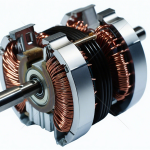
In our daily lives, electric motors are almost everywhere, from national defense, agriculture, industry, and transportation to medical equipment, telecommunications, and household appliances like washing machines, fans, vacuum cleaners, and robotic cleaners. As devices that convert electrical energy into mechanical energy, electric motors are indispensable in modern industrial production and everyday life. They are used in nearly all motion-related scenarios and are controlled by drive systems. However, the operating conditions of motors vary across different applications—some run continuously, some operate for short periods within a cycle, and others alternate between running and resting.
To categorize these variations, the concept of motor duty cycles was introduced. A motor duty cycle defines the operating mode of a motor under specific conditions and can be broadly classified into three types: continuous duty, short-time duty, and intermittent duty.
To better understand, let’s compare a motor to a human worker:
-
Continuous duty (S1) is like a person working 24 hours a day (sounds exhausting!). In reality, it means the motor runs non-stop at rated voltage and load until it reaches thermal equilibrium. (If no duty cycle is specified, manufacturers typically default to continuous duty.)
-
Short-time duty (S2) is like working just one hour a day (with weekends off). Here, the motor operates at rated conditions for a limited time, followed by a long cooling period.
-
If it runs beyond the specified time, overheating and damage may occur.
-
Standard short-time durations: 10 min, 30 min, 60 min, or 90 min.
-
-
Intermittent duty (S3-S8) is like working for 3 hours and resting for 5 hours in a repeating cycle. The motor runs intermittently, with defined work and rest periods.
-
Expressed as duty cycle percentage (load time / total cycle time). Common values: 15%, 25%, 40%, 60%.
-
Example: A 40% duty cycle means the motor runs for 4 minutes and rests for 6 minutes in a 10-minute cycle. Exceeding this can cause overload failure.
-
In practice, motor duty cycles include phases like starting, loading, braking, idling, and resting, with varying sequences and durations depending on the application.
| DUTY | START | EMPTY LOADING | Thermal stability constant load | Not-Thermal stability constant load | Variable speed and load braking | Cut-off stop | Periodicity | |
| S1 | Continuous work | |||||||
| S2 | Short-time work | ● | ● | |||||
| S3 | Intermittent cycle of work | ● | ● | √ | ||||
| S4 | Intermittent cycle work system including starting | ● | ● | ● | √ | |||
| S5 | Intermittent cycle duty system including electric braking | ● | ● | ● | ● | √ | ||
| S6 | Continuous cycle work system | ● | ● | √ | ||||
| S7 | Continuous-cycle duty system including electric braking | ● | ● | ● | √ | |||
| S8 | Continuous-cycle duty system including variable speed and variable load | ● | ● | ● | √ | |||
| S9 | Non-periodic change of load and speed | ● | ||||||
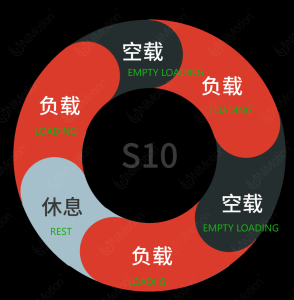
| S10 | Discrete constant-load duty system | ● | √ | |||||
Classification description
The motor working system is a specific method to control the movement of the motor, which is a kind of work guidance to avoid the motor from overheating and burning out, and it is also a user demand. At the same time, it also guides you to choose the right motor according to the working system of the motor. However, in practical applications, the working systems of many motors are diversified, and one or more working systems need to be used at the same time to meet different application scenarios.
S1 (Continuous Duty)
It means that the motor runs continuously at the rated load and the temperature reaches a stable value, with no cooling or cooling time.
This type of work is usually suitable for long-term load situations, such as applications such as fans or conveyor belts.

S2 (Short-time Work)
Operate at a constant load for a given amount of time, stopping the motor long enough to cool down (within 2K of the temperature difference from the cooling medium) before reaching thermal stability.
In this duty system, the motor runs for a very short time and the heating time is much lower than the cooling time. This type of work-type motor is commonly found in cranes, home appliance drives, valve controllers, etc.

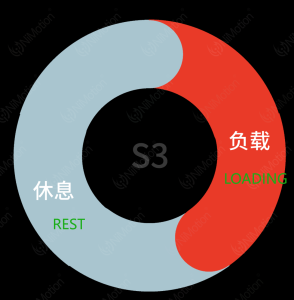
S3 (intermittent cycle)
Operates on a series of identical duty cycles that do not reach thermal equilibrium, each consisting of a period of constant load operation and a shutdown interval (interval).
The load duration is the ratio of constant load run time to load cycle.
The starting current for each cycle in this system has no significant effect on the temperature rise. However, the cycle time must last 10 minutes, and the duty cycle must be 15%, 25%, 40%, 60% of the four types of motors, which are commonly found on stamping and drilling machines.
S4 duty (including start-up intermittent cycle work)
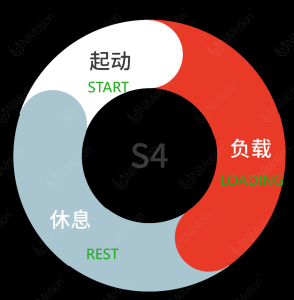
It operates on a series of identical duty cycles, each consisting of a start-up period that has a significant effect on the temperature rise, a constant-load run-time and a break-off time.
Similar to S3, but with the addition of starting on the basis of S3, the moment of inertia of the motor load, that is, the acceleration ability of the motor, is required. The motors of this working system are widely used in metal cutting machines, drilling machines, mining hoists, etc.
S5 duty (including intermittent cycle duty with electric braking)
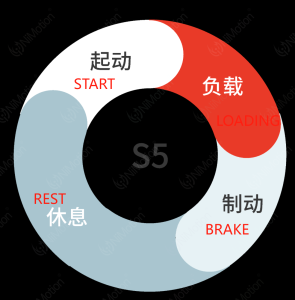
It operates in a series of identical duty cycles, each consisting of a starting time, a constant load run time, a fast electric braking time and a shut-off stop time.
Similar to the S4, the moment of inertia of the motor load is required. However, all time periods are too short to reach their respective steady-state temperatures, and this working motor is commonly used in billet mills, manipulator drives, mine hoists, etc.
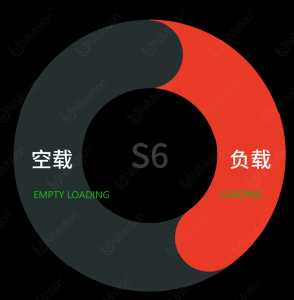
S6 (Continuous)
Operates on a series of identical duty cycles, each consisting of a constant load run time and a no-load run time, but without downtime.
That is, the running cycle = work (load + no load), similar to S3, commonly used in presses, cutting machines, etc.
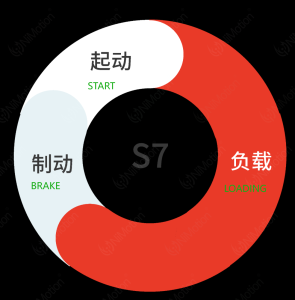
S7 duty system (continuous cycle duty system including electric braking)
It operates in a series of identical duty cycles, each consisting of a starting time, a constant load run time and a fast electric braking time without stopping. That is, the S6 with the addition of starting. It is mainly used in ginning machines.
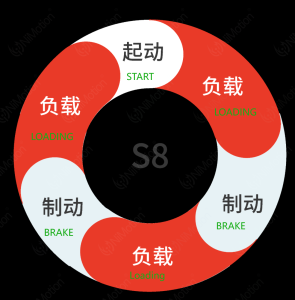
S8 duty system (including continuous cycle duty system with variable speed and variable load)
It is more complex, and in this duty system, the motor is operated by a series of the same duty cycles that have not reached thermal equilibrium.
Each cycle consists of a period of constant load operation at a predetermined speed, and one or more other constant load runs at different speeds, without a rest period, all running all the time, but all for a short period of time to reach a steady-state temperature.
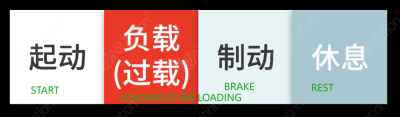
S9 (non-cyclical change of load and speed)
A non-cyclical duty system in which the load and rotational speed vary within the allowable range. This type of work includes frequent overloads, the value of which can exceed full loads. It is more complex and often stipulates according to the actual situation, such as wind power generation.
S10 (Discrete Constant Load Duty)
It includes no less than 4 discrete load values (or equivalent loads) of the duty system, which can include no-load operation and shutdown, under each load, the thermal equilibrium state is reached (even no-load or shutdown), and the minimum load value in a duty cycle can be zero. Compared to S8, it can be considered that there is a lot of constant load movement, which requires individual loads and time, but does not include acceleration and deceleration.
The working system of the motor has a great impact on the performance and service life of the motor. Choosing the right working system of the motor can ensure that the motor can operate safely and have good performance and longevity under the required load and environmental conditions.