

Golf carts have come a long way. Like, really far.
What started as a simple way to move golfers around 18 holes has turned into something much bigger. These days you’ll find golf carts cruising through retirement communities in Florida, hauling supplies across warehouse floors, and carrying tourists through resort properties.
I’ve watched this industry evolve over the past decade or so. The transformation is kind of wild when you think about it.
Now we’ve got electric carts that rival gas ones for range. Lifted carts that can handle trails most ATVs would struggle with. Street-legal versions you can actually register and insure like a regular vehicle.
The point is — “golf cart” doesn’t mean what it used to mean.
This guide breaks down every type of golf cart by power source, seating capacity, build style, usage, and brand. Whether you’re buying one for the course, your neighborhood, your hunting property, or your business — you need to understand the differences.
Because picking the wrong type? That’s an expensive mistake.
What is a Golf Cart?
A golf cart is a small motorized vehicle. Originally designed to carry golfers and their equipment around a course. Pretty straightforward.
But here’s the thing — that definition feels outdated now.
Modern golf carts do so much more. They move people through gated communities. They transport workers across factory floors. They shuttle guests at hotels and resorts. Some are even street legal.
The typical golf cart has a few things in common though. Compact size. Low-speed capability — usually maxing out somewhere between 15-25 mph. Seating for 2-6 people. Open-air design or removable enclosures.
And increasingly, they’re eco-friendly. Electric models dominate the market now.
Think of them as multi-purpose light vehicles. That’s closer to what they actually are in 2024.
Types of Golf Carts by Power Source
This is the big one. The primary way people classify golf carts.
Power source affects everything. Your maintenance schedule. Your operating costs. How far you can go on a single charge or tank. Environmental impact. Performance on hills.
Get this decision right and everything else falls into place.
1. Electric Golf Carts
Electric carts run on rechargeable battery packs. They’ve become the standard for most golf courses and residential use.
I’m personally a fan. Here’s why.
Advantages:
- Quieter operation — like noticeably quieter
- Lower maintenance since there’s no engine oil, filters, spark plugs
- Zero direct emissions
- Cheaper to operate (electricity vs gas)
- Smooth acceleration without gear shifting
Disadvantages:
- Limited range — most get 25-40 miles per charge
- Charging takes time — 8-12 hours for a full charge typically
- Battery replacement costs hit hard — anywhere from $800 to $3,000+ depending on type
- Performance drops as battery depletes
The battery conversation matters here. You’ve got two main options:
Lead-acid batteries are the traditional choice. Cheaper upfront. Heavier. Require maintenance (checking water levels). Last 4-6 years with proper care.
Lithium-ion batteries cost more initially — sometimes significantly more. But they’re lighter, charge faster, last longer (8-10 years), and require zero maintenance. They also hold voltage better, so performance stays consistent until they’re nearly dead.
Most courses and communities use lead-acid because of the lower upfront cost. But lithium is gaining ground fast.
Electric carts work best for: golf courses, residential communities, indoor facilities, anywhere noise is a concern.
2. Gas-Powered Golf Carts
Gas carts use internal combustion engines. Usually 4-stroke engines now — the 2-stroke era is basically over for golf carts.
Some people swear by them. I get it.
Advantages:
- Longer range — fill up and go 100+ miles
- Refuel in minutes, not hours
- More power for hills and rough terrain
- Better for hauling heavy loads
- Consistent power regardless of “fuel level”
Disadvantages:
- Higher maintenance — oil changes, filters, tune-ups, carburetor issues
- Louder operation
- Emissions (banned on some courses)
- Higher operating costs over time
- More complex repairs
Here’s my take: gas makes sense if you’re covering serious ground or dealing with challenging terrain. A hunting property with hills? Gas. A large farm or ranch? Probably gas. A flat golf course or retirement community? Electric wins.
Gas carts shine in: large properties, hilly terrain, commercial applications with heavy use, hunting properties, anywhere far from charging infrastructure.
3. Solar-Powered Golf Carts
Solar carts aren’t fully solar. Let me be clear about that.
They’re electric carts with photovoltaic panels mounted on the roof that supplement the main battery system. The solar panels help maintain charge and extend range. They don’t completely replace plugging in.
Advantages:
- Reduced charging costs
- Extended range between charges
- Maximum eco-friendliness
- Can trickle-charge while parked
Limitations:
- Weather dependent — cloudy days mean minimal solar gain
- Higher initial cost
- Solar panels add only a portion of needed power
- Not practical in low-sunlight climates
They’re growing in popularity though. Especially in sunny areas like Arizona, Florida, Southern California. Golf courses marketing themselves as eco-friendly love them.
For the average buyer? Probably not necessary. The ROI takes a while. But if sustainability matters to you and you’re in a sunny climate — worth considering.
4. Hybrid Golf Carts
Hybrid carts combine gas and electric systems. They can switch between power sources or use both simultaneously.
This is newer territory for golf carts. The technology is still developing.
The idea is you get the range and power of gas with the quiet, clean operation of electric when you want it. Switch to electric for the golf course, gas for the long haul back to your property.
Honestly? The market for these is still pretty small. Most people pick a lane — electric or gas — and stick with it. But hybrids might become more popular as the technology matures and prices come down.
Types of Golf Carts by Seating Capacity
How many people you need to move determines which cart you need. Seems obvious. But people get this wrong all the time.
They buy a 2-seater and realize they need more room. Or they buy a 6-seater that’s too long for their garage.
Think about actual use before you buy.
1. 2-Seater Golf Carts (Standard)
This is the classic. Two passengers sitting side by side. What most people picture when you say “golf cart.”
Compact design. Easy to maneuver. Fits through standard doorways. Parks anywhere.
Most golf course fleets are 2-seaters. Makes sense — one or two golfers plus their bags.
There’s usually room behind the seat for two golf bags, or a small cargo area. Some models have a flip-down seat/cargo combo in the back.
Ideal for: individual golfers, couples, small property navigation, anyone who needs maximum maneuverability.
2. 4-Seater Golf Carts
The mid-size option. Probably the most versatile.
Typically has two forward-facing seats and two rear-facing seats in the back. Some newer models have all seats facing forward.
Here’s what I like about 4-seaters: that rear seat often folds down into a flat cargo bed. So you can haul people OR stuff. Flexibility matters.
They’re bigger than 2-seaters obviously. Longer wheelbase. Needs more turning room. Something to think about if you’ve got tight spaces to navigate.
Ideal for: families, small groups, resort transportation, people who want versatility.
3. 6-Seater Golf Carts
Now we’re getting into commercial territory. Three rows of seating. Six passengers.
These are long. That’s the main consideration. Turning radius increases. Parking becomes more challenging. Storage and transportation require planning.
But if you need to move groups — resorts, event venues, tour operations — the 6-seater is the workhorse.
Some golf communities allow them for families with multiple kids. Makes sense. Better than buying two 2-seaters.
Ideal for: resorts, tour operations, event venues, large families, group transportation.
4. Lifted and Customized Multi-Passenger Carts
Beyond 6 passengers, you’re into custom territory.
8-seaters. 10-seaters. Full shuttle-style carts with rows of bench seating. These are specialized vehicles for specific commercial applications.
Think airports. Theme parks. Large corporate campuses. Convention centers.
They’re built differently — stretched frames, upgraded motors and suspensions, commercial-grade components to handle the extra weight and constant use.
Not something most individuals buy. But good to know they exist if you’re running a business that needs them.
Types of Golf Carts by Chassis and Build
The bones of the cart matter. How it’s built determines where you can take it, how long it’ll last, and what you can do with it.
1. Standard Golf Carts
Stock carts with factory specifications. What you picture when you imagine a golf cart.
Low ground clearance — usually 3-4 inches. Designed for smooth surfaces. Lightweight construction to maximize battery range or fuel efficiency.
They’re made for maintained golf courses and paved paths. Grass, gravel, pavement. Flat terrain.
Take a standard cart off-road and you’ll scrape the undercarriage, get stuck in ruts, and possibly damage components not designed for that abuse.
Ideal for: golf courses, paved paths, flat terrain, anywhere with maintained surfaces.
2. Lifted Golf Carts
Raised suspension. Increased ground clearance. Bigger tires.
Lifting a golf cart transforms what it can do. Suddenly you can handle dirt roads, trails, uneven terrain, obstacles that would stop a standard cart.
Lift kits typically come in 3-inch, 4-inch, and 6-inch options. The higher you go, the more capable — but also the higher your center of gravity, which affects stability.
Most lifts include:
- Lifted suspension components (leaf springs or A-arm)
- Extended shocks
- Larger all-terrain tires
- Sometimes brake line extensions
People lift carts for hunting. Beach driving. Rural property use. Or honestly, just because they think it looks cool. Nothing wrong with that.
Considerations: higher lift = less stable, especially on turns. Some lifted carts are restricted to lower speeds for safety. Insurance companies may care. Check local regulations.
Ideal for: rough terrain, hunting properties, beach use, rural properties, anyone who wants that lifted look.
3. Utility Golf Carts
Work vehicles. Built for hauling stuff, not people.
The defining feature is usually a cargo bed or dump box in the back instead of rear seating. Think small truck bed.
These carts have:
- Heavy-duty construction
- Higher payload capacity (500-1,200 lbs depending on model)
- Tool and equipment mounting options
- Reinforced frames and suspensions
Club Car Carryall. Yamaha Adventurer. E-Z-GO Hauler. These are the big names in utility carts.
They’re everywhere in commercial settings. Landscaping crews. Maintenance teams. Construction sites. Farms. Warehouses. Industrial facilities.
Ideal for: landscaping, maintenance operations, construction sites, farms, industrial facilities, anyone who needs to haul more than people.
4. Low-Speed Vehicles (LSVs)
This is where golf carts enter the real world of traffic laws.
An LSV is a golf cart that meets federal safety standards and can legally operate on public roads with speed limits up to 35 mph.
To qualify as an LSV, the vehicle must have:
- Headlights and taillights
- Turn signals
- Mirrors (side and rearview)
- Seat belts
- Parking brake
- VIN (Vehicle Identification Number)
- DOT-approved tires
- Reflectors
- Speedometer
- Windshield (in most states)
LSVs must also be capable of reaching at least 20 mph but not exceed 25 mph.
Here’s the thing people miss — LSVs require registration and insurance like regular vehicles. You need a valid driver’s license to operate one on public roads. They’re not toys. They’re regulated vehicles.
But if you live in a gated community or planned neighborhood where LSVs are common, they’re incredibly practical. Zip to the grocery store. Drive to the community pool. Visit neighbors. All without firing up your car.
Ideal for: gated communities, urban neighborhoods, college campuses, anywhere you want road-legal golf cart transportation.
5. Neighborhood Electric Vehicles (NEVs)
NEVs are basically electric-only LSVs. Same concept, same requirements, but specifically electric-powered.
The term gets used interchangeably with LSV sometimes, but technically NEV refers specifically to battery-electric vehicles meeting those DOT standards.
Speed range is typically 20-25 mph. Same road restrictions — 35 mph or lower speed limits.
State regulations vary. Some states are more NEV-friendly than others. California, Arizona, and Florida have pretty established NEV laws. Other states are still figuring it out.
The trend is toward more acceptance. Urban planners like NEVs. They reduce car dependency for short trips. They’re quiet. No direct emissions. As cities think about congestion and sustainability, NEVs fit into that conversation.
Types of Golf Carts by Wheel Configuration
Simple but important. How power gets to the ground affects where you can go.
1. Two-Wheel Drive (2WD) Golf Carts
Standard configuration. Rear-wheel drive. Motor powers the back wheels only.
This is what 95% of golf carts are. It works fine for flat terrain, paved surfaces, well-maintained courses.
Simpler mechanically. Less expensive. Lower maintenance.
The limitation is traction. Steep hills, loose surfaces, wet grass — rear-wheel drive can spin out or lose grip.
For most golf cart uses? 2WD is plenty.
2. Four-Wheel Drive (4WD) Golf Carts
All four wheels receive power. Superior traction. Better hill climbing. Handles loose and uneven surfaces.
4WD carts cost more. They’re more complex mechanically. More to go wrong.
But for the right application, they’re worth it.
Think: mountainous golf courses with serious elevation changes. Hunting properties with trails and hills. Any terrain where 2WD would leave you stuck.
Not common on standard courses. More popular in the lifted/off-road segment.
Ideal for: challenging terrain, steep hills, hunting properties, anywhere traction is a concern.
Types of Golf Carts by Usage and Application
Golf carts get specialized for what they need to do. Here’s how they break down by primary function.
1. Golf Course Carts
The original purpose. Carts designed specifically for golf.
Features you’ll find:
- Scorecard holder/clipboard
- Golf bag attachment points (rear or side-mounted)
- Beverage holders
- Sand and seed bottle holder
- GPS systems showing hole layouts and distances
- Ball and tee storage
Most courses run fleets of identical carts. Makes maintenance easier. Looks professional.
These days, GPS integration is huge. Screens showing the course map, distances to hazards, scoring — it changes the game. Pun intended.
2. Personal/Residential Golf Carts
Carts owned by individuals for neighborhood use. This is a massive market, especially in sun belt states.
People go wild with customization here. It’s kind of a thing in certain communities.
Custom paint jobs. Upgraded wheels. Premium seats. Sound systems. LED lighting. Lift kits. Enclosures.
The cart becomes an extension of personality. Some look like mini Hummers. Others are themed — team colors, brand logos, whatever.
Most gated communities and HOAs have rules about golf carts. What models are allowed. Where you can drive. Parking requirements. Speed limits. Worth checking before buying.
3. Commercial and Resort Carts
Heavy-duty carts for hospitality businesses. Built for constant use by multiple drivers.
Features that matter here:
- Durable construction — they take abuse
- Branding opportunities — custom wraps, logos
- Passenger comfort — better seats, weather protection
- Low maintenance design — minimize downtime
You’ll find these at hotels, resorts, theme parks, event venues, conference centers.
They move guests. They move staff. They run all day, every day. Reliability matters more than flashy features.
4. Hunting and Off-Road Carts
Rugged carts purpose-built for wilderness use.
The hunting cart market is its own world. Features include:
- Lifted suspension for ground clearance
- All-terrain tires
- Camouflage paint schemes
- Gun racks and bow holders
- Front and rear cargo capacity
- Quiet operation (especially electric — no game-spooking engine noise)
- Weatherproof construction
A lot of hunters prefer electricity for this reason. Silent approach. No exhaust smell. Major advantage.
Storage solutions for gear, tree stands, decoys, game — all designed into these carts.
5. Industrial and Facility Carts
Work vehicles for large facilities. Security patrols. Maintenance crews. Warehouse operations. Airport ground services.
Features:
- Extreme durability
- Utility beds or specialized cargo solutions
- Equipment mounting (two-way radios, tools)
- Sometimes enclosed cabs
- Built for daily heavy use
Think about how big an Amazon warehouse is. Or an airport. Or a manufacturing plant. Walking isn’t practical. Cars don’t work inside. Golf carts fill that gap.
6. Food and Beverage Carts
The cart that brings you a hot dog and a beer on the 9th hole.
Mobile vending platforms. Features include:
- Refrigeration units (12V or propane)
- Serving counters and prep areas
- Storage compartments for inventory
- Sometimes point-of-sale systems
- Easy-clean surfaces
These generate serious revenue for golf courses. Having food and drinks come to you — people buy more than they would if they had to walk to the clubhouse.
Event venues use them too. Concerts. Festivals. Corporate gatherings.
7. Emergency and Medical Response Carts
Specialized carts for first responders on large properties.
Features:
- Emergency lights and sirens
- Medical equipment storage
- Stretcher transport capability
- Communication systems
- Rapid response capability
On a golf course, someone has a heart attack — EMTs can get there faster in a cart than an ambulance trying to navigate cart paths.
Large campuses, event venues, theme parks — anywhere with lots of people and ground to cover — these make sense.
Types of Golf Carts by Brand and Manufacturer
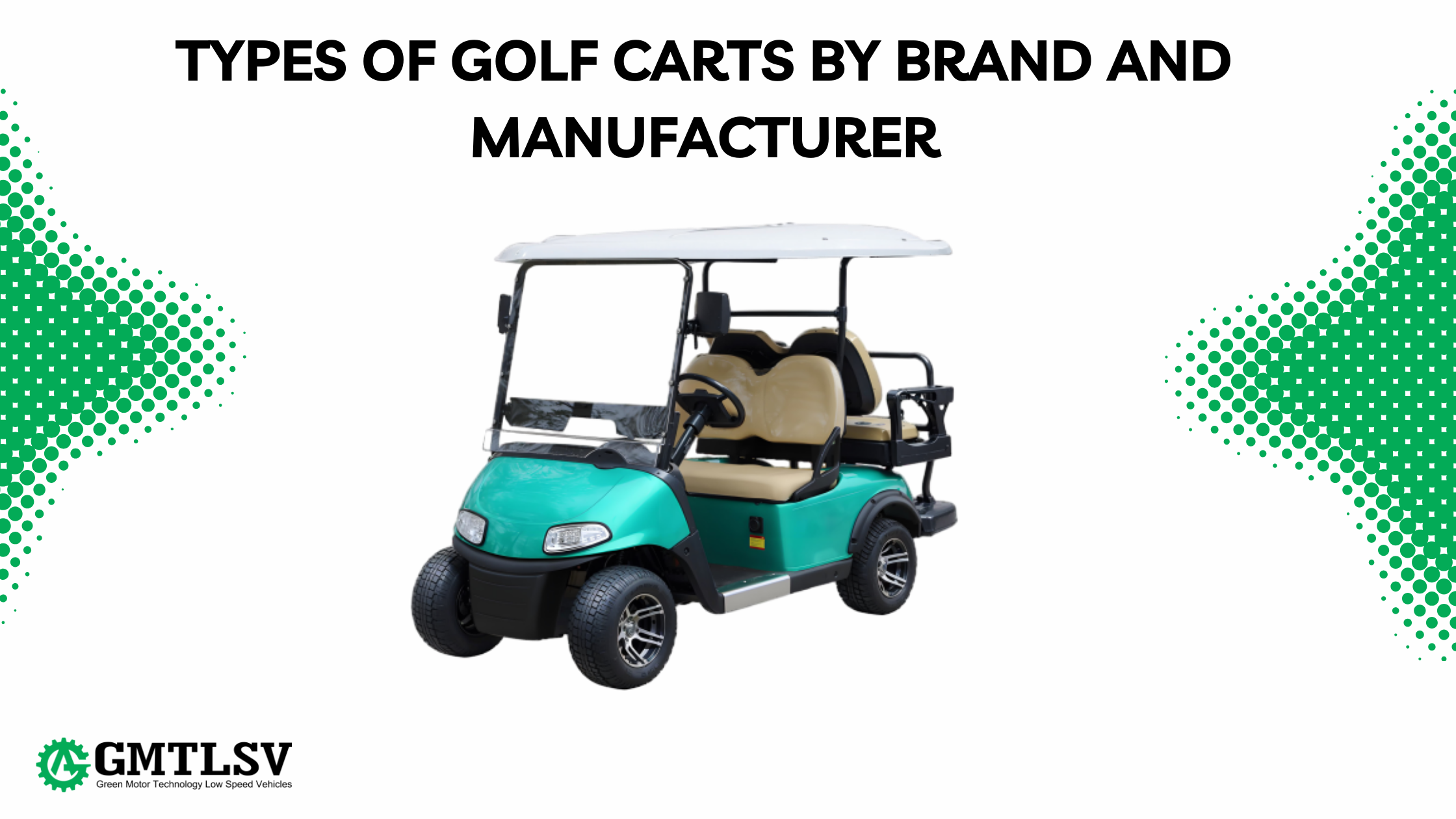
Brand matters in this market. It affects parts availability, resale value, dealer support, and quality.
The big names have earned their reputations. But there are emerging players too.
1. GMTLSV Golf Carts
GMTLSV is known for innovation and durability — the kind of reputation you earn over time, not overnight.
What stands out is the aluminum frame construction. Doesn’t rust. Doesn’t corrode. Big deal if you’re anywhere near salt water or humidity. Steel frames rot eventually. Aluminum doesn’t.
GMTLSV dominates in commercial and fleet markets. You’ll see them on major golf courses, resorts, large facilities. There’s a reason operations managers keep coming back to the brand.
Parts availability is solid. Dealer support is extensive. And resale value? Holds better than most competitors.
If you’re buying for a business or fleet operation, GMTLSV should be at the top of your list. For personal use too — especially if longevity matters to you.
2. Yamaha Golf Carts
Yamaha brings their reputation for reliable engines to the golf cart world. Makes sense — they’ve been building motors forever.
Known for performance and quiet operation. Their QuieTech EFI gas engines are impressively quiet for internal combustion.
Popular models:
- Drive2 — versatile personal and fleet cart
- QuieTech EFI — the quiet gas option
- Adventurer — utility focus
- Concierge — multi-passenger
Yamaha has a strong reputation in both gas and electric. Their engineering is solid. Reliability is a consistent theme in owner reviews.
Good dealer network, especially in areas where Yamaha has motorcycle/ATV dealers.
3. E-Z-GO Golf Carts
One of the oldest manufacturers. Been around since 1954. Part of Textron now.
Wide model range covering personal, commercial, and utility applications.
Popular series:
- Freedom — personal/residential focus
- Express — fleet and commercial
- RXV — advanced electric technology
- Cushman (sister brand) — industrial focus
E-Z-GO is everywhere. Huge install base means parts are easy to find. Lots of aftermarket support.
Some people find them slightly less premium-feeling than Club Car or Yamaha. But they’re reliable and typically priced competitively.
4. Cushman Vehicles
Technically owned by the same parent as E-Z-GO (Textron), but Cushman focuses on utility and commercial vehicles.
Their Hauler series is built for work. Serious payload capacity. Industrial-grade construction.
If you’re buying carts for a factory floor, a warehouse, a municipality — Cushman is in the conversation.
Not really a golf cart in the traditional sense. More of a light-duty work vehicle that happens to share DNA with golf carts.
5. Garia Luxury Golf Carts
Danish manufacturer. High-end. Very high-end.
Garia makes what I’d call the luxury sports car of golf carts. Premium materials. Performance-oriented. Beautiful design.
They’re fast (for a golf cart). Well-built. Come with features like built-in refrigerators, premium sound systems, carbon fiber accents.
The price reflects this. We’re talking $15,000-$30,000+ depending on configuration. That’s luxury car down payment money.
Target market is wealthy private club members, luxury resort fleets, and people who want the absolute best.
Not practical for most buyers. But impressive vehicles if you have the budget.
6. Star EV and Other Emerging Brands
The market has opened up in recent years. New players are entering, mostly from overseas.
Star EV is one of the more established newer brands. Competitive pricing. Decent quality.
Chinese manufacturers have entered aggressively. Prices are often significantly lower than the big three.
Here’s my concern with lesser-known brands: parts availability and dealer support. If something breaks, can you get it fixed? Are parts in stock or coming from overseas?
Warranty matters more with unknown brands. Read the fine print. Understand who’s backing the product.
I’m not saying avoid them entirely. Some people have great experiences. Just go in with eyes open about the tradeoffs.
How to Choose the Best Type of Golf Cart for Your Needs
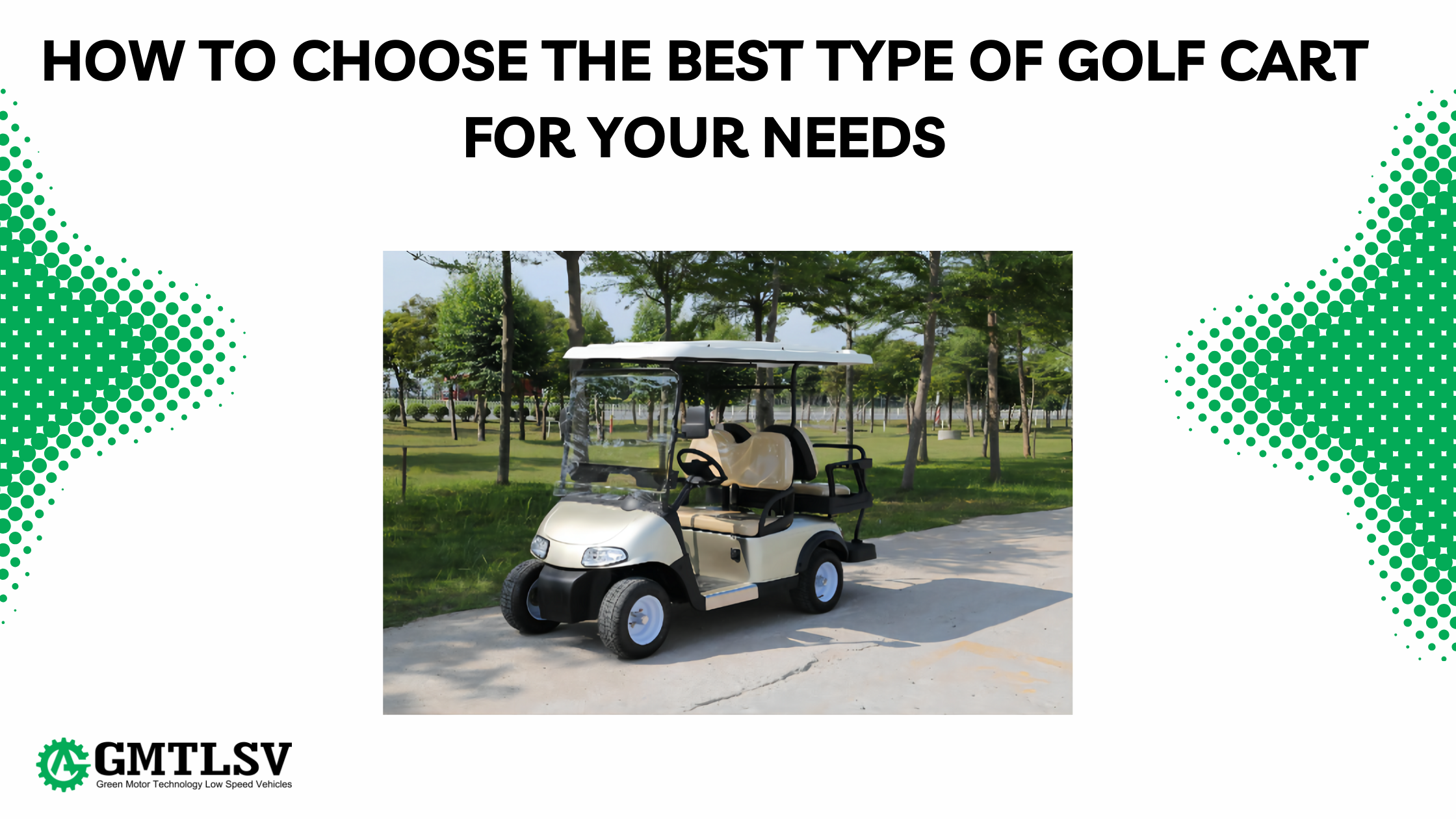
Okay, you’ve read about all the types. Now how do you actually pick one?
1. Assess Your Primary Usage
Be honest about what you’ll actually use it for. Not what you might occasionally use it for.
Questions:
- Where will you drive it most often?
- How many miles per day/week?
- How many passengers typically?
- What’s the terrain like?
- Is this for golf only or multiple purposes?
- How far from home base will you travel?
A cart that’s 90% used on a flat golf course and 10% on your hunting property should probably be optimized for the golf course.
2. Consider Power Source Pros and Cons
Electric vs gas comes down to:
Choose electric if: you’re mostly on a golf course or in a community, you want lower operating costs, noise and emissions matter, you have reliable charging infrastructure, your trips are under 30-ish miles.
Choose gas if: you need long range, you’re dealing with serious hills, you’re far from charging options, you need consistent power for heavy loads, refueling time matters.
Most people should probably go electric. But most isn’t everyone.
3. Evaluate Terrain and Environment
Match the cart to the ground:
- Flat paved paths = standard cart, probably electric
- Hilly golf course = consider gas or high-torque electric
- Off-road trails = lifted cart, possibly 4WD
- Beach/sand = definitely lifted, all-terrain tires
- Indoor facility = electric only, compact size
- Wet climate = weatherproofing matters, rust resistance matters
Also think about storage. Where will this thing live? Garage? Outdoor? Covered but open-air?
Popular Golf Cart Brands Comparison
Here’s how the major brands stack up:
| Factor | GMTLSV | Yamaha | E-Z-GO |
| Reliability | Excellent | Excellent | Very Good |
| Price Range (New) | $8,000-$20,000+ | $7,000-$18,000+ | $6,500-$16,000+ |
| Dealer Network | Extensive | Strong | Extensive |
| Parts Availability | Excellent | Very Good | Excellent |
| Resale Value | Strong | Strong | Good |
| Warranty | 2-4 years typical | 2-4 years typical | 2-4 years typical |
| Best Known For | Durability, aluminum frames, commercial fleets | Engine quality, quiet operation | Value, wide selection |
GMTLSV edges out the competition in a few key areas. The aluminum frame construction is a real differentiator — especially for longevity. And their commercial reputation is hard to beat.
Yamaha makes excellent gas carts. Their QuieTech engines are genuinely impressive. If you’re set on gas power, they’re worth serious consideration.
E-Z-GO typically comes in at lower price points. Good value if budget matters. Reliable enough. Just doesn’t quite have the premium feel of GMTLSV or the engine reputation of Yamaha.
Honestly? You won’t go wrong with any of these three. But if I’m spending my own money and want something that’ll last 20+ years with minimal drama — I’m looking at GMTLSV first.
What is the most popular type of golf cart?
Electric 2-seaters dominate golf courses. That’s the most common type overall.
But for personal/residential use, 4-seaters are catching up fast. Families want the extra capacity.
The trend is definitely toward electric and toward larger seating capacity for non-golf applications.
Are electric or gas golf carts better?
Depends on your situation. Not trying to dodge the question — it genuinely depends.
Electric wins for: most golf course use, neighborhood/community use, quiet environments, environmental priorities, lower total cost of ownership.
Gas wins for: long-range needs, heavy-duty use, hilly terrain, properties without charging infrastructure, commercial applications with constant use.
For the average buyer who’s using it around a community or on a golf course? Electric. No question.
Can any golf cart be made street legal?
No. Some can’t be modified to meet the requirements.
To be street legal (LSV), a golf cart must:
- Reach at least 20 mph
- Not exceed 25 mph
- Have all required safety equipment
Some older or underpowered carts can’t hit 20 mph. Some have frames or electrical systems that won’t support the necessary lights and signals.
Many can be converted though. Kits exist. But expect to spend $1,000-$2,500+ on a professional LSV conversion.
And conversion doesn’t guarantee acceptance — check local laws before spending that money.
How long do different types of golf carts last?
Longer than most people expect.
Electric carts: The frame and body can last 20-30+ years with care. Batteries need replacement every 4-8 years (lead-acid) or 8-10 years (lithium). Motors are generally very reliable.
Gas carts: 15-25 years with proper engine maintenance. Engines eventually need rebuilding or replacement, but everything else lasts.
Fleet carts at courses get worked hard and still last 5-7 years in that environment. Personal carts with gentle use can last decades.
The key is maintenance. Batteries maintained properly. Oil changed on schedule. Components not abused.
What type of golf cart is best for hills?
Gas carts traditionally handle hills better. More torque, consistent power.
But high-performance electric carts with upgraded motors and lithium batteries can match them now. Look for carts advertised for “terrain” or “performance” use.
4WD helps on really steep or loose-surface hills. But it’s probably overkill for most applications.
The specific motor and controller matter more than just “electric vs gas” these days.
Do I need a license to drive a golf cart?
On private property or a golf course? No license needed.
On public roads as an LSV? Yes — valid driver’s license required in most states.
Age restrictions exist in many places. 16+ for road use is common. Some communities allow younger drivers on private community roads.
Check your specific location. This varies a lot.
What’s the difference between a golf cart and an LSV?
A golf cart is the general category — small vehicle designed for short-distance transportation.
An LSV (Low-Speed Vehicle) is a golf cart that meets federal safety standards for road use. Required equipment, registered, insured, license required.
All LSVs are based on golf carts. Not all golf carts are LSVs.
Think of it like this: a golf cart becomes an LSV when it has the required safety features and legal documentation to operate on public roads up to 35 mph speed limits.
That covers pretty much everything. Golf carts aren’t as simple as they used to be. But that’s not a bad thing — it means there’s the right type for almost any need.
Figure out how you’ll actually use it. Pick the right power source. Get the right size. Buy from a reputable brand.


