Golf carts have long transcended the boundaries of the golf course and become “all – rounders” for community patrols, resort shuttles, and small – scale cargo transportation. However, few people notice that the weight of this seemingly simple means of transportation acts like an “invisible switch”, directly affecting speed, battery life, handling, and even service life. From the weight of the battery to the needs of carrying passengers and cargo, there is a lot of practical knowledge hidden behind the vehicle weight – choosing the right weight can not only make driving smoother but also reduce maintenance costs.
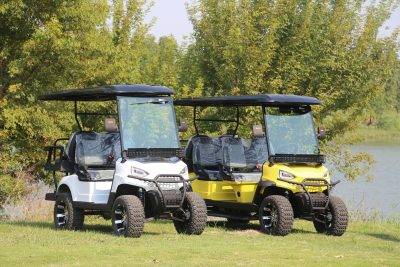
Where does the vehicle weight come from? First, understand two “weight concepts”
1.To understand the impact of vehicle weight, you need to distinguish two common terms:
dry weight and curb weight. The dry weight refers to the weight of the “bare vehicle” – the basic weight without the battery and accessories. The curb weight is the “actual combat state”: the total weight with the battery installed and common accessories (such as sunshades and storage baskets) equipped. What’s the difference between these two values? It mainly lies in the battery: the weight of a golf cart battery can range from 10 pounds (for a small auxiliary battery) to 300 pounds (for multiple sets of lead – acid batteries), directly making the curb weight 20% – 50% more than the dry weight.
2.In addition to the battery, vehicle weight is also affected by the following factors:
-
Vehicle model size:
A 2 – seater cart generally weighs 800 – 1000 pounds, while a 6 – seater cart can weigh over 1300 pounds (for example, the electric version of the Club Car Precedent Stretch PTV weighs 1293 pounds).
-
Powertype:
Electric carts are heavier than gas – powered ones. Electric carts are powered by battery packs, and a 48 – volt model is often equipped with 4 – 6 batteries. Gas – powered carts have an engine but do not require large batteries. The gas – powered version of the same model is about 300 pounds lighter than the electric version (for instance, the 2 – seater Club Car Villager weighs 975 pounds for the electric version and 675 pounds for the gas – powered version).
-
Extra accessories:
Adding rain curtains, heavy – duty cargo boxes, charging brackets, etc., for every additional 100 pounds, the curb weight will increase, adding more burden.
Vehicle weight, speed, and acceleration: The art of balancing “heavy and stable” and “light and fast”
Many people wonder why, among 2 – seater carts, some start “lightly and quickly” while others are “slow”. The answer lies in the weight. The impact of vehicle weight on speed and acceleration is essentially an “energy confrontation” – it takes more energy to move a heavy cart, which naturally slows down the pace.
-
The difference in acceleration is obvious:
Gas – powered carts start more “aggressively” due to their lighter weight. For a heavy electric cart, it may take 1 – 2 more seconds to reach 20 km/h after stepping on the pedal. However, heavy carts also have advantages. When carrying 2 people, a light cart may slip during acceleration due to its “light front and heavy rear”, while a heavy cart is more stable – this is also why beginners are more suitable for slightly heavier models.
-
The speed limit is also restricted by weight:
Most golf carts are speed – limited to 24 km/h, but for a heavy cart with over – loaded cargo, the actual speed may decrease by 5 – 8 km/h. For example, the 6 – seater electric version of the Precedent Stretch PTV can run at 22 km/h when empty, but when fully loaded with 6 people, the speed may drop to 15 km/h, and it is also prone to “weak climbing ability” – this is why 6 – seater carts are rarely used on mountainous routes on the golf course.
Battery life: How to solve the “range anxiety” of heavy carts?
For electric carts, vehicle weight is an “invisible killer” of battery life. For every additional 100 pounds of a heavy cart, the battery output current during driving will increase by about 5%. Long – term high – load discharging will accelerate battery decay. A lead – acid battery that originally lasts 3 – 5 years may need to be replaced in 2 years when installed in an over – weighted cart. Even a durable lithium – ion battery may have its lifespan shortened from 8 – 10 years to 6 years.
How to balance weight and range? There are two practical methods:
-
Replace with “light batteries”:
Replacing traditional lead – acid batteries with lithium – ion batteries can reduce the weight by 60% (for example, a set of 48 – volt batteries weighs 200 pounds for lead – acid and only 80 pounds for lithium – ion). With the curb weight reduced, the battery burden is also lightened. In actual tests, after replacing with lithium – ion batteries, the range of the same electric cart can be increased by 15 – 20 kilometers.
-
Calculate the “load account”:
Don’t overload. The rated load of a 2 – seater cart is 400 – 550 pounds. If you stuff 3 people into it (with a total weight exceeding 600 pounds), the “wear rate” of the battery during each charge – discharge cycle will increase from 0.05% to 0.1%, which is equivalent to the battery “aging” one more day per week.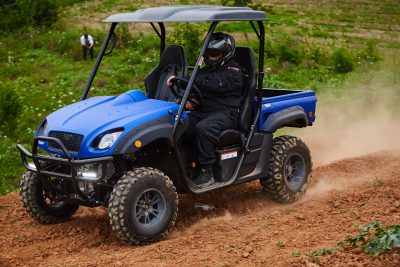
Handling and braking: Heavy carts are stable but “difficult to turn”, while light carts are agile but “prone to sway”
The core of the handling feeling is the “game between weight and inertia”.
Light carts have obvious advantages on narrow roads and sharp turns: you don’t need to exert too much force on the steering wheel, making them suitable for “avoiding obstacles” on the golf course or “passing through alleys” in the community. However, light carts are afraid of “cross – winds” and “bumps”. When passing over a speed bump at a slightly high speed, you may feel the vehicle body “floating”, and you need to hold the steering wheel tightly to stabilize it.
Heavy carts are the opposite: they are more stable on gravel roads and small slopes, with less body shaking, but the steering is “heavy”. When parking in a garage, you may need to turn the steering wheel half a turn more than a light cart. Especially for the “utility version” heavy carts with a cargo box installed, if the cargo box is filled with heavy objects and not properly fixed, it may “swing its tail” when turning, and you need to slow down in advance.
More importantly, there is the braking distance. Heavy carts have greater inertia. When traveling at 20 km/h, a light cart may need 3 – 4 meters to stop, while a heavy cart may need 5 – 6 meters. If over – loaded, the braking distance will increase by another 20%. This is also why manufacturers emphasize “don’t overload” – it not only damages the cart but also may cause danger due to insufficient braking. It is recommended that heavy – cart users check the brake pads every 3 months: the wear rate is 30% faster than that of light carts, and don’t wait until the brakes feel “soft” to replace them.
Conclusion: Weight is the “foundation”, and using it correctly is the key
The weight of a golf cart is never about “the lighter, the better” or “the heavier, the more stable” – it is the “balancing fulcrum” for performance, safety, and maintenance. When buying a cart, don’t just look at the “curb weight” in the parameter table. Ask about the “battery weight” and “rated load”, and then take a test drive according to your own usage scenarios. After all, the right weight is the prerequisite for making a golf cart truly “useful”.
If you want to know about the maintenance costs of heavy and light carts and how to choose the right vehicle weight for yourself, please contact us. You can call the hotline +86 757 2788 0666 or 181 2358 9096, or send an email to maggie@greenmotortech.com for detailed inquiries. Our reception hours are from 8:30 – 18:00 from Monday to Friday and 8:30 – 12:00 on Saturdays. During this time, a dedicated person will respond to your inquiries in a timely manner. Whether you want to consult about cooperation details or learn more relevant information, we are always waiting and look forward to establishing contact with you and moving forward together!