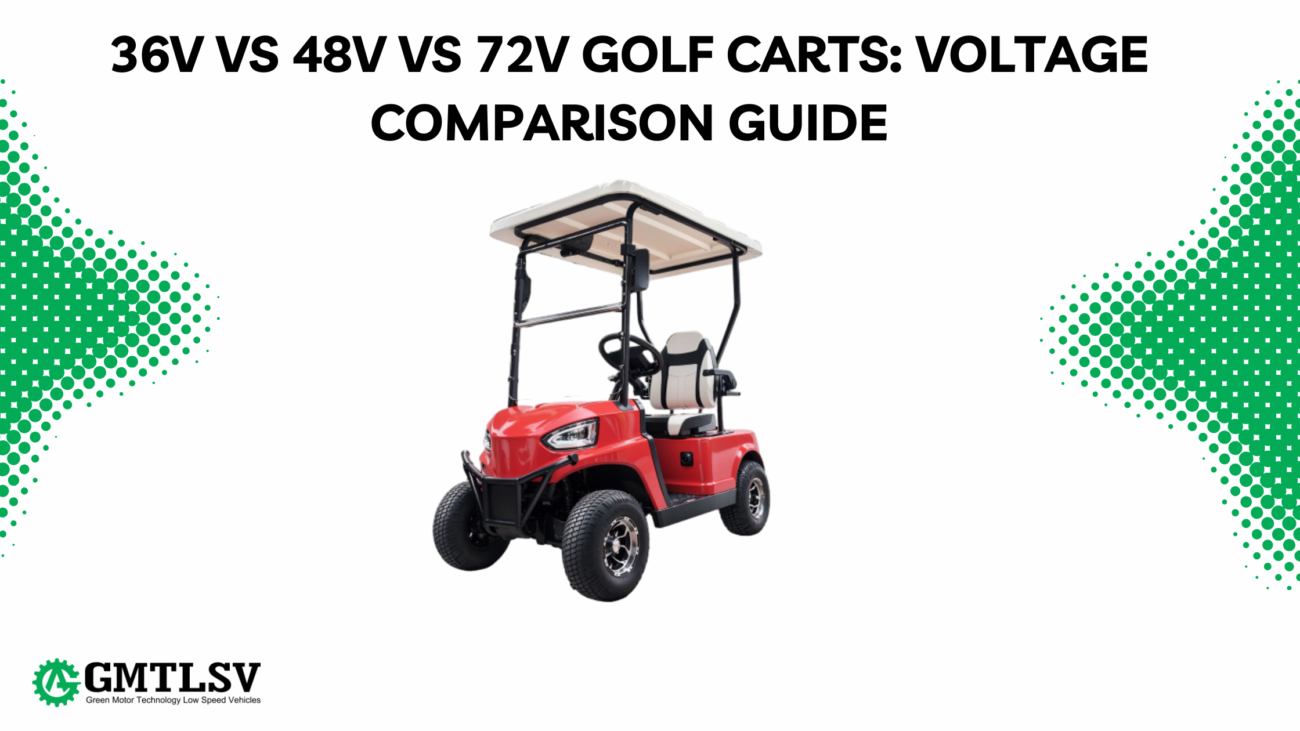
Look, voltage matters more than most people think when buying a golf cart. It’s not just some number on a spec sheet. It directly affects how fast you’ll go, how well you’ll climb hills, and honestly, how frustrated or happy you’ll be with your purchase.
I’ve seen so many people buy the wrong voltage. They get a 36V cart because it’s cheaper, then complain it can’t make it up their driveway. Or they overspend on a 72V system when they live in Florida and the biggest hill they’ll ever see is a speed bump.
What Does Voltage Mean in Golf Carts?
Think of voltage like water pressure in a hose. Higher pressure means more force pushing the water out. Same thing with electricity—higher voltage means more electrical “pressure” pushing power to your motor.
Golf cart batteries work together to create the total system voltage. So if you have six 6-volt batteries wired in series, they add up to 36 volts total. Four 12-volt batteries give you 48 volts. It’s just an addition.
This is why you’ll see different battery configurations for the same voltage. You can build a 48V system multiple ways. Six 8V batteries. Four 12V batteries. Eight 6V batteries. Same voltage, different setups.
How Voltage Affects Golf Cart Performance
Here’s the simple truth. Higher voltage = more power. More power = better everything.
Speed goes up with voltage. Torque increases. Hill-climbing improves dramatically. Acceleration gets snappier. The whole driving experience changes.
Think of it like this. A 36V cart is like a small economy car. Get the job done, nothing exciting. A 48V cart is your standard sedan. Reliable, capable, handles most situations. A 72V cart? That’s your truck. Power when you need it, climb anything, hauls whatever you throw at it.
The relationship isn’t perfectly linear though. Going from 36V to 48V gives you a noticeable jump. Going from 48V to 72V gives you another jump, but you’re also paying a premium for that extra performance. Whether it’s worth it depends on what you’re actually doing with the cart.
36V Golf Carts: Complete Overview
The 36V system is the old guard. It’s been around forever, and for a long time, it was the standard. You’ll still find tons of them out there, especially older carts and budget-friendly options.
But let’s be honest. It’s becoming the entry-level option. The industry has moved toward 48V as the baseline, and 36V is increasingly the “if you’re on a tight budget” choice. That’s not necessarily bad—it just means you need to know what you’re getting into.
Key Features of 36V Systems
- Battery configuration: Usually six 6-volt batteries or three 12-volt batteries
- Average speed: 12-14 mph (that’s stock, not modified)
- Typical range: 15-25 miles per charge depending on terrain and load
- Motor specs: Generally 3-5 HP motors
- Weight: Lighter overall system, which has some advantages
- Charging time: 6-8 hours for a full charge
Performance Capabilities
On flat ground, 36V carts do fine. Honestly, if you’re cruising around a flat golf course or a level retirement community, you might not notice any issues at all.
But throw a hill at it? That’s where things get real. A 36V cart climbing anything steeper than a gentle grade is going to slow down noticeably. You’ll feel it struggling. Add a passenger or two, and it gets worse.
Acceleration is leisurely. I’d call it “relaxed” if I’m being nice, “sluggish” if I’m being honest. You pull away from a stop and there’s just… not much urgency to it.
These carts work best on smooth, flat terrain with light loads. Pavement, well-maintained cart paths, that kind of thing. Don’t expect to take one on rough trails or steep hills without frustration.
48V Golf Carts: Complete Overview
This is the sweet spot. The 48V system has become the industry standard for good reason—it balances performance, cost, and practicality better than any other option.
When golf cart manufacturers started pushing toward 48V about 15-20 years ago, it made everything better. More speed, better efficiency, improved range. And the price difference from 36V wasn’t that dramatic.
Today, if you’re buying a new golf cart, chances are you’re looking at 48V as the baseline. It’s just where the market has landed.
Key Features of 48V Systems
- Battery configuration: Six 8-volt batteries, four 12-volt batteries, or eight 6-volt batteries are all common
- Average speed: 15-20 mph stock
- Typical range: 25-40 miles per charge
- Motor specs: Usually 4-7 HP motors
- Efficiency: About 15-20% more efficient than equivalent 36V systems
- Charging time: 8-10 hours for full charge
Performance Capabilities
48V carts feel noticeably more capable than 36V. The acceleration actually has some urgency to it. You pull away from a stop and the cart responds like it wants to move.
Hill climbing is significantly better. Moderate grades that would bog down a 36V cart? A 48V handles them without drama. Steeper hills still slow it down, but it doesn’t feel like the motor is crying.
Top speeds in the 15-20 mph range feel appropriate for most settings. Fast enough to get where you’re going, not so fast that you’re endangering anyone.
Load handling improves too. Three or four passengers don’t kill the performance like they would on a 36V system. The cart maintains composure.
These systems handle varied terrain well. Pavement, cart paths, light gravel, small inclines—all manageable. You’re not limited to perfectly flat surfaces.
72V Golf Carts: Complete Overview
Now we’re talking about serious power. 72V systems are the high-performance tier—more speed, more torque, more capability across the board.
These used to be pretty niche. Performance enthusiasts, commercial operations, people with serious hills to climb. But they’ve been getting more popular lately. The efficiency benefits are real, and as people push golf carts harder (longer distances, more challenging terrain), 72V makes more sense.
This is the premium option with premium pricing. But for the right application, it’s absolutely worth it.
Key Features of 72V Systems
- Battery configuration: Six 12-volt batteries or twelve 6-volt batteries
- Average speed: 20-25+ mph
- Typical range: 40-60 miles per charge (efficiency pays off here)
- Motor specs: 7-10+ HP motors, high-performance controllers
- Controller technology: More advanced systems for power delivery
- Charging time: 8-12 hours depending on charger amperage
Performance Capabilities
72V carts feel genuinely quick. The acceleration surprises people who’ve only driven lower-voltage carts. You press the pedal and it actually moves.
Hill climbing is where 72V really shines. Steep grades that would slow a 48V cart to a crawl? A 72V system pulls through with power to spare. This is why commercial operations in hilly areas often go with 72V—they can’t afford carts that struggle.
Top speeds above 20 mph start getting into “actual transportation” territory. You can cover real distances efficiently.
Heavy loads don’t faze these systems. Fill all the seats, load up the cargo area, and the cart still performs. The motor isn’t straining.
Challenging terrain—rough paths, significant inclines, loose surfaces—becomes manageable. These are capable machines when properly equipped.
36V vs 48V Golf Carts: Direct Comparison
This is the comparison most people face. You found a cheaper 36V cart and a 48V cart that costs a bit more. Which one should you buy?
Let me break it down directly.
Speed and Acceleration Comparison
36V typical speed: 12-14 mph 48V typical speed: 15-20 mph
That’s a 25-40% speed difference. On paper, maybe not a huge deal. In practice? It’s noticeable. The 48V cart just feels more capable.
Acceleration shows a bigger gap. A 48V cart gets to its top speed noticeably faster. You feel the difference every time you start from a stop. The 36V cart builds speed gradually. The 48V cart has actual responsiveness.
Power and Torque Differences
48V provides approximately 33% more power than 36V. That math is just voltage difference, but real-world torque improvements match.
Hills are the clearest example. A grade that has a 36V cart slowing to 5-6 mph might only drop a 48V cart to 10-12 mph. The 48V system maintains momentum where the 36V system loses it.
Load capacity shows similar patterns. A 36V cart with four passengers and cargo struggles. The same load on a 48V cart is barely noticeable.
Range and Efficiency
Typical range on single charge:
- 36V: 15-25 miles
- 48V: 25-40 miles
That’s a significant difference, and it comes from better efficiency. The 48V motor doesn’t work as hard to produce the same movement. Less energy wasted as heat means more energy goes to the wheels.
Add hills or weight, and the gap widens. A loaded 36V cart on hilly terrain might only get 10-12 miles. The 48V cart in the same conditions might still manage 20-25 miles.
Cost Comparison
Initial purchase: 36V carts typically cost $500-1500 less than equivalent 48V models
Battery replacement:
- 36V: 6 batteries × $100-150 each = $600-900
- 48V: 6 batteries × $130-180 each = $780-1080
The 48V batteries cost more individually, but you often have similar total battery counts. Long-term operating costs favor 48V due to efficiency.
Maintenance: Similar for both, maybe slightly more for 48V due to additional electrical complexity.
Which to Choose: 36V or 48V?
Choose 36V if:
- Your terrain is completely flat
- Budget is the primary constraint
- You only use the cart occasionally
- Short trips with light loads are all you need
- You’re buying a second/backup cart
Choose 48V if:
- You have any hills at all
- You’ll use it regularly
- You carry passengers or cargo
- You want reasonable resale value
- You’re buying your primary cart
My recommendation? Go 48V unless money is truly tight. The performance difference is worth the price difference for most people. And when you go to sell it later, 48V carts hold value better.
48V vs 72V Golf Carts: Direct Comparison
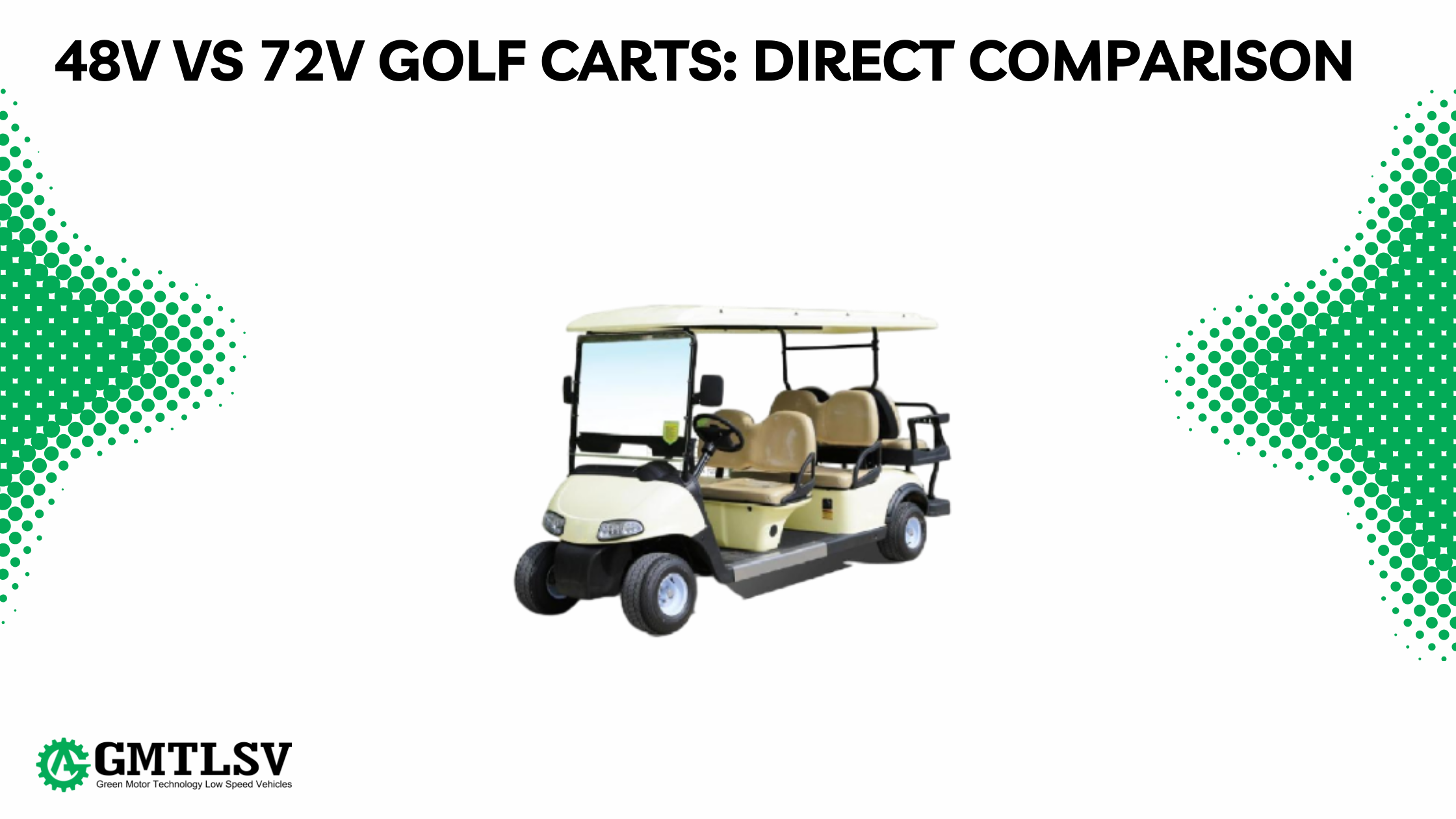
This comparison is about whether to get the standard option or pay up for premium performance. Both are capable—this is about degrees of capability.
Speed and Performance Gap
48V typical speed: 15-20 mph 72V typical speed: 20-25+ mph
That 5+ mph difference matters more than it sounds. At 48V speeds, you’re clearly in “golf cart territory.” At 72V speeds, you’re getting into low-speed vehicle range, actual transportation speeds.
The acceleration gap is noticeable too. The 72V cart launches with authority. It’s not sports-car quick, but it feels purposeful. The 48V cart feels adequate. The 72V cart feels eager.
Power Delivery and Efficiency
Here’s something that surprises people: 72V systems are more efficient, not less.
Higher voltage means lower amperage to deliver the same power. Lower amperage means less resistance loss, less heat generation, less wasted energy. A 72V system doing the same work as a 48V system uses less electricity to do it.
Motor heat reduction is significant. Lower amps mean cooler motors. Cooler motors last longer. Over thousands of hours of use, this adds up.
I’ve seen estimates that 72V systems are 10-15% more efficient than 48V systems doing equivalent work. That translates directly to range and component longevity.
Hill-Climbing and Terrain Capability
This is where 72V justifies its existence.
A 48V cart climbing a 15% grade slows significantly. A 72V cart on that same grade barely notices.
If you have steep hills—really steep, the kind where you worry about the cart—72V is the answer. Nothing else provides the same confident hill climbing.
Which to Choose: 48V or 72V?
Choose 48V if:
- Your terrain is mostly flat to moderate
- You’re a typical residential user
- Budget matters
- You want the broadest parts and accessory availability
- Your needs are “normal”
Choose 72V if:
- You have serious hills to climb
- You’re running a commercial operation
- Long daily distances are common
- Heavy loads are frequent
- Efficiency and longevity matter more than upfront cost
- You want maximum capability
The 72V premium is justified for demanding applications. For average use? 48V is plenty. Don’t overspend if you don’t have to.
36V vs 72V Golf Carts: The Extreme Comparison
This comparison shows the full range of what’s available. These aren’t usually the two options someone is deciding between—but understanding the extremes helps frame the whole picture.
Performance Gap Analysis
The numbers are dramatic:
Speed: 36V at 12-14 mph vs 72V at 20-25+ mph. That’s potentially double.
Power: 72V delivers approximately 100% more power than 36V. Twice the electrical pressure, roughly twice the capability.
Range: 36V might get 15-20 miles. 72V might get 40-50 miles. The efficiency difference is massive.
Hill climbing: A hill that stops a 36V cart dead is barely an inconvenience for a 72V system.
Everything about the driving experience changes. A 36V cart feels like basic transportation. A 72V cart feels like a legitimate vehicle.
Use Case Scenarios
36V makes sense when:
- Budget is severely limited
- Terrain is pancake flat
- Use is infrequent and light
- Basic transportation is all you need
72V makes sense when:
- Hills are serious and frequent
- Commercial duty is the application
- Performance really matters
- Long-term efficiency outweighs upfront cost
When 48V makes more sense than either:
- Most situations, honestly
- When you need more than 36V but less than 72V
- When you want the most options and support
- When you’re not sure what you need
Is the Upgrade Worth It?
Jumping straight from 36V to 72V is a big leap. You’re essentially going from entry-level to premium, skipping the standard tier entirely.
When it makes sense: You know you need serious capability. Hills are steep, distances are long, use is heavy. The 48V option would be a compromise you’d regret.
When it doesn’t make sense: You’re just frustrated with 36V limitations. A 48V cart solves most of those problems at much lower cost. Going to 72V would be overcorrecting.
Calculate it this way: What problems are you solving? If 48V solves them, spend less. If only 72V solves them, it’s worth the premium.
Complete Voltage Comparison Chart
| Specification | 36V | 48V | 72V |
| Typical Speed | 12-14 mph | 15-20 mph | 20-25+ mph |
| Common Battery Setup | 6×6V or 3×12V | 6×8V, 4×12V, or 8×6V | 6×12V or 12×6V |
| Average Range | 15-25 miles | 25-40 miles | 40-60 miles |
| Hill Climbing | Poor-Fair | Good | Excellent |
| Ideal Use | Flat terrain, light use | General purpose | Hills, commercial, performance |
| Relative Price | $ | $$ | $$$ |
| Efficiency | Baseline | +15-20% | +25-35% |
| Maintenance | Simple | Moderate | More complex |
| Parts Availability | Good | Excellent | Growing |
| Motor Strain | Higher | Moderate | Lower |
| Heat Generation | Higher | Moderate | Lower |
| Weight | Lightest | Medium | Heaviest |
| Acceleration | Slow | Moderate | Quick |
| Load Handling | Limited | Good | Excellent |
| Resale Value | Lower | Best | Good |
Battery Considerations Across Voltages
The battery system is where voltage becomes real. This is what you’ll actually buy, maintain, and eventually replace.
Battery Types and Compatibility
Lead-acid options: Lead-acid batteries come in 6V, 8V, and 12V configurations. You mix and match to hit your target voltage. Six 6V batteries for 36V. Six 8V batteries for 48V. Six 12V batteries for 72V. Simple math.
The 8V batteries are particularly popular for 48V systems because they offer a good balance of capacity and weight. You get more amp-hours per battery than 6V units.
Lithium options: Lithium battery packs are typically sold as drop-in replacements matched to specific voltages. You buy a 48V lithium pack, not individual cells to configure yourself.
Lithium works with all three voltages, but the cost premium is significant. We’re talking 3-4 times the price of lead-acid, sometimes more.
Compatibility considerations: Don’t mix battery types in the same system. All lead-acid or all lithium. Don’t mix old and new batteries either—they’ll drag each other down.
Battery Life and Replacement Costs
Lead-acid lifespan: 4-6 years with proper maintenance, 500-1000 charge cycles
Lithium lifespan: 8-10+ years, 2000-5000 charge cycles
Replacement cost comparison:
| System | Lead-Acid Cost | Lithium Cost |
| 36V | $600-900 | $2000-3500 |
| 48V | $800-1200 | $2500-4500 |
| 72V | $1000-1500 | $3500-6000 |
Long-term, lithium often wins on cost-per-mile. But that upfront investment is steep.
Most economical over time: 48V lead-acid for budget-conscious users. 48V lithium for heavy users who can afford the upfront cost.
Charging Requirements
Every voltage needs its own charger. This is non-negotiable. A 36V charger on a 48V system won’t fully charge it. A 48V charger on a 36V system could damage the batteries.
Charger costs:
- 36V chargers: $150-300
- 48V chargers: $200-400
- 72V chargers: $250-500
Charging times scale with battery capacity, not voltage directly. Higher amp chargers reduce charging time but cost more.
Always match charger voltage to system voltage exactly. It’s the most basic rule and people still mess it up.
Lithium vs Lead-Acid for Each Voltage
For 36V systems: Lithium conversion can almost double range. Weight drops significantly—maybe 100+ pounds lighter. But on a budget 36V cart, the lithium cost often exceeds the cart’s value.
For 48V systems: This is the sweet spot for lithium upgrades. Broad compatibility, lots of options, proven performance. Weight savings of 150-200 pounds are common. Range improvements of 50-80% are typical.
For 72V systems: Lithium makes 72V even more impressive. Range can exceed 60-70 miles. But costs are highest here. Most 72V lithium conversions are for serious commercial or performance applications.
My take: If you’re going lithium, 48V offers the best value. Most options, most support, best balance of improvement to cost.
GMTLSV Golf Cart Offerings
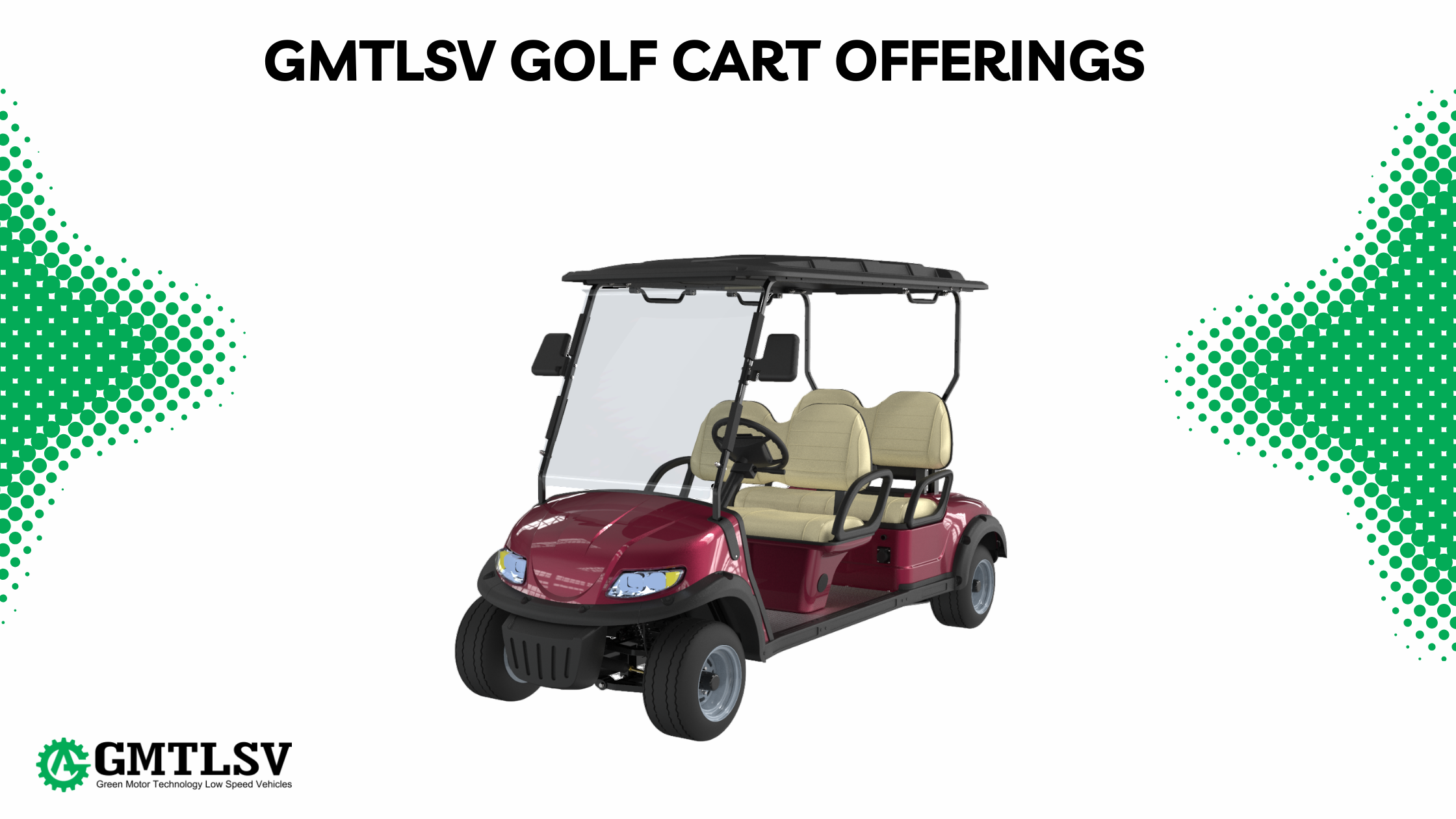
GMTLSV offers low-speed vehicles and golf carts across voltage options. Their lineup includes both standard golf carts and street-legal LSVs.
What stands out: quality construction, multiple voltage configurations available, and customization options for different applications. Whether you need a basic community cart or a commercial-duty machine, they have options.
If you’re shopping seriously, check out what GMTLSV offers. Their customer support can help match the right voltage and configuration to your specific needs. Worth a conversation before you decide.
Which voltage is fastest?
72V is the fastest. Top speeds of 20-25+ mph compared to 15-20 mph for 48V and 12-14 mph for 36V.
But “fastest” isn’t always “best.” Consider where you’ll drive. Many communities limit speeds anyway. Faster isn’t valuable if you can’t use it.
Speed also depends on motor choice, controller programming, tire size, and weight. Two 48V carts can have different top speeds based on other components.
Which voltage is most efficient?
72V is most efficient. Higher voltage means lower amperage for the same power output. Lower amps means less energy lost to heat and resistance.
The efficiency improvement is real—roughly 10-15% better than 48V, which is itself 15-20% better than 36V.
This matters most for heavy users. If you’re driving 20+ miles daily, efficiency savings add up. For occasional use? Probably not significant enough to drive your decision.
Can I upgrade my golf cart voltage?
Yes, but it’s not simple.
You’ll need to replace:
- All batteries (obviously)
- Motor (must be rated for new voltage)
- Controller (must match new voltage)
- Charger (must match new voltage)
- Possibly wiring (heavier gauge for some upgrades)
Total cost for a 36V to 48V upgrade: typically $2000-4000 depending on components chosen.
When it’s worth it: You love your cart’s frame, body, and accessories. Buying new would mean losing those things.
When it’s not worth it: The cost approaches buying a newer cart. Used 48V carts are available, often cheaper than upgrading.
Which voltage is best for hills?
72V. Not close.
72V handles steep grades (15-20%+) that would stop lesser carts. The power and torque overcome gravity more effectively.
48V handles moderate hills (8-15%) adequately. You’ll slow down but maintain progress.
36V struggles on anything significant. Grades over 10% become real problems, especially with passengers.
If you have serious hills—the kind where you’re actually worried about making it—go 72V. If your hills are moderate, 48V is fine.
How much does voltage affect range?
More than people expect.
Higher voltage improves efficiency, which extends range. But battery capacity (amp-hours) matters too. A 48V system with high-capacity batteries might outrange a 72V system with smaller batteries.
Typical ranges:
- 36V: 15-25 miles
- 48V: 25-40 miles
- 72V: 40-60 miles
Conditions matter significantly. Hills, weight, speed, temperature—all affect real-world range. Those numbers assume moderate conditions.
Which voltage is most economical long-term?
48V, for most people.
Five-year cost analysis:
| System | Purchase + 1 Battery Replacement | Efficiency Factor | Total Cost Ranking |
| 36V | Lowest initial, moderate batteries | Worst efficiency | Often highest long-term |
| 48V | Moderate initial, moderate batteries | Good efficiency | Usually lowest long-term |
| 72V | Highest initial, expensive batteries | Best efficiency | Middle long-term for heavy use |
The efficiency gains of 72V only pay off with serious use—daily, heavy, demanding. For typical users, 48V hits the sweet spot of purchase price, operating costs, and performance.
Do I need a special charger for each voltage?
Yes. Absolutely yes.
A charger must match system voltage exactly. Using the wrong charger risks:
- Undercharging (won’t fully charge, reduced battery life)
- Overcharging (heat, damage, potential safety issues)
- Complete battery failure in severe cases
Charger costs range from $150-500 depending on voltage and amperage rating. When you buy a cart, make sure a properly matched charger is included or budgeted.
Which voltage is best for beginners?
48V for most beginners.
Here’s why: It’s capable enough to handle real-world conditions without being overwhelming. Parts and support are widely available. If you have problems, any golf cart shop can help.
36V can work for beginners with truly simple needs—flat terrain, light use, budget priority.
72V is probably overkill for beginners unless you know you have specific demanding requirements (steep property, commercial application, etc.).
Start with 48V. If it doesn’t meet your needs after a year of use, you’ll know exactly what you need and why. Upgrading from educated experience beats guessing at the start.