

Switching your golf cart from lead-acid to lithium batteries is one of those upgrades that makes you wonder why you waited so long. The difference is immediate. And honestly, kind of dramatic.
We’re talking about dropping 60-70% of your battery weight overnight. Charging in 2-5 hours instead of waiting 8-12 hours for lead-acid to crawl to full. No more watering batteries. No more checking acid levels. No more corrosion eating through your terminals every few months.
This guide walks through the entire conversion process. Every step. From disconnecting your old lead-acid pack to firing up your new lithium system for the first test drive. It’s not as complicated as it sounds. Most people handle it in the afternoon. At GMTLSV, we’ve helped countless golf cart owners and fleet operators make this switch. The technology has matured to the point where lithium conversions are straightforward, reliable, and absolutely worth the investment.
Why Convert from Lead-Acid to Lithium Batteries?
The reasons stack up fast once you start comparing the two technologies side by side.
Golf cart owners, fleet managers, residential community operators. Doesn’t matter who you are. The practical benefits hit everyone the same way. Less maintenance. Better performance. Lower long-term costs. More usable power when you actually need it.
Let me break down the five biggest reasons people make the switch.
1. Extended Battery Lifespan
Lithium batteries last 3-5 times longer than lead-acid. That’s not marketing fluff. That’s cycle count reality.
Lead-acid batteries typically manage 500-800 charge cycles before they start failing. In practical terms, that’s 3-5 years for most golf cart owners. Then you’re buying another set.
Lithium? We’re talking 3,000-5,000 cycles. That translates to 8-10 years of use. Sometimes longer with light usage patterns.
Here’s what matters for your wallet. After 3,000 cycles, quality lithium batteries still retain 80% of their original capacity. They’re not dead. They’re still working. Lead-acid batteries at that point would have been replaced twice already.
Run the total cost of ownership numbers. Even though lithium costs more upfront, you’re buying one battery system instead of two or three over the same time period. The math works out in lithium’s favor almost every time.
2. Significant Weight Reduction
Lithium batteries weigh 60-70% less than lead-acid equivalents. This isn’t a minor difference. It changes how the cart drives.
Specific numbers: A 48V lithium pack weighs roughly 50-90 pounds. A 48V lead-acid setup? 200-350 pounds. We’re talking about removing 150-300 pounds from your cart.
That weight reduction shows up everywhere. Acceleration improves noticeably. Hill climbing gets easier. The cart feels more responsive, more maneuverable. You’re not lugging around all that dead weight anymore.
Less weight also means less strain on your motor, controller, and suspension components. They last longer. Tires wear more evenly. And you’ve got more capacity for passengers and gear since you’re not burning that capacity hauling battery mass.
3. Consistent Power Output
This one frustrates lead-acid owners constantly. You start your round with plenty of power. By the back nine, you’re crawling up hills. That’s voltage sag. Lead-acid batteries experience significant voltage drop as they discharge.
Lithium maintains steady voltage throughout the discharge cycle. From 100% charge down to 20%, you get consistent power delivery. The cart performs the same whether you just unplugged it or you’ve been driving for hours.
No more guessing whether you’ll make it up that hill. No more embarrassing slowdowns toward the end of your day. Reliable, predictable power from start to finish.
4. Faster Charging Times
Lead-acid batteries need 8-12 hours for a full charge. That’s overnight, basically. Miss your charging window and you’re waiting until tomorrow.
Lithium charges 5x faster. Full charge in 2-5 hours depending on your setup and charger capacity.
The efficiency difference matters too. Lithium achieves roughly 95% charge efficiency versus 80% for lead-acid. Less energy wasted as heat. Lower electricity costs over time.
For commercial fleets and daily users, this changes everything. Opportunity charging becomes possible. Plug in during lunch. Grab some charge during a break. You’re not locked into overnight charging cycles anymore.
5. Zero Maintenance Requirements
Lead-acid maintenance is tedious. Checking water levels. Adding distilled water. Cleaning corrosion off terminals. Running equalization charges. Dealing with acid spills and toxic fumes.
Lithium batteries need none of that. Zero watering. No acid to leak. No corrosion buildup. No equalization cycles.
They’re safe for indoor storage. No toxic chemical concerns. The built-in Battery Management System handles everything automatically. Cell balancing, temperature monitoring, overcharge protection.
Fleet operators see labor cost reductions around 75% just from eliminating battery maintenance tasks. That’s hours every week that staff can spend on other things.
Step-by-Step Conversion Process
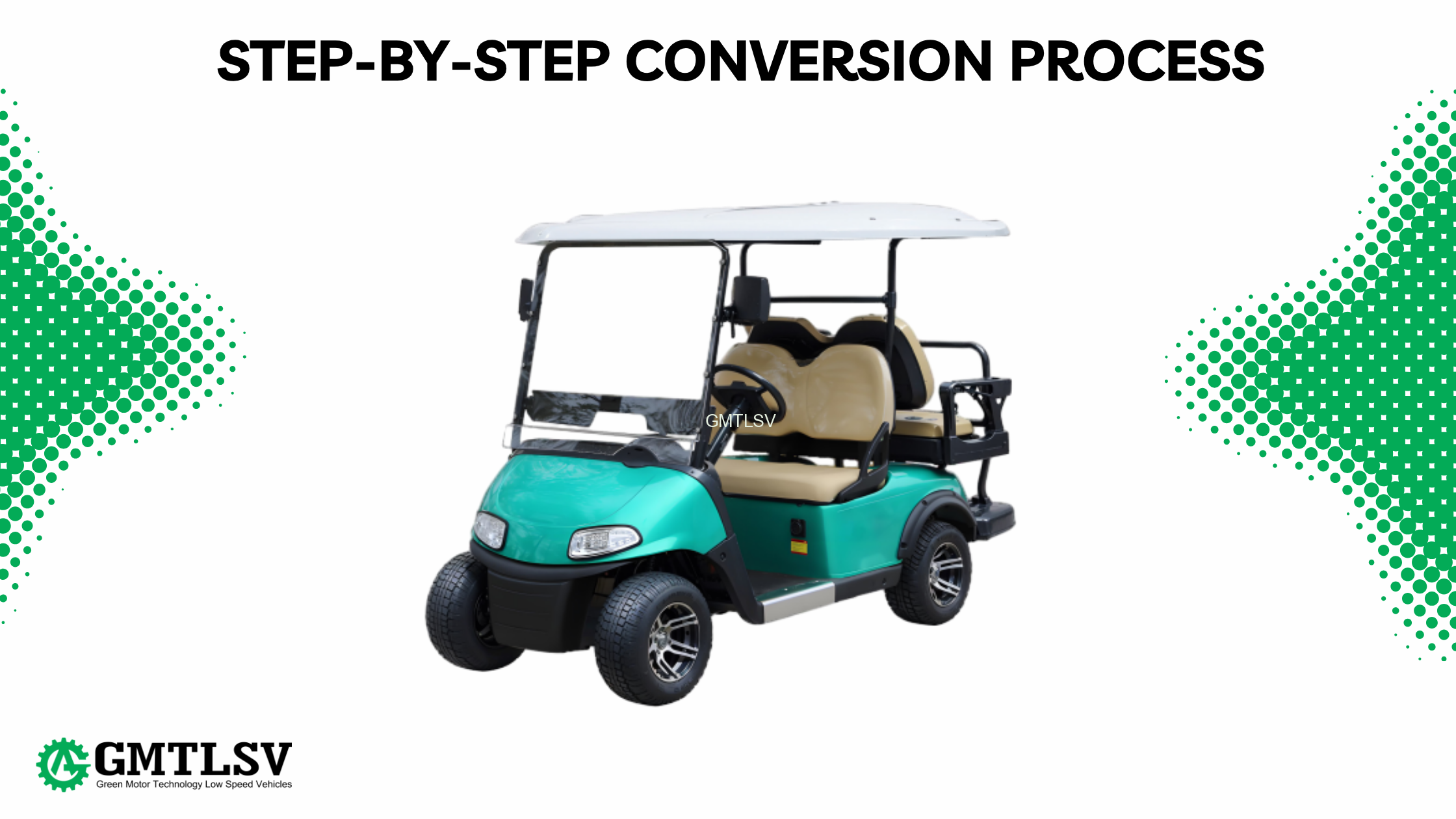
Now for the actual conversion. Follow these detailed steps to safely and successfully convert your golf cart from lead-acid to lithium batteries. Take your time, follow safety protocols, and you’ll have your upgraded cart running in a few hours.
Step 1: Prepare Your Golf Cart
Start with safety. Always.
Park the cart on a flat, level surface. Turn the ignition key completely OFF. If your cart has a “tow” mode switch, engage it now. Set the parking brake firmly.
Remove the seat to access the battery compartment. Most carts have quick-release seats or a few bolts.
Take photos of your existing wiring setup. Seriously. Do this. Those photos save headaches during reconnection when you’re trying to remember which cable went where.
Disconnect main power. Make absolutely sure the cart can’t move or activate during work. You’re about to have your hands deep in high-current electrical connections.
Step 2: Disconnect and Remove Old Lead-Acid Batteries
Here’s where the heavy lifting starts. Literally.
Disconnect the negative terminal FIRST. Always negative first. Then disconnect the positive terminal. This sequence matters for safety.
If you have a battery watering system installed, disconnect those hoses. Leave the caps on the batteries.
Remove all remaining battery cables between the batteries. You’ll need a 1/2″ socket for most connections.
Take out any battery hold-down brackets, straps, or J-hooks. Save these. You might need them for the lithium installation.
Now the hard part. Lead-acid batteries weigh 40-60 pounds each. Use a battery strap or puller to lift them out carefully. Get help if you need it. Back injuries aren’t worth it.
Pay attention to which cables connect to the cart’s controller and which go to ground. Note this before disconnecting everything.
Set old batteries aside for proper disposal. Most auto parts stores accept lead-acid batteries for recycling. Don’t just throw them away.
Step 3: Clean the Battery Compartment
Don’t skip this step. Tempting, but don’t.
Use a wire brush to clean the entire battery tray. Remove all debris, corrosion, and acid residue. Lead-acid batteries leave behind nasty stuff that you don’t want contaminating your new lithium system.
Inspect your main cables carefully. Look for corrosion. If the cables show significant corrosion, replace them. Corroded cables create resistance. Resistance creates heat. Heat creates problems.
Check all terminals and connections while you’re at it.
Make sure the tray is completely dry before installing new batteries. Moisture plus electrical connections equals future headaches.
Step 4: Install Lithium Battery Pack
Installation depends on whether you’re using drop-in replacement batteries or a single lithium pack.
For Drop-In Batteries:
Place the lithium batteries in the tray slots. Distribute weight evenly across the compartment. Position them so terminals and cables are easily accessible for wiring.
Secure with your original mounting brackets, straps, or J-hooks. If you’re using fewer lithium batteries than your original lead-acid count (common since lithium packs are more energy-dense), use battery spacers to fill the empty slots. You don’t want batteries shifting around during operation.
For Single Pack Systems:
Position the lithium battery in the compartment. Install custom mounting brackets if your kit includes them. Secure firmly with the provided hardware.
Test stability. Push on the battery. It shouldn’t shift or move during driving. Vibration and movement cause connection problems over time.
Step 5: Wire the Lithium Battery System
Pay attention here. This is where mistakes happen.
IMPORTANT WIRING DIFFERENCE: Lithium batteries wire in PARALLEL. Positive to positive. Negative to negative. This is different from lead-acid, which wires in series.
Do NOT wire lithium batteries in series like you did with lead-acid. Wrong wiring configuration damages batteries and creates safety hazards.
Connect the positive terminal to the positive lead running to your cart’s controller. Connect the negative terminal to the negative lead going to ground.
Double-check polarity before tightening anything. Reversed polarity can fry your new batteries and controller. Use a multimeter to verify connections. You should read correct system voltage: 36V, 48V, or 72V depending on your setup.
Make sure all connections are tight and secure. Loose connections cause resistance, heat, and eventual failure.
Follow the manufacturer’s specific wiring diagram included in your conversion kit. They know their product better than generic guides.
Use proper gauge cables. Typically 2/0 AWG for optimal current flow. Undersized cables create bottlenecks and heat.
Step 6: Remove Old Charge Port (If Applicable)
Most lithium systems don’t use your cart’s original charging receptacle. They use standard 110V household plugs instead.
Locate the backside of your factory charging receptacle in the battery compartment. Trace the wires from that receptacle to the controller and solenoid.
Disconnect these wires. Your cart no longer needs them.
Remove the old charge receptacle from the cart body if you want a cleaner look. Or leave the hole and install your new charging port there.
Step 7: Install Lithium-Compatible Charger
If your kit includes a new 110V charging port, install it where the factory port was located. Clean fit, convenient location.
Connect the charger to your lithium battery following manufacturer instructions. Every kit is slightly different.
Most lithium systems use a built-in 110V charging plug. You can run this cable out from under the seat and plug directly into any wall outlet when charging. Simple.
Make absolutely sure your charger voltage matches your battery voltage. 48V battery needs 48V charger. Mismatched voltage damages batteries.
Test the initial charge cycle while monitoring temperature. This verifies your BMS is functioning correctly. Watch for any unusual heat or behavior.
Critical warning: Never use a lead-acid charger on lithium batteries. Different charging profiles. Wrong charger causes damage, safety hazards, and voids your warranty. Budget $200-$400 for a proper lithium charger if your kit doesn’t include one.
Step 8: Install State of Charge (SOC) Meter (Optional)
If your kit includes an SOC meter, it acts like a fuel gauge showing remaining charge.
Choose a visible mounting location. Dashboard or steering column work well.
You’ve got two mounting options. Flush mount looks cleaner but requires drilling into your cart. Bracket mount avoids drilling but sits on the surface.
Connect per the included instructions. Pretty straightforward wiring.
Alternative: Many modern lithium batteries include Bluetooth connectivity. Download the app and monitor charge levels, voltage, capacity, and temperature directly on your smartphone. Sometimes more convenient than a physical gauge.
If your system includes BMS monitoring connections, hook those up too.
Step 9: Test the System
Almost done. Final checks before you drive.
Double-check every connection. Verify proper polarity with your multimeter one more time. Ensure no loose wires or forgotten tools in the battery compartment. Happens more than you’d think.
Turn on the cart ignition. Check voltage reading. Should show full charge or close to it from shipping charge.
Take a short test drive in a safe area. Parking lot, driveway, somewhere without traffic.
Monitor for smooth acceleration, consistent power delivery, proper voltage readings, no error codes on your display, no unusual sounds or smells. Burning smell means something’s wrong. Stop immediately.
Check your SOC meter or Bluetooth app functionality. Make sure everything reports correctly.
Test all cart functions. Lights, horn, turn signals, anything electrical.
Perform an initial full charge cycle and monitor the entire process. Make sure everything works as expected before relying on the cart.
Post-Conversion: Optimizing Your Lithium System
Your conversion is complete. Now let’s make sure you get maximum benefit from your new lithium setup through proper usage and maintenance practices.
Good habits extend battery life. Bad habits shorten it. The difference over 10 years is significant.
Proper Charging Practices
Charge regularly. Don’t let your battery drop below 20-30% routinely. Unlike old advice about lead-acid needing full discharge cycles, lithium prefers staying topped up.
Only use a lithium-specific charger. We covered this already but it bears repeating.
Avoid charging in extreme temperatures. Ideal range is 32-113°F. Most BMS systems won’t allow charging below freezing anyway.
Opportunity charging is your friend now. Plug in during lunch. Charge during breaks. Take advantage of what lithium allows that lead-acid never could.
Full charge takes 2-5 hours depending on your charger and battery capacity. No need to unplug immediately after reaching full charge. The BMS protects against overcharge.
For long-term storage (winter months, extended trips), store at approximately 50% charge in a cool, dry location.
Maintaining Your Lithium Battery
Here’s the maintenance schedule: Almost nothing.
No watering needed. No acid level checks. No equalization charges. Just… use the battery.
If corrosion appears on terminals (rare but possible), clean with a baking soda and water solution. Dry thoroughly.
Monitor battery health through the Bluetooth app if your system has one. Check voltage, temperature, cycle count occasionally.
Inspect connections annually. Make sure everything remains tight. Vibration can loosen connections over time.
Store properly during off-season. Keep firmware updated if your BMS supports updates.
That’s essentially it. Compared to lead-acid maintenance requirements, this feels like cheating.
Monitoring Battery Performance
Modern lithium batteries give you data. Use it.
Through Bluetooth apps or BMS monitors, you can track: current voltage, state of charge percentage, battery temperature, total cycle count, individual cell balance, and any fault codes.
Watch for warning signs: sudden capacity drops, overheating, unusual voltage readings between cells, BMS warnings or fault codes.
Most quality lithium batteries display real-time data. This enables proactive maintenance instead of discovering problems when the cart stops working.
Set up alerts if your monitoring system supports them. Get notified about potential issues before they become actual problems.
Upgrading Your Charger Settings (If Applicable)
Some lithium chargers offer adjustable settings. Worth exploring if yours does.
A 10A-20A charging rate reduces stress on the battery and can extend overall lifespan. Faster charging is possible, but gentler charging preserves longevity.
Temperature compensation features help optimize charging across different conditions. Enable these if available.
Follow your manufacturer’s recommendations for optimal charge profiles. They’ve tested what works best with their specific batteries.
How long does a lithium golf cart battery last?
Typically 8-10 years or 3,000-5,000 charge cycles with proper care. That’s significantly longer than lead-acid batteries, which typically last 3-5 years or 500-800 cycles.
Light-use applications can exceed 10 years. Heavy commercial use might see the lower end of that range.
Lifespan depends on usage patterns, charging practices, operating temperatures, and battery quality. Cheap batteries from unknown brands don’t last as long as quality units from established manufacturers.
Can I use my existing lead-acid charger?
No. Absolutely not.
Lead-acid chargers use completely different charging profiles than lithium requires. Using the wrong charger can damage your lithium batteries. Potentially irreversibly.
You must invest in a lithium-specific charger with appropriate BMS communication. This isn’t optional.
Wrong charger risks include battery damage, safety hazards, and voided warranty. Budget $200-$400 for a proper lithium charger. Many conversion kits include one.
What happens if my lithium battery gets too cold?
Quality lithium batteries include low-temperature charging cutoff protection as part of the BMS. The battery simply won’t accept a charge below freezing (typically 32°F).
This protects the cells from damage. Charging lithium in freezing temperatures can cause permanent harm.
You can still discharge and operate the cart in cold weather. Just don’t try to charge until temperatures rise.
Some premium batteries include integrated cell heaters specifically for cold weather operation. Nice feature for northern climates.
Best practice: Store your cart in a heated area during winter months if possible.
Cold weather reduces range somewhat but doesn’t damage the battery as long as the BMS protection functions properly.
Can I mix lithium and lead-acid batteries?
Never. Don’t do this.
You cannot combine lithium and lead-acid batteries in the same system. They have completely different charging requirements, discharge characteristics, and internal resistance.
Mixing chemistries causes improper charging, premature battery failure, safety hazards, and BMS errors.
Convert your entire battery system to one chemistry or the other. No mixing. No exceptions.
How much weight will I save?
Typically 60-70% weight reduction.
Concrete example: A 48V lithium pack weighs 50-90 pounds. An equivalent 48V lead-acid setup weighs 200-350 pounds. That’s 150-300 pounds of weight savings.
Those savings translate to better acceleration, improved hill climbing ability, reduced wear on suspension and tires, more capacity for passengers and cargo, and enhanced overall efficiency.
You’ll feel the difference immediately on your first drive.
What range can I expect per charge?
Typically 30-50 miles per charge for a 100Ah battery under normal conditions.
Range varies based on several factors: battery capacity (higher Ah means more range), terrain (flat courses versus hilly neighborhoods), passenger and cargo weight, driving style and speed, tire condition and pressure, weather conditions.
Conservative estimate: 40-50 miles for average golf course or community use.
Larger capacity batteries (150Ah) can exceed 50+ miles on a single charge. Heavy loads, hills, and aggressive driving reduce range.

