

Winter hits and suddenly your golf cart barely makes it around the neighborhood. Sound familiar?
It’s one of the most common complaints I hear. People buy an electric golf cart, love it all summer, then December rolls around and they’re wondering if something’s broken. Usually nothing’s wrong. It’s just cold.
Cold weather and electric golf cart range don’t mix well. That’s the reality. But here’s the thing — if you understand why it happens, you can actually do something about it. Or at least stop worrying that your batteries are dying.
Most golf cart owners lose anywhere from 10% to 40% of their range in winter. Sometimes more. And nobody tells you this when you buy the cart. They just hand you the keys and talk about how far it goes on a nice sunny day.
So let’s get into what’s actually happening. And more importantly, what you can do about it.
Why Cold Weather Affects Electric Golf Cart Range
This isn’t a golf cart problem. It’s a battery problem. And it’s physics. You can’t really fight physics, but you can work around it.
Every battery — doesn’t matter if it’s in your phone, your car, or your golf cart — performs worse when it’s cold. The chemical reactions that create electricity slow down. The battery has to work harder to deliver the same power. And “working harder” means draining faster.
There’s more to it though. Cold air is denser. Tires lose pressure. Your cart’s motor has to push against more resistance. Everything compounds.
The Science Behind Battery Performance in Low Temperatures
Okay, I’ll try not to make this boring.
Batteries work through chemical reactions. Ions moving between electrodes. That movement creates electricity. Simple enough.
When it gets cold, those chemical reactions slow way down. Think about cold syrup versus warm syrup. Cold syrup barely moves. Same thing happens inside your battery. The electrolyte — that’s the liquid or gel inside — gets thicker. More viscous. The ions can’t move as freely.
The result? Less available power. Not because the power isn’t there, but because the battery can’t release it efficiently.
Lead-acid batteries feel this worse than lithium-ion batteries. The chemistry is different. Lead-acid uses a sulfuric acid solution that really doesn’t like the cold. Lithium-ion batteries handle it better, but they’re not immune.
One thing people don’t realize — cold batteries also don’t accept charge as well. So even if you plug in overnight, you might not get a full charge. Double whammy.
Temperature Thresholds: When Range Starts Dropping
Let me give you actual numbers because vague advice doesn’t help anyone.
60-80°F (15-27°C): This is the sweet spot. Your battery performs at or near its rated capacity. This is what manufacturers test at.
50-60°F (10-15°C): Minimal impact. Maybe 5% reduction. Most people won’t notice.
32-50°F (0-10°C): Now you’re feeling it. Expect 10-20% range loss. That 30-mile range becomes 24-27 miles.
20-32°F (-7 to 0°C): Significant reduction. 20-30% loss is common. Maybe more if your batteries are older.
Below 20°F (-7°C): This is where it gets rough. 30-50% range loss. Your 30-mile cart might only do 15-20 miles.
These are estimates. Real-world numbers depend on your specific batteries, how old they are, and how well you maintain them. But this gives you a baseline.
How Much Range Do You Lose in Cold Weather?
Numbers. People want numbers. I get it.
Here’s the problem — every situation is different. But I can give you reasonable expectations based on what I’ve seen and what the data shows.
Expected Range Reduction by Temperature
Let me break this down more specifically:
| Temperature | Expected Range Loss |
| 32°F (0°C) | 10-20% |
| 20°F (-7°C) | 20-30% |
| 0°F (-18°C) | 30-50% |
| -10°F (-23°C) | 40-60% |
A cart rated for 40 miles in summer might only do 25 miles when it’s 20°F outside. That’s real. Plan for it.
Few things affect these numbers:
- Battery age matters a lot. A 3-year-old lead-acid battery in winter? You’re looking at the worse end of those ranges. Brand new lithium pack? Better end.
- State of charge when it gets cold. A fully charged battery handles cold better than one sitting at 50%.
- How the cart was stored. Inside a garage? Better. Outside in the wind? Worse.
The lithium vs. lead-acid difference is significant enough that I need to break it out separately.
Lead-Acid vs. Lithium-Ion Batteries in Cold Weather
This is where lithium batteries really prove their value. Especially if you live somewhere with actual winters.
Lead-Acid Batteries:
- Range loss of 20-50% below freezing
- Can literally freeze if discharged below 50% state of charge
- Recover slowly when warmed back up
- Internal resistance increases dramatically in cold
- May not accept full charge when cold
- Cheaper upfront but struggle in winter
Lithium-Ion Batteries:
- Range loss of 10-30% below freezing
- Some have built-in heating elements
- Maintain voltage better under load
- Recover quickly once warmed
- Won’t freeze in normal winter conditions
- Better long-term value for cold climates
If you’re running lead-acid and you live where it gets below 20°F regularly, you’re fighting an uphill battle. The upgrade to lithium makes more sense in cold climates than anywhere else. The math actually works out faster because you’re not replacing damaged lead-acid batteries every 2-3 years.
GMT offers lithium battery options on their carts, and honestly — for anyone north of Tennessee, I’d seriously consider it. The performance difference in January is night and day.
Factors That Impact Your Electric Golf Cart Range in Winter
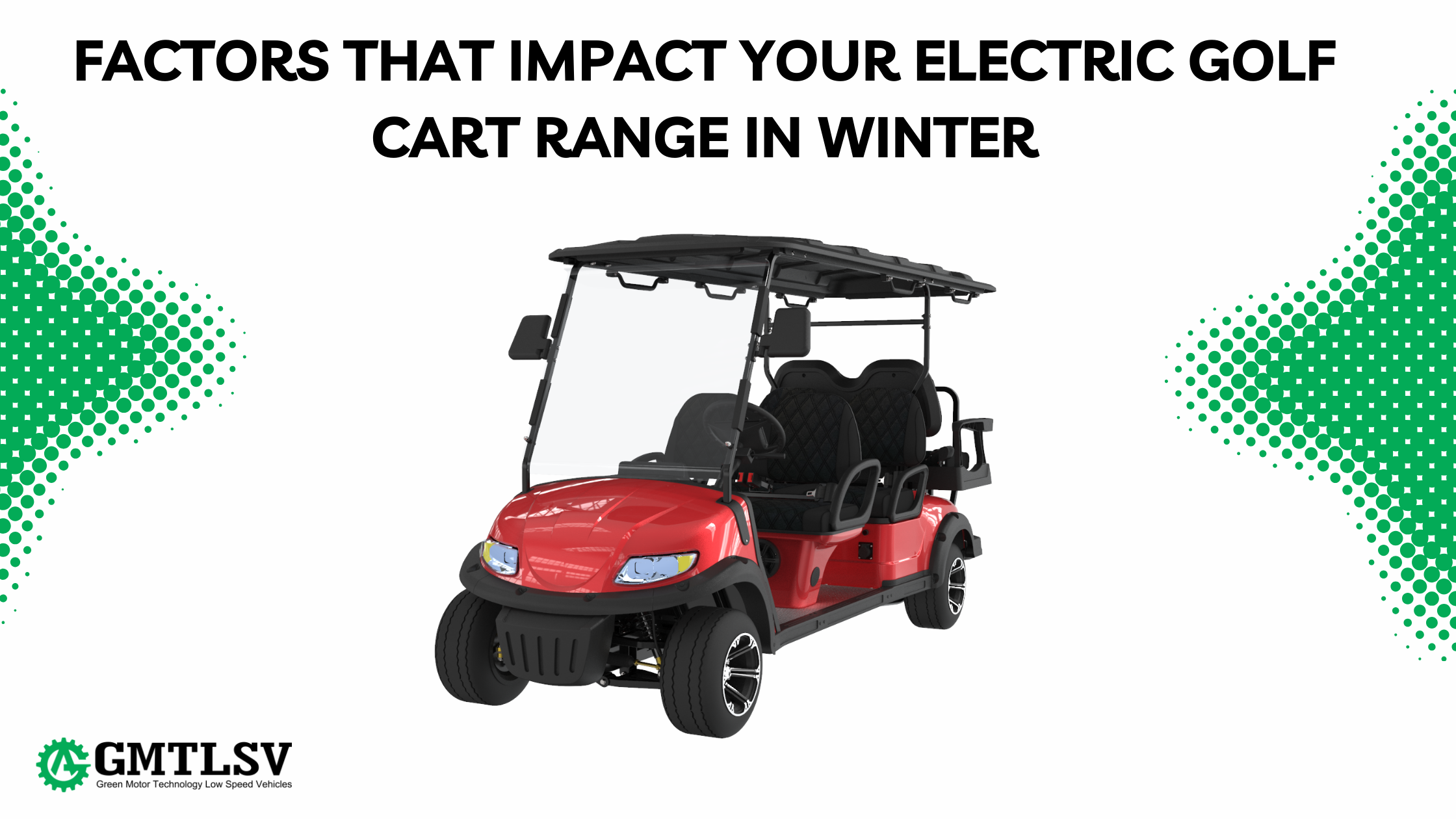
Cold temperature is the headline. But it’s not the whole story.
There’s a bunch of stuff that compounds in winter. Understanding all of them helps you figure out where your range went.
1. Battery Age and Condition
This is the big one people ignore.
Your battery might perform fine all summer. It’s got maybe 70% of its original capacity, but 70% of a 40-mile range is still 28 miles. Plenty for most people.
Then winter comes.
That same battery at 70% health might only deliver 40-50% of rated capacity in the cold. Suddenly you’re looking at 16-20 miles. That changes things.
Old batteries have higher internal resistance. Cold increases internal resistance. Those two stack on top of each other.
Get your batteries load-tested before winter. Every year. Seriously. A $20 test can tell you if you’re about to have problems. Most golf cart dealers will do this. GMT’s service team can do it in minutes.
If your batteries are marginal going into winter, you have a decision to make. Replace now or gamble. I’d replace now.
2. Terrain and Driving Conditions
Where you drive matters more in winter.
Hills drain batteries faster — that’s true year-round. But cold batteries can’t deliver peak power as easily, so hills hit harder in winter. That steep driveway might take 3% of your battery in summer and 5% in January.
Then there’s the surface. Wet pavement, gravel, snow-covered paths, even damp grass — all increase rolling resistance. Your motor works harder. Battery drains faster.
Ice is the worst. Not just because of safety, but because traction control systems (if your cart has them) pulse the brakes and motor constantly. That eats power.
If you have a choice of routes in winter, take the flatter one.
3. Speed and Driving Habits
Here’s something people don’t want to hear: slow down.
Battery drain isn’t linear with speed. It’s closer to exponential. Going 20 mph doesn’t use double the power of going 10 mph — it might use three or four times as much.
In cold weather, this effect is amplified because the battery is already stressed.
Aggressive acceleration is the real killer. Flooring it from a stop asks the battery to deliver maximum current exactly when it least wants to. In cold weather, the battery voltage sags more under heavy load. You feel the cart hesitate. That’s the battery struggling.
Smooth acceleration. Consistent speed. Coast when you can. These habits might add 20-30% to your winter range. That’s not nothing.
4. Additional Electrical Loads
Your cart is an electric golf cart. Everything runs on that battery. Not just the motor.
In winter, what do people use? Heaters. Heated seats. Headlights because it gets dark at 5pm. Windshield defrosters. Phone chargers.
Each accessory pulls power. Rough estimates:
- Heater: 150-500 watts
- Heated seats: 40-80 watts per seat
- Headlights: 30-100 watts depending on type
- Radio/speakers: 20-50 watts
- USB chargers: 10-25 watts
A 500-watt heater running for an hour takes meaningful capacity from a 5-6 kWh battery pack. You might lose 10% of your range just keeping warm.
I’m not saying don’t use them. I’m saying know that you’re trading range for comfort. Sometimes that’s the right trade.
5. Tire Pressure and Type
Tires lose about 1 PSI for every 10°F drop in temperature. That’s real physics. Air contracts when it’s cold.
If your tires were at 20 PSI in September when it was 70°F, and now it’s 30°F, they might be at 16 PSI. That’s 20% underinflated.
Underinflated tires increase rolling resistance. Studies show that every 1 PSI below optimal can reduce efficiency by 0.2-0.3%. Doesn’t sound like much, but 4 PSI low across all four tires? That’s 3-5% range loss. On top of everything else.
Check your tire pressure every week in winter. Or at least every couple weeks. Takes two minutes.
Most golf cart tires should run 18-22 PSI, but check your specific tires. It’s printed on the sidewall.
6. Wind Resistance and Weather Conditions
Cold fronts bring wind. And wind is the enemy of efficiency.
A steady 15 mph headwind can reduce your range by 10-15%. That’s been measured in electric vehicles, and golf carts are even more susceptible because they’re lighter and have worse aerodynamics.
Enclosures help. They block the wind and keep you warmer. But they also add weight and create a bigger sail in crosswinds. Trade-offs.
If it’s really windy and you don’t need to take the cart out, maybe don’t. Save the range for calmer days.
Maximizing Your Electric Golf Cart Range in Cold Weather
Enough about the problems. Let’s talk about solutions.
You can’t change the weather. But you can change how you deal with it.
Pre-Winter Battery Maintenance
Do this in fall. Before it gets cold.
- Get a load test. Find out your actual battery health. If capacity is below 70%, winter is going to be rough.
- Fully charge your batteries. A full battery resists freezing better than a depleted one. For lead-acid, a 50% charged battery can freeze at 0°F. A fully charged battery won’t freeze until -75°F.
- Clean the terminals. Corrosion adds resistance. Resistance wastes power. Wire brush, baking soda solution, protective spray. Takes 20 minutes.
- Check water levels (lead-acid only). Top off with distilled water if needed. Low water = damaged plates = dead cells.
- Inspect cables and connections. Loose connections cause voltage drop. Tighten everything.
- Consider a battery blanket. For really cold climates, insulated battery wraps or heated blankets help. $50-150 investment.
GMT dealers can do a full winterization service. Worth it if you’re not the DIY type.
Optimal Charging Practices for Cold Weather
How you charge matters as much as how you drive.
Location matters. Charge in a garage if you can. Even an unheated garage is warmer than outside. Every degree helps.
Never charge a frozen battery. If the battery is below 32°F, let it warm up first. Charging a frozen lead-acid battery can crack the case. Charging a frozen lithium battery can cause internal damage. Just wait.
Use a smart charger. Modern chargers adjust their output based on temperature and battery state. Dumb chargers just push power regardless. Smart chargers are worth the upgrade.
Charge more frequently. In winter, don’t run your batteries all the way down. Keeping them above 50% reduces stress. Partial charges are fine and actually better than deep cycles in cold weather.
The 20-80% rule for lithium. If you have lithium batteries, try to keep state of charge between 20% and 80% in winter. Full charges and full discharges stress the cells more in cold temperatures.
Charge after driving, not before. The battery is warmer right after you use it. That warmth helps it accept charge better. Charge when you get home, not the next morning.
Storing Your Golf Cart During Winter
Not everyone uses their cart year-round. If you’re storing it, do it right.
Indoor is better. Always. A garage, a barn, anything with a roof and walls. Temperature swings are smaller inside.
Keep it charged. Don’t just park it and forget it. Batteries self-discharge over time. A lead-acid battery sitting for 3 months uncharged will sulfate and die. Check monthly. Top off if below 80%.
Or use a maintenance charger. A float charger or battery tender keeps the battery at optimal charge without overcharging. Set it and forget it. Well worth the $30-50.
Disconnect if you can’t maintain it. If you’re leaving for 4+ months and can’t plug in a maintainer, disconnect the negative terminal. This stops parasitic drain but doesn’t stop self-discharge.
Never store a dead battery in freezing temps. This kills batteries. It will freeze, expand, and crack. Expensive lesson.
Cover it. A breathable cover keeps dust and moisture off. Don’t use a plastic tarp directly on the cart — it traps moisture.
Driving Techniques to Preserve Range
Small changes add up.
Warm up the battery before heavy use. Not like a car engine, but similar idea. Take it easy for the first few minutes. Let the battery warm up internally from use. Then drive normally.
Drive slower. Yeah, I said it before. But it’s the single most effective thing you can do. 15 mph instead of 25 mph might double your range. Seriously.
Avoid jackrabbit starts. Smooth acceleration. Every time.
Plan shorter routes. Don’t push the range in winter. If you need 20 miles, and you’ve only got 22 miles of range, that’s too close. Find a way to charge mid-trip or take a different approach.
Turn off what you don’t need. Lights, heaters, radio — if you can do without, do without.
Use eco mode. If your cart has it, use it. It limits top speed and acceleration, which saves battery.
Coast more. When you see a stop sign ahead, let off the accelerator early. Don’t drive until you need to brake. Coasting is free. Braking wastes energy. Accelerating uses the most energy of all.
Insulation and Protection Solutions
If you’re dealing with a serious cold, insulation helps.
Battery box insulation. Foam insulation or reflective barriers around the battery compartment help retain heat. Batteries warm up during use, and insulation keeps that warmth around longer.
Heated battery boxes. For extreme climates, these exist. They’re a pad or blanket that plugs in and keeps batteries above a threshold temperature. Mostly for people in places that see 0°F regularly.
Golf cart enclosures. A full enclosure keeps wind off you and the cart. Less heater use, less heat loss. They range from $200 soft covers to $1,000+ hard enclosures.
Windshield and front cover. Even if you don’t want a full enclosure, a windshield blocks a lot of cold air.
Undercarriage skirts. These block wind from hitting the batteries and motor from below. Some carts have them stock. If not, they’re a cheap addition.
GMT has accessory options for their carts. Ask about cold-weather packages if you’re buying new.
When to Seek Professional Help
Sometimes DIY isn’t enough.
Signs you need professional help:
- Battery won’t hold charge even after proper maintenance
- Range drops more than 50% in cold weather (beyond normal loss)
- Battery warning lights come on in cold
- Cart hesitates or shuts down under load
- Visible damage to batteries (cracks, leaks, swelling)
When to consider upgrading to lithium:
- Your lead-acid batteries are 3+ years old
- You’re replacing them for the second time in 5 years
- You regularly operate below 30°F
- You need consistent range regardless of weather
- You’re tired of maintenance
The lithium upgrade costs more upfront but pays off faster if you’re in a cold climate and/or heavy user.
Professional winterization services are offered by most dealers. Battery testing, terminal cleaning, fluid check (for lead-acid), tire inspection, full charge, and storage prep. Usually $75-150. Worth it for peace of mind.
GMT’s service team knows their carts inside and out. They can diagnose problems faster and recommend the right solution — not just upsell you parts you don’t need.
GMT Golf Carts: Built for All-Season Performance
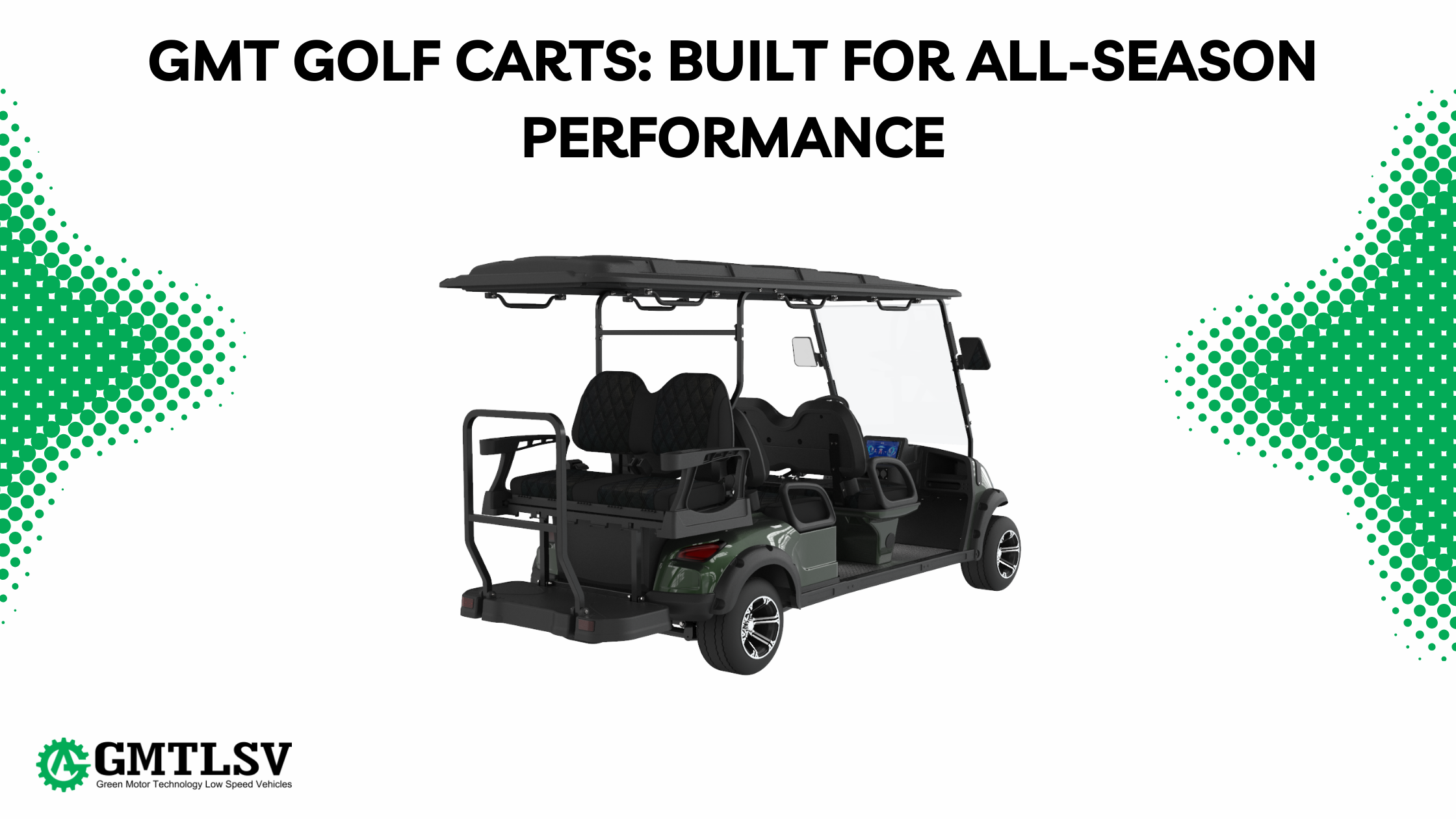
I should mention — GMT carts are built with this stuff in mind.
The frames are powder-coated steel. The electrical components are weather-sealed. They’re not fair-weather machines.
More importantly, GMT offers lithium battery options on their builds. If you’re reading this and thinking “I’m tired of dealing with lead-acid batteries dying every winter,” the lithium upgrade solves most of that. Better cold performance. Longer lifespan. Less maintenance.
GMT has customers in Minnesota, Wisconsin, Michigan — places where “cold weather” isn’t 40°F, it’s -10°F. Their carts work. People use them for neighborhood transport, property management, hunting, you name it. Year round.
If you’re shopping for a new cart and you live anywhere with real winters, talk to GMT about their cold-weather setups. Lithium batteries, enclosed cabs, heater options, the works.
Or if you’ve got an existing cart that’s struggling, their service team can evaluate what’s going on. Sometimes it’s just old batteries. Sometimes it’s something else. Either way, they can tell you.
Browse their inventory or reach out to a dealer to see what makes sense for your situation.
Can I use my electric golf cart in freezing temperatures?
Yes. With caveats.
Most electric golf carts work fine down to around 20°F. Below that, you need to be more careful.
Safe operating guidelines:
- Above 32°F: Normal operation. Expect some range loss.
- 20-32°F: Use with caution. Pre-warm the battery if possible. Expect 20-30% range reduction.
- 0-20°F: Limited use. Short trips only. Watch for voltage sag and warning lights.
- Below 0°F: Generally not recommended for lead-acid batteries. Lithium can handle it better but still with reduced performance.
The bigger concern is charging, not driving. Don’t charge a battery that’s below 32°F. Warm it up first.
What can actually get damaged: lead-acid batteries can freeze if discharged and left in the cold. Frozen batteries crack. That’s permanent damage. Keep them charged.
Will cold weather permanently damage my golf cart battery?
It can. Depends on what you do.
What causes permanent damage:
- Letting a lead-acid battery freeze (happens when discharged and exposed to low temps)
- Charging a frozen battery
- Repeated deep discharges in cold weather
- Leaving batteries uncharged in freezing temps for extended periods
What’s reversible:
- Temporary capacity loss due to cold (warms up, capacity returns)
- Slow charging acceptance in cold (resolves once battery warms)
- Sluggish performance in cold (normal once temps rise)
The key is avoiding deep discharge and freezing. If you keep your batteries above 50% charge and above 20°F, you probably won’t cause permanent damage. Below those thresholds, risk goes up fast.
Lithium batteries are more forgiving. They won’t freeze at temperatures you’d encounter in the continental U.S. But they can still be damaged by charging when too cold. Many lithium packs have built-in protection that prevents charging below a certain temperature.
How do I know if my battery is too cold to charge?
Good question. Most people have no idea.
Signs your battery is too cold:
- Battery feels cold to the touch (obvious, but people ignore this)
- Charger takes much longer than usual or shows error
- Battery temperature gauge (if you have one) shows below 32°F
- You just brought the cart in from below-freezing temps
General rule: If ambient temperature is below 32°F, and the cart has been sitting outside for more than a few hours, assume the battery is too cold.
What to do:
- Bring the cart inside if possible
- Wait 2-4 hours for battery to warm toward room temperature
- Then start charging
What NOT to do:
- Don’t try to warm the battery with a heat gun or heater pointed directly at it (fire risk)
- Don’t charge and hope for the best
- Don’t assume the charger will “figure it out”
Some smart chargers can detect battery temperature and won’t charge until safe. But not all chargers have this feature. Don’t assume yours does.
Do electric golf carts lose range faster than electric cars in cold?
Percentage-wise, it’s pretty comparable. Sometimes worse for golf carts.
Electric cars lose 20-40% of range in cold weather — that’s well documented from studies on Teslas, Leafs, etc.
Golf carts often lose 20-50%, depending on battery type and age. So yes, often worse.
Why?
- Thermal management. Electric cars have sophisticated battery heating and cooling systems. Most golf carts have… nothing. The battery just sits there in whatever temperature it is.
- Battery age and quality. EVs use cutting-edge lithium cells. Many golf carts still use lead-acid, which handles cold much worse.
- Insulation. Car batteries are typically in insulated enclosures. Golf cart batteries are often more exposed.
- Heater draw. Both lose range to cabin heating. But in a car, heating a sealed cabin is more efficient than heating a golf cart with an open or semi-open design.
That said — if you have a newer golf cart with lithium batteries, the gap narrows. You might be looking at 15-25% loss, comparable to a modern EV.
Should I upgrade to lithium batteries if I live in a cold climate?
Maybe. Here’s how to think about it.
Upgrade makes sense if:
- You use your cart year-round, including below 32°F
- You’ve replaced lead-acid batteries more than once due to cold-related damage
- Consistent range matters to you (work, community transport, etc.)
- You want less maintenance
- You’re planning to keep the cart 5+ years
Upgrade might not be necessary if:
- You only use the cart April-October
- You properly store and maintain the cart in winter
- Your current batteries are new and performing fine
- Budget is tight and current setup works
The math:
Lead-acid batteries cost $800-1,500 for a set. Last 3-5 years typically. In cold climates with poor maintenance, sometimes only 2-3 years.
Lithium batteries cost $2,000-5,000+ depending on capacity and brand. Last 8-15 years typically. Less affected by cold, so lifespan holds even in harsh climates.
If you’re replacing lead-acid every 3 years at $1,000 per set, you spend $3,000 over 9 years. A $3,500 lithium pack that lasts 12 years is actually cheaper long-term. Plus better performance the whole time.
GMT offers financing on battery upgrades and new carts. If the upfront cost is the hangup, ask about options.
Look, cold weather is going to reduce your electric golf cart range. That’s just how it is. You can’t change physics. But you can prepare for it. Maintain your batteries. Store it right. Drive smart. And if you’re in a really cold climate, consider lithium.


