

Electric golf carts have come a long way. Like, seriously far.
I’ve been following this market for years now, and 2026 models? They’re different. Better batteries. Smarter tech. More range. It’s not even close to what we had five years ago.
Here’s the thing — buying a golf cart isn’t simple anymore. There’s a lot to wade through. Lithium versus lead-acid. Street-legal versus golf-course-only. Two-seaters, four-seaters, eight-seaters. Touchscreens, GPS, Bluetooth. It gets overwhelming fast.
So I put this guide together. We’ll cover what features actually matter in 2026, walk through my top picks across different categories, look at the brands worth your money, and answer the questions I see people asking all the time.
Whether you’re buying for the course, your neighborhood, or your property — there’s a cart here for you.
Let’s get into it.
Key Features to Look for in 2026 Electric Golf Carts
2026 models aren’t just incremental upgrades. A few things actually changed this year.
Battery tech made another leap. Charging is faster. Smart features went from “nice to have” to pretty standard on anything mid-range or higher. And manufacturers are finally taking safety more seriously — you’ll see better lights, better brakes, actual seat belts that don’t feel like an afterthought.
Here’s what to pay attention to.
1. Battery Technology & Range
This is the biggest decision you’ll make. Everything else flows from it.
Lithium-ion is where the market’s headed. Lighter, lasts longer, charges faster, basically zero maintenance. Most 2026 lithium carts get somewhere between 30-50 miles per charge. Some higher-end models push past that.
Lead-acid is still around, mostly in budget models. Cheaper upfront, sure. But heavier, slower to charge, and you’ll replace them sooner. Maybe 15-25 miles per charge in real-world use.
Charging times dropped again this year. A full lithium charge takes 4-6 hours on most models. Some have fast-charge options that get you to 80% in under 3 hours. Lead-acid? Still 8-12 hours.
Battery lifespan matters too. Lithium packs last 8-10 years or more with decent care. Lead-acid, you’re looking at 3-5 years, maybe 6 if you’re religious about maintenance — watering them, keeping them charged, all that.
If you can swing the extra cost upfront, go lithium. It’s not even a debate anymore.
2. Motor Power & Performance
Most electric golf carts run AC motors now. They’re more efficient, last longer, and give you better torque than the old DC setups.
You’ll see motor ratings anywhere from 3 HP on basic models up to 10+ HP on performance-focused carts. For flat courses and neighborhoods, 5 HP is plenty. If you’ve got hills or want to haul stuff, look for something in the 7-10 HP range.
Torque matters more than horsepower for hill climbing. Manufacturers don’t always publish torque specs, which is annoying. But if a cart’s marketed as good for hilly terrain, they’ve usually tuned it for that.
Speed options:
- Standard golf carts top out around 12-15 mph
- High-speed or “lifted” models hit 20-25 mph
- LSVs (Low Speed Vehicles) are capped at 25 mph for street legality
Think about where you’ll actually drive it. If it’s just the golf course, you don’t need a speed demon. If you’re taking it on public roads, you’ll want an LSV-rated model anyway.
3. Seating Capacity & Configuration
Pretty straightforward, but think carefully about this one.
2-seaters are classic. Nimble, lighter, easier to park. Great for couples or solo use.
4-seaters are the sweet spot for most people. Family use, bringing friends, enough room without being massive. Some have flip-down rear seats that convert to a cargo bed, which is genuinely useful.
6-seaters and up — you’re getting into people-mover territory. Great for resorts, large families, or hauling groups around properties. Just know they’re longer, heavier, and less maneuverable.
Bench seats versus bucket seats is mostly preference. Buckets feel more secure, benches fit more people. Some 2026 models have upgraded cushioning that actually makes a difference on longer rides.
4. Smart Technology & Connectivity
This is where 2026 models really show off.
GPS is showing up in more carts now, not just premium ones. Course management, tracking, even some fleet management features if you’re running multiple carts.
Bluetooth audio is basically standard on anything mid-range. Built-in speakers, phone connectivity, decent sound. Nice for cruising around.
USB charging ports — look for multiple. People have phones, tablets, whatever. More ports = fewer fights.
Digital displays are replacing analog gauges. Battery percentage, speed, trip distance, sometimes even diagnostics. Some have touchscreens now. Not sure they’re necessary, but they look cool.
Smartphone apps are the new thing. Monitor your cart remotely, check battery status, get service alerts. Some even have anti-theft tracking. Worth having.
Security features improved too. Keyless ignition, PIN codes, GPS tracking, alarms. If you’re parking somewhere visible, these matter.
5. Safety Features
Golf carts got safer in 2026. Finally.
Seat belts — actually standard now on most models. They used to be optional. Still see some cheaper models skip them.
Lighting got better. LED headlights, taillights, brake lights. Some models have turn signals built in. If you’re driving at dusk or on roads, this stuff matters.
Brake systems are more robust. Look for four-wheel hydraulic brakes on higher-end models. The cheaper carts still use drum brakes on the rear only, which work fine but don’t inspire confidence.
Speed limiters come standard on most. Adjustable on some. Good for family use or fleet management.
Backup cameras and alarms are showing up more often, especially on larger carts. Not essential, but helpful if you’re maneuvering in tight spaces.
6. Build Quality & Durability
Cheap carts feel cheap. You’ll know it when you sit in one.
Frame materials — aluminum is lighter and rust-resistant. Steel is stronger and cheaper. Good manufacturers treat their steel properly. Cheap ones don’t. Ask about the coating and rust protection.
Weatherproofing varies wildly. If you’re leaving this outside or live somewhere humid, pay attention. Sealed battery compartments, corrosion-resistant hardware, covered electrical components.
Suspension makes a real difference in ride quality. Basic carts have leaf springs. Better ones have independent suspension or at least upgraded shocks. If your terrain is rough, don’t cheap out here.
Tires — most come with standard turf tires. Fine for courses and flat ground. If you’re going off-pavement, look for all-terrain options or plan to upgrade.
Build quality separates a cart that lasts 10+ years from one that falls apart in 5. It’s worth paying a bit more upfront.
Best Electric Golf Carts for 2026: Our Top Picks
These picks balance performance, features, reliability, and price. Different carts for different needs. No one cart is best for everyone.
Here’s what made the cut.
1. GMT GAH4 (4-Seater) — Best Overall Electric Golf Cart
The GAH4 nailed it.
This is the cart I’d buy if I could only pick one. It does everything well without any glaring weaknesses. That’s rare in this market.
What you get: 4-seater with a lithium battery pack, around 40-50 miles of range depending on terrain. AC motor with plenty of torque for hills. Digital display. Bluetooth audio. USB ports front and rear. LED lighting package. Solid suspension.
The build quality is genuinely good. Aluminum frame, powder-coated. Feels sturdy without being heavy.
Price range: Mid-range, typically $10,000-$13,000 depending on configuration.
Best for: Families, residential communities, golf course members who want something better than the course carts.
It’s not the cheapest. It’s not the most luxurious. But it hits the value sweet spot better than anything else I’ve tested.
2. Club Car Tempo — Best Budget Electric Golf Cart
Club Car’s been making carts forever. The Tempo is their answer to “give me something reliable without all the fancy stuff.”
And honestly? It delivers.
What you get: Basic but solid. Lead-acid battery standard (lithium upgrade available). 2 or 4 seat configurations. Around 25-35 miles range depending on battery. Good ergonomics. Decent suspension. The essentials done right.
Price range: Budget-friendly, $6,000-$9,000 base.
Best for: Golf-course-only use, buyers on a strict budget, people who value simplicity over features.
3. Garia Via Golf+ Buggy — Best Premium/Luxury Electric Golf Cart
This one’s for people who want the best and don’t mind paying for it.
Garia’s a Danish company. They build carts like Europeans build cars — obsessive attention to detail, premium materials, and features you didn’t know you wanted.
What you get: Automotive-grade construction. Lithium battery with impressive range. Built-in refrigerator. Touchscreen display. High-end audio. Leather seats on some trims. GPS. The fit and finish is on another level.
Is it overkill for most people? Probably. Does it feel amazing to drive? Absolutely.
Price range: Premium tier, $15,000-$25,000+.
Best for: High-end residential communities, luxury resorts, buyers who want the best available.
If money isn’t the deciding factor, this is as good as golf carts get.
4. GMT GAH2 (2-Seater) — Best for Golf Courses
Back to GMT for this one. The GAH2 is their compact workhorse.
What you get: Purpose-built for golf. Tight turning radius, quiet operation, turf-friendly tires. Lithium battery, 35-45 miles range. Built-in cooler space. Bag storage designed for actual golf bags. Scorecard holder. Simple and functional.
It feels like someone who actually plays golf designed it. Little touches that make sense once you’re on the course.
Price range: $8,000-$11,000.
Best for: Serious golfers, couples who play together, anyone buying primarily for course use.
If golf is the main event, this cart was made for you.
5. EZGO Express L6 — Best for Personal/Residential Use
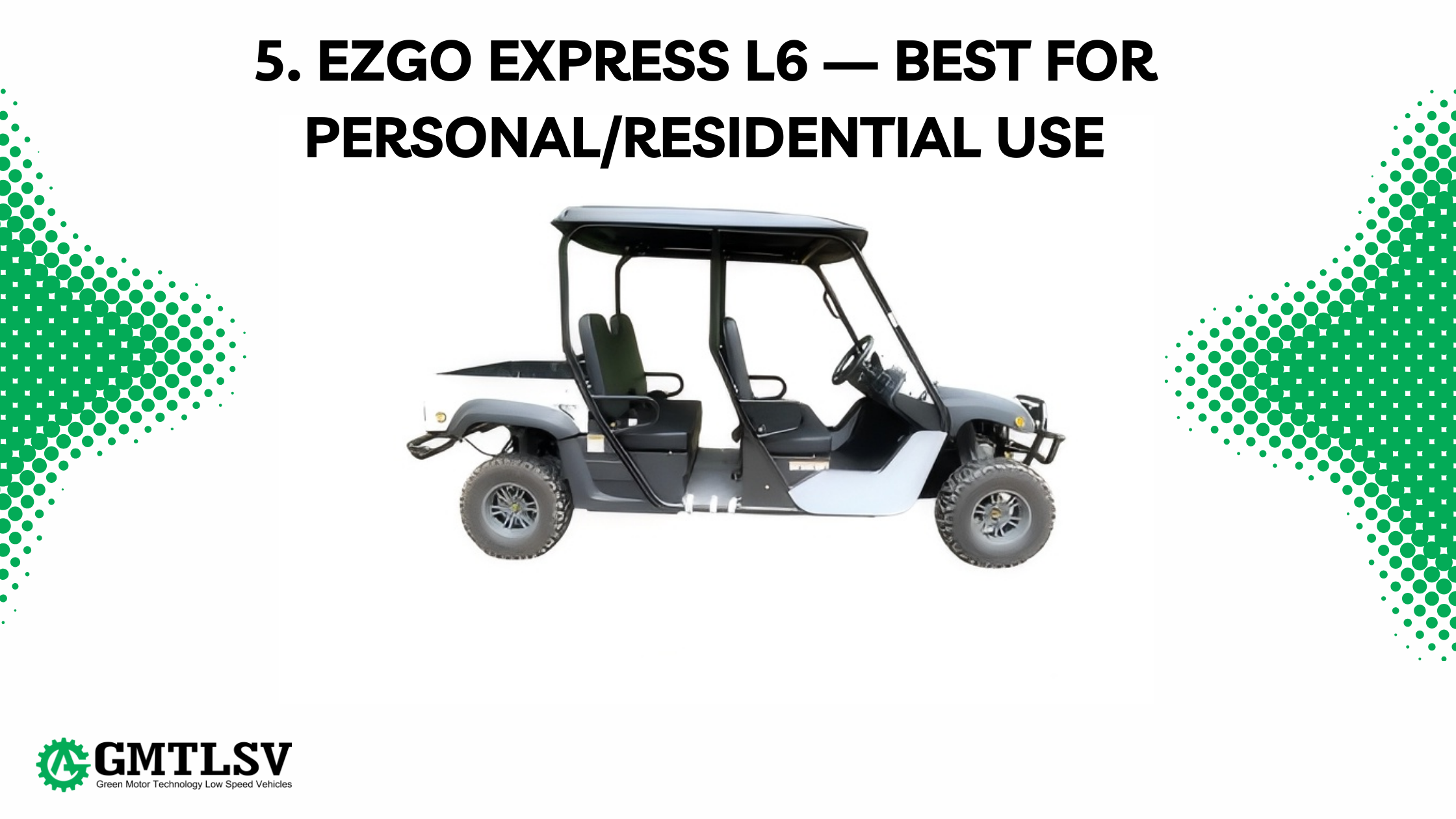
E-Z-GO is one of the legacy brands. The Express L6 is their utility-focused offering.
What you get: Street-legal capable (LSV spec). 6-seater capacity. Good cargo bed option with fold-down rear seats. 30-40 miles range. Headlights, turn signals, mirrors — the works for road use. Decent tech package.
This is the cart for people who want transportation, not just golf.
Price range: $11,000-$14,000.
Best for: Neighborhood driving, gated communities, people who need to carry stuff, street-legal requirements.
It’s not exciting. It’s practical. Sometimes that’s exactly what you need.
6. GMT GAH2+2 (4-Seater) — Best High-Performance Electric Golf Cart
Want something faster? GMT built this for you.
What you get: Performance-tuned motor with more HP than standard models. Enhanced suspension for higher speeds and rougher terrain. Sporty design. Lithium battery. Still seats 4, but the focus here is driving feel.
Price range: $12,000-$16,000.
Best for: Speed enthusiasts, people with larger properties, anyone who wants their cart to feel a little special.
Not everyone needs this much cart. But if you want it, it’s excellent.
7. GMT GAH6+2 (8-Seater) — Best for Large Groups/Families
Sometimes you need to move a lot of people.
What you get: Eight seats total. Lithium battery sized for the extra weight. Extended frame with good stability. Multiple rows with reasonable legroom. Storage for everyone’s stuff. Higher capacity suspension.
It’s basically a small shuttle bus at this point. But for the right use case, nothing else works.
Price range: $16,000-$22,000.
Best for: Large families, resorts, event venues, anyone regularly moving groups.
Niche? Sure. But when you need it, you need it.
Top Electric Golf Cart Brands in 2026
Brand matters in this market. Not for status — for support, parts, reliability, and resale.
Here’s who’s worth knowing.
GMTLSV
GMT has been gaining ground fast. They focus on electric-only, which means no divided attention between gas and electric like some legacy brands.
Their build quality improved a lot over the past few years. Competitive pricing. Good feature sets. Growing dealer network.
If you’re open to newer brands, GMT delivers serious value.
Known for: Feature-rich models, lithium battery standard, strong price-to-value ratio.
Price range: Mid to mid-high. $8,000-$20,000 depending on model.
E-Z-GO (Textron)
One of the “big three” traditional brands. Owned by Textron, which is massive. They’ve been making carts since the 1950s.
E-Z-GO has the service network, the parts availability, and the track record. Their carts are reliable workhorses. Not always the most innovative, but consistently solid.
Known for: Reliability, widespread service availability, fleet options.
Price range: Budget to mid-high. $6,000-$15,000.
Yamaha Golf Carts
Another legacy brand. Yamaha brings their manufacturing quality from motorcycles and other equipment. That shows in the build.
They’re particularly popular for course use. Reliable, efficient, durable. Not flashy, but they last.
Known for: Build quality, efficiency, long-term reliability.
Price range: Mid-range. $8,000-$14,000.
Star EV
Star EV carved out space by focusing on features and customization. They offer a ton of options — colors, seats, upgrades. Good if you want something personalized.
Quality has been solid. Growing reputation.
Known for: Customization options, feature variety, value pricing.
Price range: Budget to mid. $7,000-$13,000.
Evolution Electric Vehicles
A relatively newer brand that’s made noise with modern designs and strong feature sets. They look sharper than most competitors.
Known for: Modern styling, tech features, competitive pricing.
Price range: Mid-range. $9,000-$15,000.
How much do electric golf carts cost in 2026?
Depends heavily on what you’re buying.
Budget tier: $5,000-$8,000. Basic features, often lead-acid batteries, smaller capacity. Gets the job done.
Mid-range: $8,000-$12,000. This is where most buyers land. Lithium batteries, decent features, reliable brands. Best balance for most people.
Premium: $12,000-$20,000+. High-end features, luxury materials, top-tier performance. Nice if you can swing it.
Price swings based on battery type, seating capacity, brand, features, and whether it’s LSV-rated.
How far can electric golf carts travel on a single charge?
Lithium battery carts: 30-50 miles typically. Some premium models push higher.
Lead-acid carts: 15-25 miles in real-world use.
That said — terrain matters. Hills drain batteries faster. Cold weather reduces range. Heavy loads (more passengers, cargo) pull it down too. And speed affects efficiency.
Flat course on a mild day with two people? You’ll hit the upper end of the range. Hilly neighborhood with four adults and cargo? Expect less.
Can electric golf carts be driven on public roads?
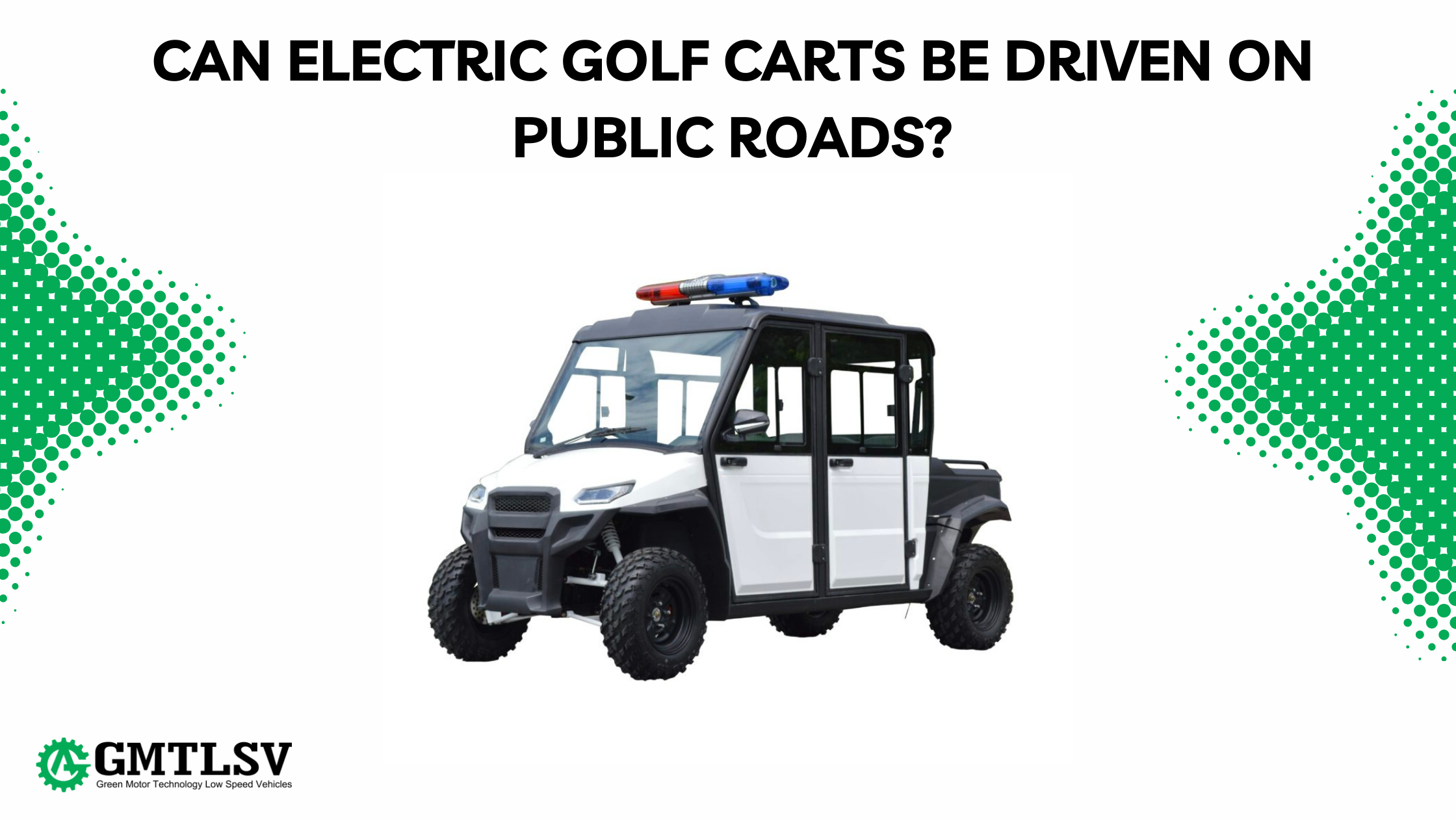
Sometimes. It depends on the cart and where you live.
LSVs (Low Speed Vehicles) are street-legal in most states on roads with speed limits of 35 mph or less. They need specific equipment: headlights, taillights, turn signals, mirrors, seat belts, DOT-approved windshield, VIN number, and registration.
Standard golf carts — usually no. They lack the safety equipment and can’t be registered.
Rules vary by state and even by municipality. Some areas are very golf-cart-friendly (Florida, Arizona communities, resort areas). Others are stricter.
Check your local laws before assuming you can drive on roads.
What is the top speed of electric golf carts?
Standard golf carts: 12-15 mph. Typical course carts.
High-speed models: 19-25 mph. Modified or performance-focused.
LSVs: Capped at 25 mph by federal regulation.
You can modify carts to go faster. Some people do. Just know it might void warranties and create liability issues. And anything over 25 mph can’t be street-legal as an LSV.
How long does it take to charge an electric golf cart?
Lithium batteries: 4-6 hours for a full charge. Some have fast-charge options that hit 80% in 2-3 hours.
Lead-acid batteries: 8-12 hours for full charge. Overnight charging is standard.
Charger quality matters. Higher-amp chargers are faster but cost more. Most people just plug in overnight and don’t worry about it.
Do electric golf carts require a driver’s license?
On private property: No license needed. Anyone can drive (though manufacturers recommend age 16+).
On public roads (LSVs): Yes, you typically need a valid driver’s license. Most states treat LSVs like slow-moving motor vehicles. No special license, but a standard one is required.
Some states have age requirements even on private courses or communities. Check local rules.
What maintenance do electric golf carts need?
Less than gas carts. Way less.
Regular maintenance:
- Check tire pressure
- Inspect brakes
- Clean battery terminals (especially lead-acid)
- Water lead-acid batteries
- Check for loose bolts and connections
- Clean the cart regularly
- Lubricate moving parts occasionally
Lithium carts need even less. No watering. Less terminal corrosion. Fewer maintenance tasks overall.
Annual professional checkups are still a good idea. They’ll catch things you might miss.
Are electric golf carts good in cold weather?
They work, but expect reduced performance.
Battery range drops in cold. Lithium handles cold better than lead-acid, but both lose capacity. Expect 10-30% less range depending on how cold it gets.
Cold affects charging too. Batteries charge slower in cold temps. Some chargers won’t work below certain temperatures.
Storage matters. If you’re storing for winter, keep batteries charged (50-80% for lithium, full for lead-acid) and store somewhere temperature-controlled if possible.
Cold isn’t a dealbreaker. Just know what to expect.


