

Here’s something most golf cart owners don’t realize. You might be leaving money on the table.
Solar-powered golf carts have gotten pretty popular lately. And I get it. You slap some panels on top, extend your range, cut down on charging costs. Makes sense. But the part people miss? There are actual tax credits and incentives for this stuff.
We’re talking about federal programs. State rebates. Sales tax exemptions. Property tax breaks. It adds up.
The Federal Investment Tax Credit alone can knock off a solid chunk of your solar equipment costs. Some states pile on even more. California, Arizona, Florida — they all have programs that can save you hundreds, sometimes thousands.
And look, I’ll be honest with you. The rules aren’t always crystal clear. Golf carts sit in this weird gray area. They’re not quite cars. Not quite… appliances? The tax code wasn’t really written with solar golf carts in mind.
But that doesn’t mean you can’t benefit.
Whether you’re a homeowner with a cart in a golf community, a business running a fleet, or a golf course looking to go green — there’s probably something here for you. Environmental benefits plus financial savings. That’s the combo everyone wants.
Let me break down what’s actually available.
What Are Solar Golf Cart Tax Credits?
Solar golf cart tax credits are exactly what they sound like. Financial incentives from the government — federal or state — designed to make solar-powered vehicles more affordable.
The idea is simple. The government wants more people using clean energy. So they offer credits to offset your costs.
Here’s the important distinction though. A tax credit is not the same as a tax deduction.
A deduction reduces your taxable income. A credit reduces your actual tax bill. Dollar for dollar. Way better.
So if you owe $2,000 in federal taxes and you have a $600 solar credit? You now owe $1,400. That’s real money back.
Who qualifies? It depends on the program, but generally:
- Individual homeowners
- Businesses
- Golf courses
- Resorts
- Retirement communities
Basically anyone buying or installing solar equipment on golf carts. The specifics vary. But the opportunity is there.
Understanding the Federal Investment Tax Credit (ITC) for Solar Golf Carts
Okay, this is where things get interesting. And a little complicated.
The Federal Investment Tax Credit was created for solar energy systems. Think rooftop panels. Solar farms. That kind of thing.
But the language is broad enough that solar panels on vehicles — including golf carts — can sometimes qualify.
The keyword there is “sometimes.”
It depends on how the system is set up. What it’s connected to. How it’s used. I’ll get into the details below.
What is the Federal Solar Investment Tax Credit?
The Federal ITC has been around since 2006. It’s gone through a bunch of changes over the years.
Here’s where it stands now:
As of 2024, the credit is 30% of the cost of your solar equipment. That’s thanks to the Inflation Reduction Act, which extended and boosted the program.
So if you spend $1,000 on solar panels for your golf cart, you could potentially claim a $300 credit on your federal taxes.
It’s a dollar-for-dollar reduction. Not a deduction. An actual credit.
The current 30% rate is scheduled to stay through 2032. Then it steps down:
- 2033: 26%
- 2034: 22%
- 2035 and beyond: Uncertain (likely expires for residential, may continue for commercial)
So there’s a window here. The incentive is strongest right now.
How to Claim the Federal ITC for Your Solar Golf Cart
Here’s the process:
Step 1: Save everything.
Receipts. Invoices. Specifications for the solar panels. Installation records. Photos. All of it.
You need to prove what you bought, what it cost, and that it’s actually solar equipment.
Step 2: Use IRS Form 5695.
That’s the Residential Energy Credits form. Part I covers the solar investment tax credit.
If you’re claiming as a business, you’ll use different forms — likely Form 3468 (Investment Credit) and attach it to your business return.
Step 3: Calculate your credit.
Take the total cost of your solar equipment (panels, charge controllers, installation labor specifically for solar). Multiply by 30%.
Don’t include the cost of the golf cart itself. Just the solar components.
Step 4: File with your return.
The credit applies to the tax year when the system was placed in service. Not when you bought it — when it was installed and operational.
Step 5: Keep records for at least 3-5 years.
The IRS can audit. You want documentation ready.
Honestly, I’d recommend working with a tax professional for this. Especially if it’s your first time claiming energy credits. The rules are specific, and mistakes can trigger issues.
Federal EV Tax Credits for Electric Golf Carts
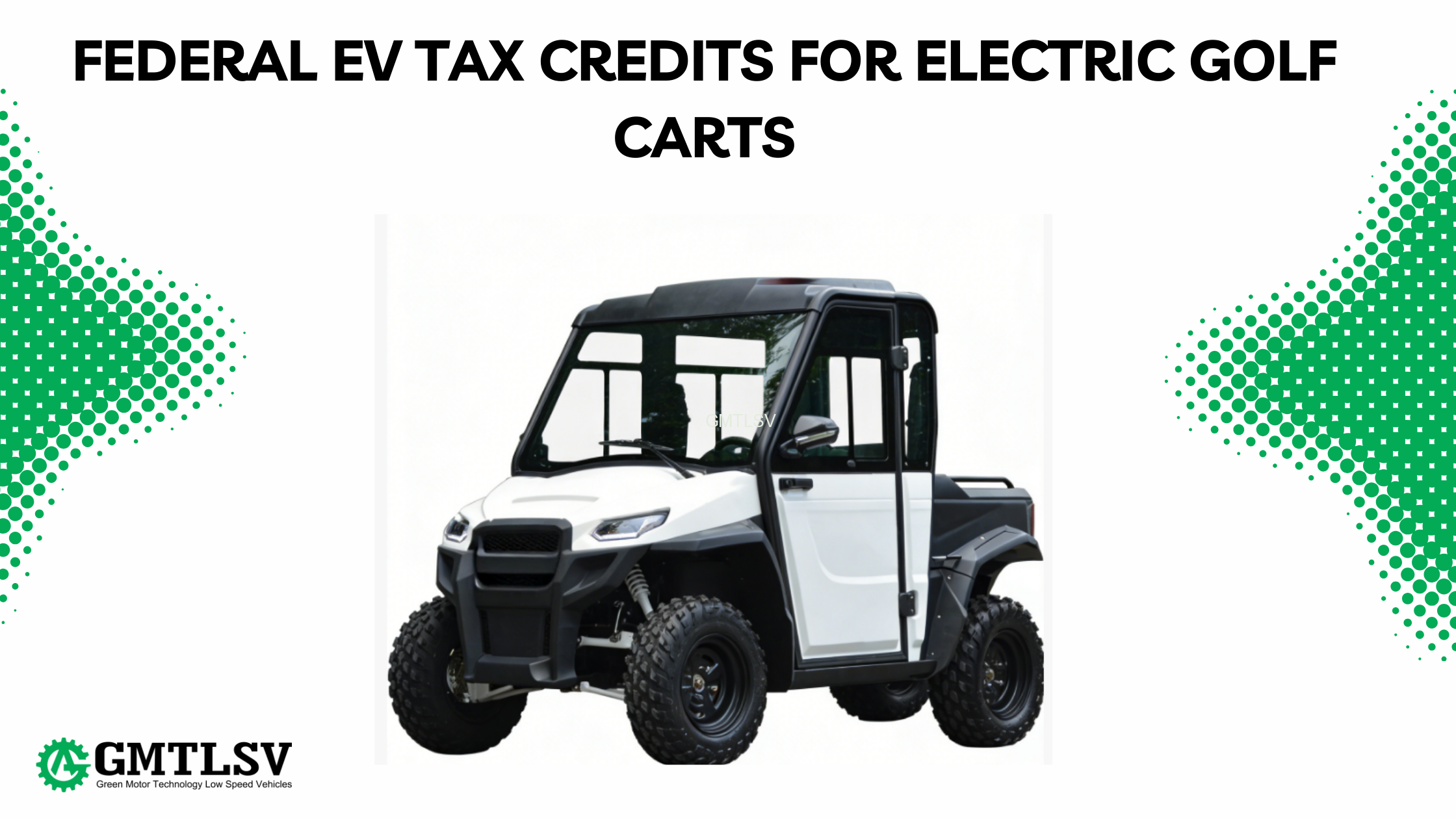
Let’s address this directly because it comes up a lot.
Can you claim the federal EV tax credit (the one that gives you up to $7,500 for electric vehicles) on a golf cart?
Almost certainly not.
Here’s why.
The federal EV credit (under Section 30D of the tax code) has specific requirements. The vehicle needs to:
- Be manufactured primarily for use on public streets
- Have a gross vehicle weight rating under 14,000 pounds
- Meet certain battery capacity requirements
- Be made by a qualified manufacturer
Standard golf carts don’t qualify. They’re classified as Low-Speed Vehicles (LSVs) or just off-road vehicles. They’re not designed for highway use. Most can’t even legally go on public roads without modifications.
What about street-legal golf carts?
Some golf carts are modified to become LSVs — with headlights, turn signals, seat belts, etc. These can legally operate on roads with speed limits of 35 mph or less.
But even then, they typically don’t meet federal EV credit requirements. The battery specs, manufacturer qualifications, and intended use criteria usually exclude them.
So if you’re counting on that $7,500 EV credit for your golf cart? Don’t.
The solar ITC is your better bet. Focus there.
State-Level Solar Golf Cart Tax Credits and Incentives
Here’s where things get more interesting.
States have their own programs. And some are pretty generous.
The catch? They vary wildly. What’s available in California isn’t available in Texas. What Florida offers, New York doesn’t. You have to check your specific state.
Types of state incentives include:
- State tax credits (similar to federal, but state-level)
- Direct rebates (cash back, essentially)
- Sales tax exemptions (no tax on solar equipment purchases)
- Property tax exclusions (solar upgrades don’t increase your property tax)
Some states stack multiple incentives. So you could potentially get a federal credit, a state credit, AND a sales tax exemption. That’s when the savings really add up.
Top States Offering Solar Golf Cart Incentives
Let me run through the major ones:
California
- Self-Generation Incentive Program (SGIP) offers rebates for energy storage systems
- State tax credits available for solar installations
- Local utility rebates vary by provider
- Generally the most robust incentive structure in the country
To apply, you typically go through your utility or a state-approved installer.
Arizona
- State solar tax credit up to $1,000 for residential systems
- Sales tax exemption on solar equipment
- Strong net metering policies if your cart system connects to home storage
Florida
- 100% sales tax exemption on solar equipment
- Property tax exclusion — solar installations don’t increase assessed value
- No state income tax, so no state credit, but the exemptions are valuable
New York
- State tax credit of 25% (up to $5,000) for solar installations
- NYSERDA programs offer additional rebates
- Can stack with federal ITC
Hawaii
- State tax credit of 35% for solar systems
- One of the highest state incentives in the country
- Makes sense given electricity costs there
Texas
- No state income tax, so no state credit
- BUT — property tax exemption for solar equipment value
- Franchise tax deductions for businesses
- Some local utility rebates in certain areas
Colorado
- State tax credit has varied over the years — check current rates
- Local rebates through utilities like Xcel Energy
- Strong overall solar policy environment
For each state, check:
- Current percentage or dollar amount
- Income or purchase limits
- Application deadlines
- Whether it applies to mobile solar installations specifically
Sales Tax Exemptions on Solar Equipment
This one’s underrated.
Several states exempt solar equipment from sales tax. That means when you buy solar panels for your golf cart, you don’t pay state sales tax at checkout.
Sounds small. But on a $1,500 solar setup, avoiding 6-8% sales tax saves you $90-$120 instantly.
States with solar sales tax exemptions include:
- Florida
- Arizona
- New Jersey
- New York
- Maryland
- Massachusetts
- And others
The exemption usually applies at point of purchase. You may need to fill out an exemption certificate or have the seller document it properly.
Does it apply to DIY conversions? Usually, yes — if you’re buying the equipment yourself. The exemption is typically on the equipment, not the installation type.
Factory-installed systems should qualify automatically when purchased in exempt states.
State Rebate Programs for Solar-Powered Vehicles
Some states offer straight-up rebates. Not credits against your taxes — actual cash back or point-of-sale discounts.
The difference matters.
A tax credit requires you to have tax liability to use it. A rebate is money in your pocket regardless.
States with rebate programs for solar equipment include California (through SGIP and utility programs), New York (through NYSERDA), and some local utility districts in other states.
Application processes vary:
- Some require pre-approval before purchase
- Some reimburse after installation
- Timelines can be weeks to months
- Many have annual caps or funding limits
Income-based qualifications exist in some programs — lower income households sometimes get higher rebates.
For businesses, there are often separate commercial tracks with different amounts.
Rebate ranges can be anywhere from $100 to several thousand dollars depending on system size and program specifics.
Property Tax Incentives for Solar Golf Carts
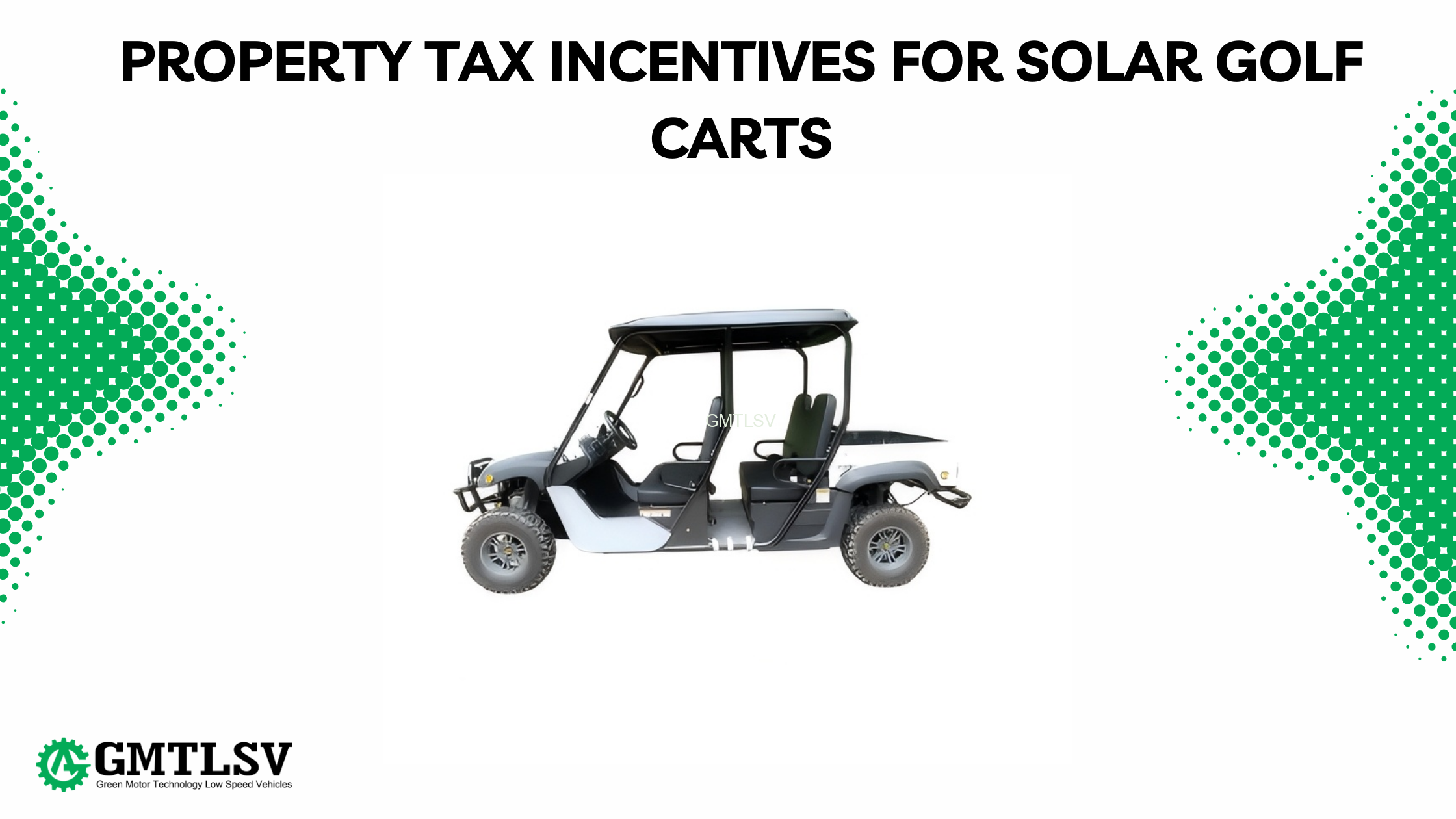
Here’s one that benefits golf courses and businesses especially.
Many states exclude solar equipment from property tax assessments. What does that mean?
Normally, when you improve your property, the assessed value goes up. Higher value = higher property taxes.
But if solar equipment is excluded, you can install solar systems without your property taxes increasing.
States with solar property tax exclusions include:
- Florida
- Texas
- Arizona
- New Jersey
- New York
- Massachusetts
- And many others
For golf courses and resorts running solar golf cart fleets, this is significant. You’re improving your operations without the tax penalty.
Exclusions typically last for the life of the equipment or a set number of years (often 10-20 years).
You may need to apply for the exclusion with your local tax assessor. It’s not always automatic.
Can I claim tax credits for adding solar panels to my existing golf cart?
Yes. Usually.
Retrofitting solar panels onto an existing cart can qualify for incentives, as long as you meet the requirements.
The key considerations:
- The solar equipment itself must qualify. It needs to be legitimate solar electric property — panels, charge controller, proper installation.
- You’ll need documentation. Receipts for the panels, proof of installation, specifications showing it’s a functioning solar charging system.
- Cost allocation matters. You can only claim credits on the solar equipment portion, not on any other cart upgrades you do at the same time.
For aftermarket installations, keep your invoices clean. Have the installer itemize the solar components separately if possible.
State rules vary on retrofits. Some programs are specifically for new equipment. Others cover any qualifying solar installation regardless of when the base vehicle was purchased.
Check your state’s program details before assuming you qualify.
Do I need a street-legal golf cart to qualify?
For most solar tax incentives? No.
The Federal ITC doesn’t require your golf cart to be street-legal. It cares about the solar equipment, not the vehicle classification.
State solar credits and exemptions typically work the same way. They’re focused on the solar system, not whether your cart can go on public roads.
Where street-legal status matters:
- Federal EV tax credit: Requires vehicles designed for road use. Standard golf carts don’t qualify anyway.
- Some state vehicle-specific rebates: If a program is designed for “alternative fuel vehicles” rather than solar equipment broadly, you might need LSV certification.
So generally, whether your cart is on-road legal or just used on your property or golf course — you can still claim solar equipment incentives.
That said, use cases can affect eligibility in edge cases. A cart that’s purely for personal recreation might be treated differently than one used for business purposes. Check program specifics.
What happens if my tax liability is less than the credit amount?
Good question. This trips people up.
The Federal ITC is a non-refundable credit. That means if you owe $200 in federal taxes but have a $500 credit, you don’t get a $300 refund. You just reduce your liability to zero.
But — and this is important — unused federal energy credits can often be carried forward.
For the ITC, you can typically carry forward unused credits for up to 5 years. So if you can’t use it all this year, you may be able to apply it to future tax years.
State credits vary:
- Some are refundable (you get the excess back)
- Some allow carryforward
- Some are use-it-or-lose-it
To maximize your credit:
- Time your purchase in a year when you expect higher tax liability
- If you’re close, consider accelerating other income
- For businesses, consult a tax professional about timing
Don’t let a good credit go to waste because of poor planning.
Are solar golf cart incentives available for businesses and golf courses?
Absolutely. In many cases, businesses get even better treatment.
Federal ITC for businesses:
Commercial installations qualify for the 30% ITC just like residential. But businesses can also potentially use accelerated depreciation (MACRS) on the solar equipment, adding more tax savings.
Enhanced deductions:
Section 179 and bonus depreciation rules can let businesses write off solar equipment faster. Combined with the ITC, this can significantly reduce effective cost.
Fleet considerations:
If you’re outfitting multiple carts — like a golf course with 50 carts — you’re multiplying the benefits. Volume purchasing plus multiple credits plus depreciation. It adds up.
Commercial property tax benefits:
Property tax exclusions often apply to business properties too. Golf courses adding solar to their fleets won’t see higher property assessments in states with exclusions.
Special programs:
Some states have programs specifically for businesses, including hospitality and recreation industries. USDA grants exist for rural businesses going solar. Local economic development incentives might apply too.
For golf courses and resorts specifically, this is worth serious attention. The numbers work even better at scale.
There you go. That’s the landscape for solar golf cart tax credits as it stands.
The federal ITC is the big one. 30% off your solar equipment costs. But don’t sleep on state programs — depending on where you are, you could stack multiple incentives and come out way ahead.
My advice? Talk to a tax professional who knows energy credits. Document everything. And don’t wait too long — these programs change, and the current incentives are as good as they’ve been in years.


