Here’s the thing most people don’t realize until they’re stranded somewhere—electric golf cart range isn’t one number. It’s a bunch of numbers. And the one that matters is the one that applies to your situation.
I’ve seen people buy a cart expecting 40 miles and getting 22. I’ve also seen people baby a cheap lead-acid setup and squeeze out way more than they expected. The difference? Understanding what actually affects range.
Most electric golf carts go somewhere between 15 and 40 miles on a single charge. That’s a huge gap. And it exists because range depends on your battery type, the terrain you’re driving, how much weight you’re hauling, how you drive, even what the weather’s like.
If you’re buying a cart—for personal use, your business, a golf course, whatever—this number matters. A lot. Running out of juice halfway through your day isn’t just annoying. It’s a problem.
Let’s break down what actually determines how far you can go.
Key Factors That Affect Electric Golf Cart Range
Range isn’t something the manufacturer just assigns to your cart. It shifts. It changes based on how you use it, where you use it, and how well you maintain it.
These are the variables that make the biggest difference. If you want to actually understand your cart’s range—not just guess at it—you need to know these.
1. Battery Type and Age
This is the big one.
Lithium batteries and lead-acid batteries don’t even play in the same league when it comes to range. Lithium gives you more usable capacity, holds voltage better under load, and doesn’t fade as fast over time. Lead-acid works, but it’s heavier, less efficient, and loses capacity faster as it ages.
AGM (Absorbent Glass Mat) batteries are a middle ground—maintenance-free lead-acid, basically—but still nowhere close to lithium performance.
Here’s the lifespan reality:
- Lead-acid batteries: 3-5 years with proper care
- Lithium batteries: 8-10 years, sometimes longer
Battery age matters more than people think. A 4-year-old lead-acid pack might only hold 60% of its original capacity. That 25-mile range just became 15. And you won’t really notice until you’re stranded somewhere wondering what happened.
Signs your batteries are wearing out: slower acceleration, the cart feels sluggish toward the end of your trip, the charge meter drops faster than it used to, or you’re adding water constantly (lead-acid).
2. Terrain and Driving Conditions
Flat pavement is easy. Hills are not.
On flat terrain, your cart runs at baseline efficiency. The motor doesn’t have to work hard. You get your expected range, more or less.
Add hills? Expect 20-30% less range. That’s not a small difference. If your cart normally does 30 miles, you might be looking at 21-24 on hilly terrain.
Off-road conditions—gravel, grass, rough paths—eat into range too. The motor has to push harder, and your tires are fighting more resistance.
Stop-and-go driving kills range faster than steady cruising. Every time you accelerate from a stop, you’re pulling max current from the battery. If you’re doing a lot of short trips or frequent stops, you’ll drain faster than someone driving the same distance in one continuous stretch.
3. Weight and Payload Capacity
More weight means more work for the motor. More work means more battery drain.
The math is pretty straightforward: every additional 100 lbs can reduce your range by 10-15%. So if you’re fully loaded with four passengers, coolers, and gear, you’re not getting the same range as when you’re driving solo.
Most standard golf carts have a payload capacity around 800-1000 lbs total. Street-legal LSVs and commercial carts can handle more. But even if you’re under the limit, every pound still costs you distance.
This is why I always tell people to think about how they’ll actually use the cart. Not just occasionally. Regularly. If you’re always carrying heavy loads, budget for less range.
4. Speed and Driving Habits
Faster is fun. Faster also drains your battery quicker.
At 10-12 mph, you’re being efficient. That’s where most carts are happiest. Push to 15-20 mph, and energy consumption goes up noticeably—some estimates put it at 25-40% more drain at higher speeds.
Rapid acceleration is a range killer too. Flooring it from every stop might be satisfying, but you’re pulling peak current every time. Smooth, gradual acceleration is way better for range.
Aggressive driving in general—hard stops, quick starts, high speed runs—will consistently give you less distance than calm, steady driving. Not by a little bit either.
If you want maximum range, drive like you’re trying to be boring.
5. Tire Pressure and Maintenance
This one surprises people. Tire pressure actually makes a noticeable difference.
Underinflated tires increase rolling resistance. The motor has to work harder to maintain speed. That extra effort drains your battery faster.
Most golf cart tires run best around 18-22 PSI, but check your specific tires because it varies. Keep a tire gauge around. Check monthly at minimum—weekly if you use the cart daily.
Beyond tire pressure: wheel alignment matters, bearing condition matters, brake drag matters. If your brakes are slightly stuck or your bearings are worn, you’re creating friction that costs you range. Same with the motor—worn brushes and dirty connections reduce efficiency.
It’s all connected. Maintenance isn’t just about longevity. It directly affects how far you can go.
6. Weather and Temperature Conditions
Batteries don’t like extremes.
Cold weather is the bigger problem. When temperatures drop below 50°F, battery performance starts declining. Below freezing? You can lose 20-40% of your range. Lead-acid batteries are hit hardest by cold because their chemical reactions slow down significantly.
Seasonal tips: in winter, store your cart somewhere warmer if possible, or at least keep the batteries charged (warm batteries hold charge better). In summer, avoid leaving the cart in direct sun for extended periods, and make sure your battery compartment has decent ventilation.
7. Use of Accessories and Features
Every accessory plugged in is pulling power from somewhere.
Common drains:
- Headlights: 30-60 watts (LEDs use about 70% less than traditional)
- Radio systems: 10-50 watts depending on volume and system
- Heaters: 100-500 watts—these are huge drains
- USB chargers: 10-25 watts
- Lift kits: don’t directly drain power, but the larger tires that usually come with them increase rolling resistance
Air conditioning, if you have it, is probably the biggest single drain on your system. We’ll get into that more later.
Running headlights and a radio on a normal trip? Probably not a big deal. Running a heater all day in winter? That’s gonna cut into your range noticeably.
LED upgrades are one of the cheapest ways to reduce accessory drain. Worth it if you use lights frequently.
Electric Golf Cart Range by Model Type
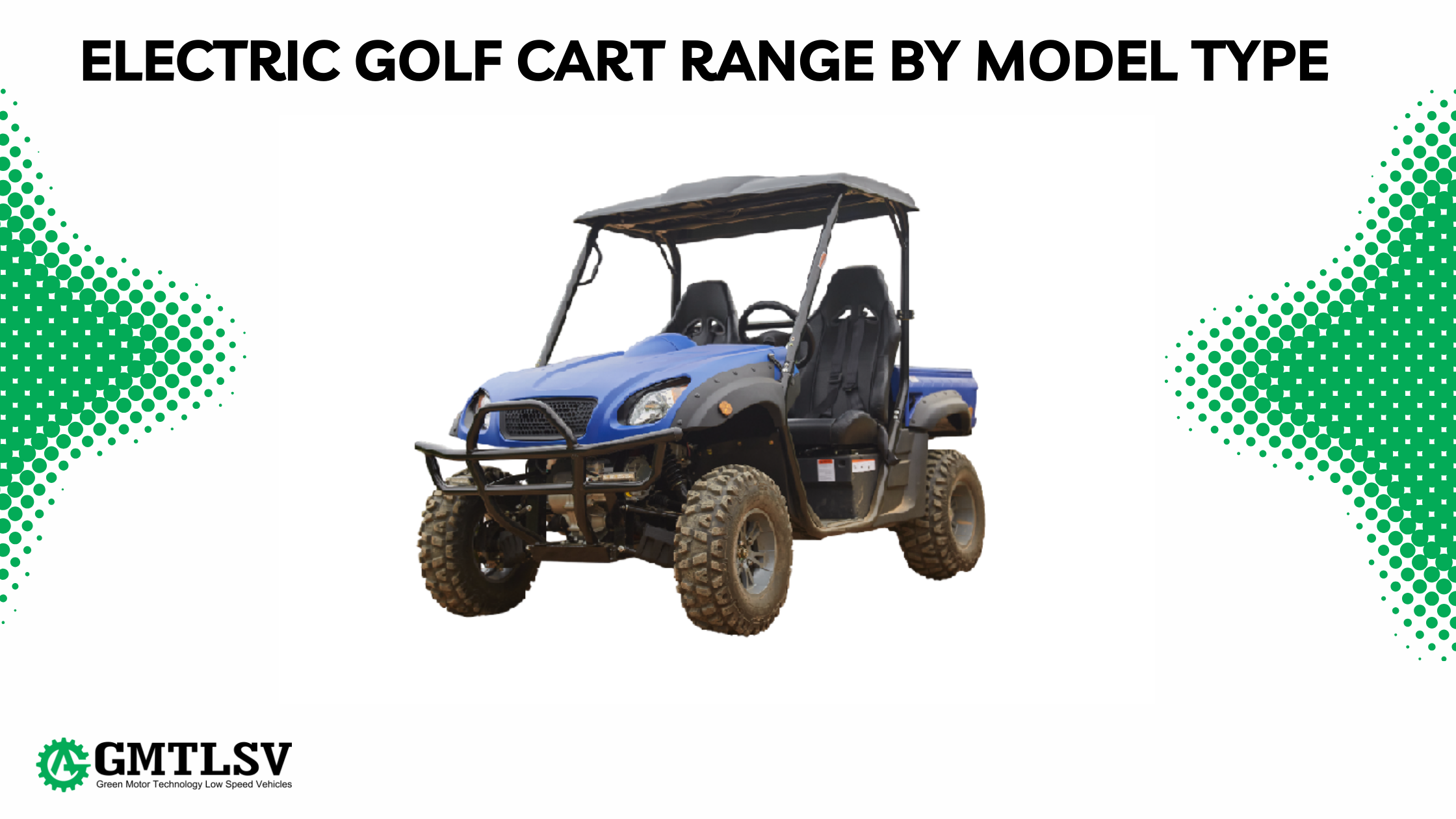
Not all golf carts are built for the same purpose. And that purpose drives the range design.
Standard Golf Course Carts
These are what you see at 90% of golf courses. Typical range is 18-25 miles per charge.
Golf courses are mostly flat, or at least not that hilly. The carts are designed for short trips—18 holes is usually only 4-6 miles of actual driving. So they don’t need huge range. They need to be reliable, cheap to maintain, and easy to charge overnight.
Most course carts run on 36V systems. That’s lower voltage than street-legal carts, which limits their range but also makes them simpler and cheaper.
Golf courses usually have charging infrastructure built in—carts plug in after each use, ready for the next day. So range isn’t as critical as it would be for personal use.
Street-Legal LSV Golf Carts
LSVs (Low-Speed Vehicles) are a different animal. Range typically runs 25-40 miles.
These carts are built for road use, which means they need more range to actually be practical. Can’t plug in at every corner. Most run 48V or higher systems with better batteries to accommodate this.
DOT requirements add weight—mirrors, seat belts, lights, turn signals, horn, all that stuff. But manufacturers offset this with better battery capacity.
GMTLSV street-legal models are designed around real-world driving, not golf course loops. That means specs that actually hold up in everyday conditions.
Utility and Commercial Golf Carts
Range varies more here—usually 20-35 miles depending on how loaded they are.
Commercial carts are used differently. Maintenance crews might drive continuously for hours. Security patrols cover a lot of ground. Hospitality carts run back and forth all day.
The use patterns are heavier, the payloads are often heavier, and the routes might include more stopping and starting. All of that affects real-world range.
If you’re buying for commercial use, buffer your range estimate. Whatever you think you need, add 20-30%. GMTLSV offers commercial solutions designed for these heavier use cases.
Lifted and Modified Golf Carts
Modifications typically cost you 15-30% of your range. Sometimes more.
Lift kits add weight. Bigger tires increase rolling resistance. Performance motors pull more current. Sound systems drain extra power.
None of this means you shouldn’t modify your cart. Just go in knowing the tradeoff. If you’re adding a 6″ lift and 23″ tires, your 30-mile cart might become a 22-mile cart. That’s the deal.
Some modifications are worse for range than others. Larger, heavier tires hurt more than LED light bars. A bigger motor hurts more than a custom seat. Plan accordingly.
How to Maximize Your Electric Golf Cart Range
The good news: you can push your range higher with the right habits. 20-30% improvement is realistic if you’re currently doing things the hard way.
Proper Charging Practices
Charge after every use. Don’t wait until the battery is dead.
Complete discharge is bad for most batteries—especially lead-acid. Running them all the way down before charging accelerates degradation. Keep them topped up.
Use the right charger. A charger that’s wrong for your battery type or voltage can damage cells and reduce capacity over time. Match your charger to your battery setup.
Typical charge time is 6-8 hours for a full charge from partially depleted. Don’t interrupt charging mid-cycle regularly.
Smart chargers are worth the investment. They monitor battery state and adjust the charge cycle automatically—better for battery health, better for maintaining capacity long-term.
The “battery memory” thing you might have heard about—where batteries “remember” partial charges and lose capacity? Mostly a myth for modern batteries. Don’t worry about it.
GMTLSV carts come with matched chargers for their battery systems. Use them. Or if you upgrade batteries, upgrade the charger too.
Regular Battery Maintenance
Lead-acid batteries need attention. Check water levels monthly. Use distilled water only. Clean terminals when you see corrosion building up. Run an equalization charge periodically (your charger manual will explain when and how).
Lithium batteries are simpler. No watering. But the BMS (Battery Management System) matters—make sure it’s functioning properly. Keep batteries within their temperature range. That’s mostly it.
Seasonal maintenance: before winter, fully charge batteries. Before summer, check for swelling or heat damage.
Get a professional inspection annually, especially for lead-acid systems. Catching a weak cell early can save the whole pack.
Reduce Unnecessary Weight
Remove stuff you’re not using. That cooler you haven’t touched in six months? The tool kit you never open? The extra seat cushions nobody sits on?
Every pound counts. Seriously.
If you can limit passenger count on longer trips, do it. If you can avoid carrying cargo you don’t need, do that too.
Choose lightweight modifications when possible. Aluminum accessories instead of steel. Smaller speakers if you’re adding audio.
The math: if you remove 50 lbs of stuff you weren’t using anyway, you might get an extra 5-7% range. That could be 1-2 miles. Matters more than it sounds.
Keep Tires Properly Inflated
Check tire pressure weekly if you’re using the cart daily. Monthly at minimum.
Different carts and tires have different optimal PSI—check the tire sidewall or your cart’s documentation. Usually somewhere between 18-22 PSI for standard golf cart tires. Street tires on LSVs might be higher.
Proper inflation can improve range by 5-10%. Improper inflation also wears your tires faster, so you’re losing twice.
Replace tires when the tread is worn. Bald tires don’t grip well and actually increase energy use because the motor has to work harder to maintain traction.
Schedule Regular Maintenance
Monthly: check tire pressure, inspect battery terminals, look for loose wiring, test brakes.
Quarterly: clean battery connections thoroughly, check water levels (lead-acid), inspect tire condition, lubricate moving parts.
Annually: full professional inspection covering motor brushes, controller function, wiring integrity, bearing condition, brake system, steering components.
Preventive maintenance keeps your cart running efficiently. Efficiency means range. Neglect means gradual loss of performance that you won’t notice until it’s significant.
Keep records. Knowing when you last replaced bearings or serviced the motor helps you catch issues before they cost you range.
Comparing Battery Technologies for Range
This is where most of the range difference comes from. Battery choice matters more than almost anything else.
Lead-Acid Battery Range Performance
Lead-acid has been the standard forever. It works. It’s cheap upfront.
But for range? It has real limitations.
Voltage sag is the big issue. As lead-acid batteries discharge, voltage drops significantly. That means power output decreases. Your cart slows down, struggles on hills, and generally performs worse as the battery drains.
Depth of discharge matters too. You really shouldn’t use more than 50% of a lead-acid battery’s capacity regularly. Go deeper and you’re shortening its life significantly. So that “100 amp-hour” battery? You’re really working with 50 usable amp-hours.
Temperature sensitivity is worse than lithium. Cold kills lead-acid performance more drastically.
The degradation curve is steep. After year two, you’re probably already seeing capacity loss. By year four or five, you might be at 60% of original capacity. That 25-mile range is now 15.
Maintenance requirements (checking water, cleaning terminals, equalization charging) take time. Skip them and the battery degrades even faster.
Lithium-Ion Battery Range Advantages
Lithium is better at basically everything range-related.
Consistent voltage output through the discharge cycle. Your cart performs the same at 80% battery as it does at 20%. That alone makes a huge practical difference.
Usable capacity is 80-90%, not 50%. So a 100 amp-hour lithium battery gives you 80-90 usable amp-hours. Massive improvement right there.
Voltage sag is minimal. Hills don’t slow you down as much even when the battery is getting low.
Cold weather performance is significantly better. You still lose some range, but not as dramatically.
Lifespan maintains range longer. After 5 years, a lithium battery might still have 85-90% of its original capacity. Lead-acid at 5 years? You’d probably be replacing it.
Faster charging allows more daily use. If you need to top up mid-day, lithium gets there much quicker.
Which Battery Type is Best for Range?
Depends on how you use the cart.
Daily long-distance users: Lithium, no question. The range consistency, lifespan, and performance benefits pay for themselves.
Occasional users: Lead-acid might be fine. If you’re only driving 10 miles a few times a week, lead-acid can handle that for years at lower upfront cost.
Commercial applications: Lithium ROI is usually strong. The reliability, longer life, and faster charging mean less downtime and lower replacement costs over time.
Budget constraints: Lead-acid gets you driving for less money today. Just know you’ll pay more over the long haul in maintenance and replacements.
GMTLSV offers both battery options across their lineup. They can help match the right battery to your specific use case.
Can you extend range with a second battery set?
Yes. It’s possible.
You can wire batteries in parallel to increase amp-hours (more range) or series to increase voltage (more speed/power). For range extension, parallel is usually the goal.
Doubling your battery capacity can roughly double your range—minus some efficiency losses and the added weight of the extra batteries.
But there are considerations. Your charging system needs to handle the larger bank. The cart needs space to fit additional batteries. Weight increases, which costs some of that gained range back. And your charger needs to be compatible.
It’s doable for most carts but requires planning. Not just a quick swap.
Does air conditioning significantly reduce range?
Yes. Significantly.
AC systems can reduce range by 20-40% depending on how hard they’re running. On a hot day with the AC cranked, you’re diverting a lot of power to keep that compressor going.
Heating systems are similar—sometimes worse. Electric heaters are huge power draws.
If you need climate control, plan for reduced range. Or use it strategically—cool down, then turn it off for a while. Minimize the total run time.
How accurate are manufacturer range estimates?
Not very. At least not for real-world use.
Manufacturer testing happens under ideal conditions. Flat terrain. Light weight. Optimal temperature. Steady speed. No accessories running. New batteries at peak capacity.
Your reality probably includes none of that.
Expect actual range to be 15-25% lower than published specs in typical real-world use. Possibly more if your conditions are challenging (hilly, heavy loads, extreme temperatures).
Treat manufacturer numbers as best-case scenarios. Plan around a more conservative estimate.
What’s the minimum range needed for golf course use?
An 18-hole round typically requires 4-6 miles of cart driving.
For comfortable single-round use, 15 miles minimum. That gives you buffer for detours, practice rounds, driving to and from the cart storage, etc.
For 36-hole days, you either need 25+ miles of range or a charging opportunity between rounds. Most courses have charging infrastructure, so mid-day top-ups are usually possible.
If you’re a course manager buying a fleet, budget for 20+ mile range to cover varying conditions and battery degradation over time.
Choosing the Right Electric Golf Cart for Your Range Needs
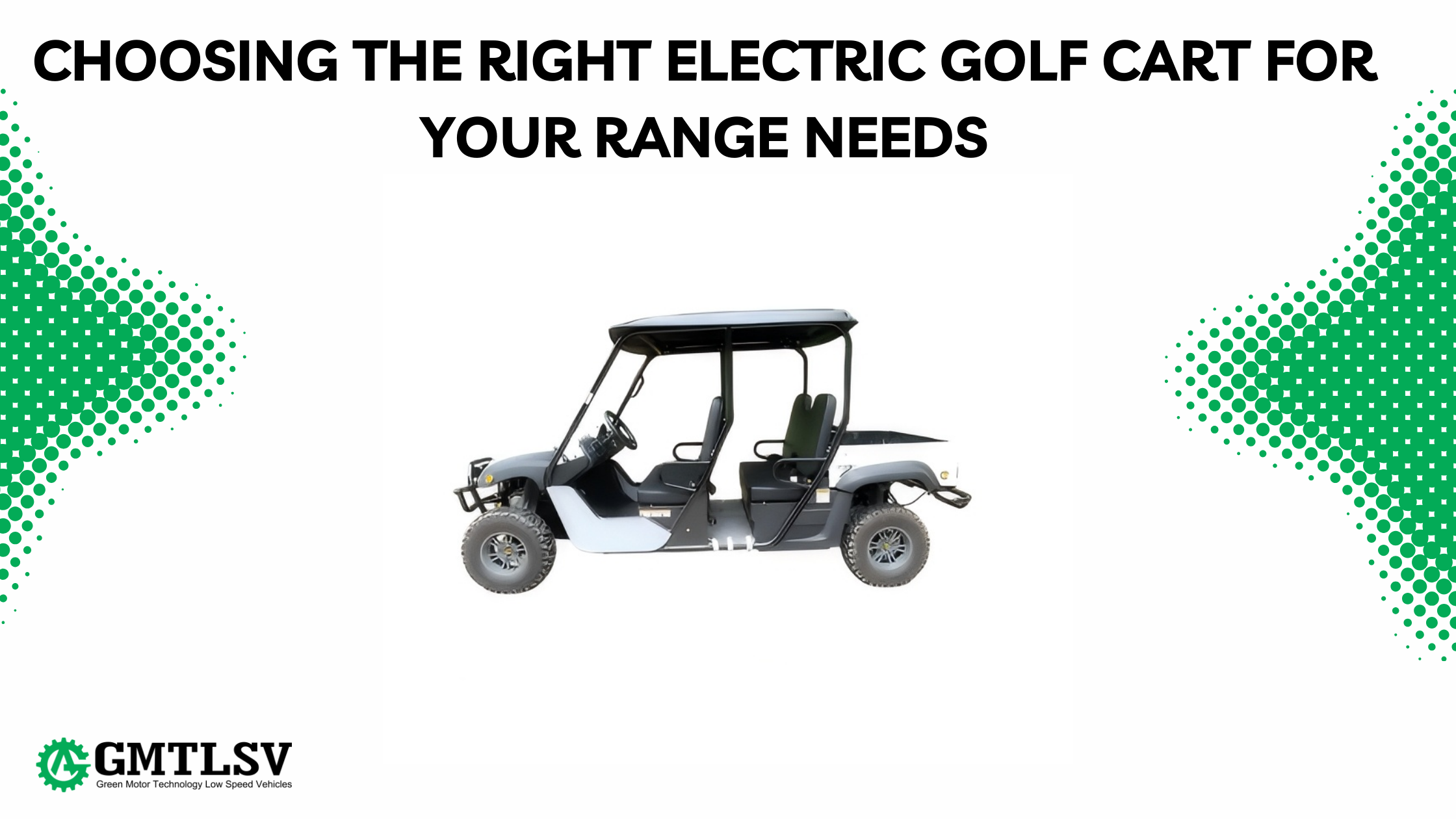
Let’s bring this back to practical decisions.
Assessing Your Range Requirements
Start with actual numbers.
How many miles do you typically drive in a day? In a week? Don’t guess—track it for a few weeks if you’re not sure.
What terrain are you covering? Flat roads? Hills? Grass and gravel?
How many passengers usually? How much cargo?
What’s your longest single trip? That’s your baseline minimum range needed.
Add 25-30% buffer for degradation, unexpected detours, and real-world variability.
If you drive 20 miles on a typical heavy-use day, you want a cart rated for 25-30 miles. If your longest trip is 15 miles, you want 20+ mile range.
Don’t buy for the minimum. Batteries lose capacity over time. Conditions vary. You’ll regret cutting it close.
GMTLSV Electric Golf Cart Range Options
GMTLSV builds carts for different use cases, which means different range specs.
Their street-legal LSV models are built for longer trips—real commuting distances, not just golf course loops. Battery options include both lead-acid and lithium configurations depending on your budget and range needs.