

Golf carts aren’t just for golf anymore. Honestly? They haven’t been for a while now.
Drive through any retirement community in Florida and you’ll see them everywhere. Grocery runs. Visiting neighbors. Just cruising around. Same goes for beach towns, college campuses, large properties—anywhere people need to get somewhere nearby without firing up a full-size vehicle.
And it makes sense. Gas prices are ridiculous. Parking is a nightmare. Why take your truck to the mailbox when you’ve got a cart that does the job just fine?
But here’s the thing. Buying a golf cart isn’t as simple as people think. There’s gas vs electric. New vs used. Lifted vs standard. Different seating configs. Different brands. Different price points. Some carts are street-legal, some aren’t. Some need batteries replaced every few years, some don’t.
I’ve seen people drop $8,000 on a cart that didn’t fit their needs. Could’ve spent half that and been happier. I’ve also seen folks cheap out and regret it six months later when something breaks.
So that’s what this guide is for. I’m going to walk you through everything—types of carts, what to look for, what to avoid, how much you should actually expect to pay. We’ll cover the big brands, the maintenance stuff, the legal stuff that trips people up.
By the end? You’ll know exactly what golf cart makes sense for your situation. Not what some salesman wants to sell you. What actually works.
Let’s get into it.
What is a Golf Cart?
A golf cart is basically a small vehicle designed to carry a few people over short distances. That’s the simple definition.
Originally? Yeah, they were just for golf. Hence the name. You’d ride them around the course so you didn’t have to lug your clubs 18 holes.
But that changed. Somewhere along the way, people figured out these things were useful for more than fairways. Now they’re everywhere—gated communities, resorts, warehouses, farms, airports, you name it.
You’ll hear different names for them too. Golf cars. Utility vehicles. Neighborhood Electric Vehicles (NEVs). Low-Speed Vehicles (LSVs). They’re not all exactly the same thing, but people use the terms interchangeably.
A typical golf cart has a simple setup. Electric motor or small gas engine. Batteries or fuel tank. Steering wheel. Accelerator pedal. Brake. Basic suspension. That’s about it. Some have roofs, some don’t. Some have storage, some have extra seats.
They’re not complicated machines. That’s actually part of the appeal.
Types of Golf Carts Available
Before you start shopping, you need to know what’s out there. Because not all golf carts are the same.
The type you choose depends on a few things. How are you going to use it? What kind of terrain? What’s your budget? Do you need power or is quiet operation more important?
Get this wrong and you’ll be frustrated. Get it right and you’ll wonder why you didn’t buy one sooner.
- Gas-Powered Golf Carts
Gas carts run on regular unleaded fuel. Pretty straightforward.
Most modern gas carts use 4-cycle engines. They’re more efficient than the old 2-cycle stuff. You get better fuel economy and they’re not as smoky.
Power-wise? Gas carts generally have more of it. They pull better on hills. They can handle heavier loads without straining. If you’re running your cart hard—long days, steep terrain, heavy use—gas holds up.
Big names like Club Car, E-Z-GO, and Yamaha all make gas models. Parts are easy to find. Mechanics know how to work on them.
The good stuff:
- More power, especially on hills
- Longer range before refueling
- Quick fill-up (no waiting hours to charge)
- Better for demanding use
The not-so-good stuff:
- Louder. Your neighbors will hear it.
- More maintenance—oil changes, spark plugs, air filters
- Emissions. Not great if you care about that.
- Fuel costs add up
Best for: Golf courses, commercial operations, hilly properties, anyone who needs serious runtime without breaks.
- Electric Golf Carts
Electric carts run on battery packs. Usually 48-volt systems, though some higher-end models run 72-volt.
You’ve got two main battery types. Lead-acid and lithium-ion.
Lead-acid is cheaper upfront. It’s the traditional option. But they’re heavy, they need regular maintenance (watering the cells), and they don’t last as long.
Lithium-ion costs more—sometimes significantly more—but lasts longer, charges faster, and requires basically zero maintenance. Plus they’re lighter, which helps with range and performance.
Charging time varies. Lead-acid takes 8-12 hours for a full charge. Lithium can do it in 2-4 hours depending on the charger.
The good stuff:
- Quiet. Like, really quiet.
- Way less maintenance than gas
- No emissions—eco-friendly, if that matters to you
- Cheaper to run day-to-day
- Better for neighborhoods (nobody complains about noise)
The not-so-good stuff:
- Limited range (typically 15-25 miles per charge)
- Charging takes time—you can’t just fill up and go
- Battery replacement is expensive ($800-$3,000+)
- Struggles more on steep hills
Best for: Residential communities, short-distance travel, anyone who wants quiet operation, eco-conscious buyers.
- Solar-Powered Golf Carts
Solar golf carts are a newer thing. They’re still basically electric carts, but with solar panels on the roof that help supplement charging.
Here’s the honest truth though. Solar isn’t going to fully power your cart. Not yet anyway. The panels don’t generate enough juice for that.
What they do is extend your range. Maybe add a few extra miles. Keep your batteries topped off while you’re parked in the sun.
It’s a nice bonus if you’re in a sunny area. But don’t buy one expecting to never plug in again. That’s not how it works right now.
Technology’s improving though. Give it a few years and solar might become more viable.
Current limitations:
- Can’t fully charge batteries—just supplements
- Panels add cost
- Limited availability compared to standard electric
Where it makes sense: Sunny climates, eco-focused buyers who want every little efficiency boost, people who like early-adopter tech.
- Lifted vs. Standard Golf Carts
Standard golf carts sit low to the ground. They’re designed for paved paths and smooth terrain. Golf courses, sidewalks, flat neighborhoods.
Lifted golf carts sit higher. They’ve got bigger tires and more ground clearance. Usually this is done with a lift kit—either spindle lifts or A-arm lifts.
Why lift a cart? Off-road use. Rough terrain. Gravel roads. Grass. Hunting land. Anywhere a standard cart might bottom out or struggle.
Ground clearance on a stock cart is usually around 3-4 inches. A lifted cart can have 6+ inches.
Trade-offs:
- Lifted carts look cooler (subjective, but still)
- Better off-road capability
- Larger tires can mean better ride quality
- But—higher center of gravity means less stable at speed
- More expensive
- Can be overkill for paved-only use
Bottom line: If you’re sticking to pavement, standard is fine. If you’re going off-road or have rough terrain, lifted makes sense.
- 2-Seater vs. 4-Seater vs. 6-Seater Golf Carts
This one’s pretty straightforward but people still overthink it.
2-seater: Smallest and most maneuverable. Easiest to park and store. Lightest, which helps with range and performance. Good for solo use or couples.
4-seater: Most common. Usually has a rear-facing back seat that can flip down to become a cargo bed. Best of both worlds for most people.
6-seater: Bigger. Usually forward-facing rear seats. Good for families or if you regularly haul groups. Less maneuverable though. Takes more space to store.
Things to think about:
- More seats = bigger cart = less nimble
- More seats = higher price
- Rear-facing seats aren’t as comfortable for adults on longer rides
- 4-seater with flip seat is probably the most versatile option for most buyers
Don’t buy more capacity than you need. But don’t underestimate either. If you think you might need 4 seats sometimes, get the 4-seater.
New vs. Used Golf Carts: Which Should You Buy?
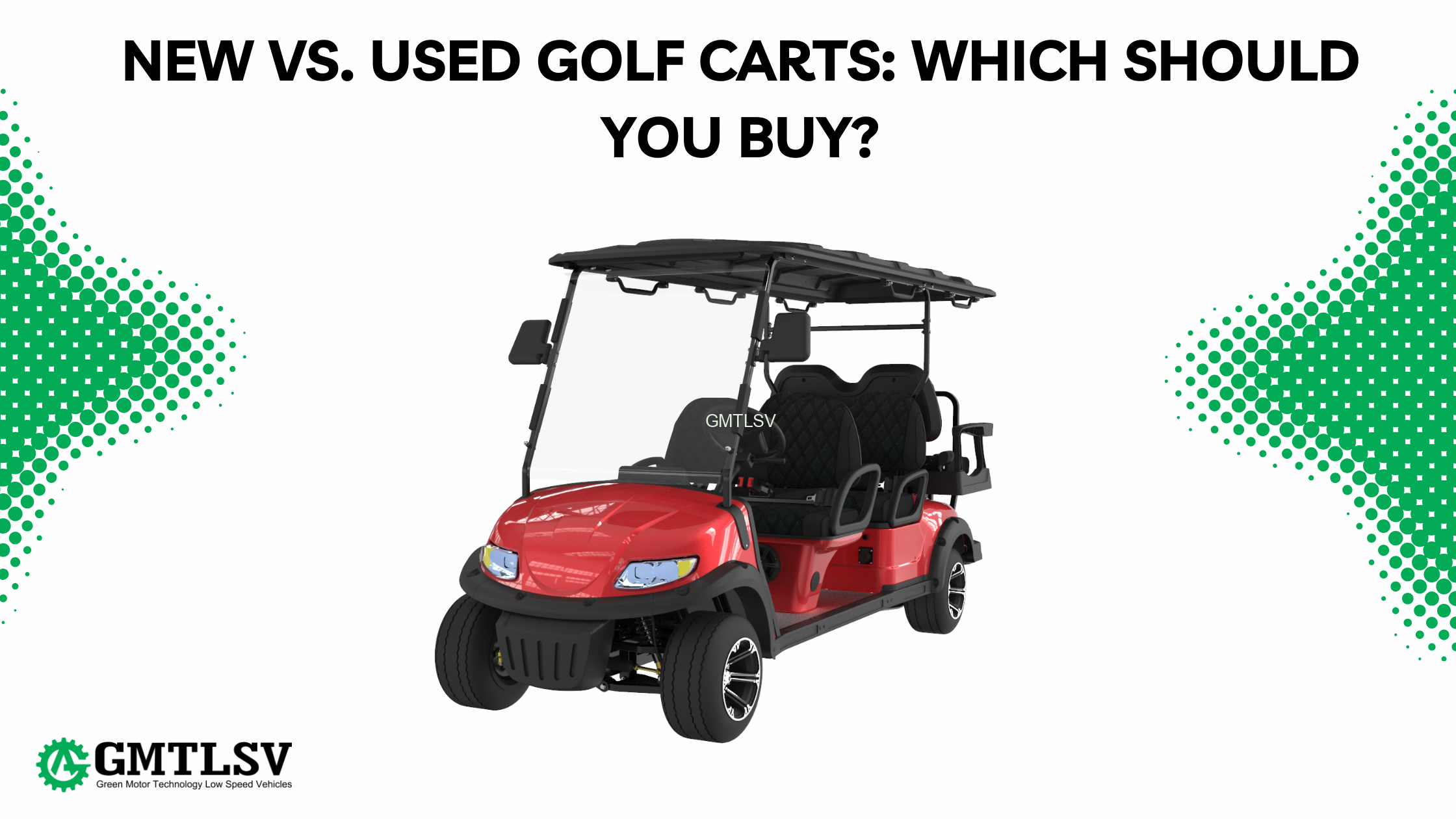
This is the big question for a lot of people. And honestly? There’s no universal right answer.
Buying new:
- You know exactly what you’re getting
- Full warranty
- Latest features and tech
- Can customize it how you want
- No hidden wear or abuse
- But—you’re paying premium price
Buying used:
- Way cheaper. Sometimes half the price or less.
- Immediate availability (no waiting for delivery or build)
- Plenty of well-maintained carts out there
- But—you’re taking on risk
- Could have hidden issues
- Batteries might be near end of life
If you’re buying used, check these things:
- Battery condition. This is huge for electric carts. Ask about age. Test voltage.
- Frame integrity. Look for rust, cracks, bends.
- Tire wear. Uneven wear can indicate alignment or suspension issues.
- Electrical systems. Test everything—lights, gauges, charger.
- Hour meter. Like an odometer but for operating hours. More hours = more wear.
- Overall maintenance history if you can get it.
Price ranges (rough estimates):
- New: $5,000 to $20,000+ depending on brand, type, features
- Used: $2,000 to $10,000+ depending on age, condition, brand
When to buy new: You want peace of mind, specific features, warranty coverage, or plan to keep it long-term.
When to buy used: Budget is tight, you’re okay doing some due diligence, or you just need something functional without the bells and whistles.
Key Factors to Consider When Buying a Golf Cart
Price matters. Obviously. But it’s not the only thing.
People focus too much on sticker price and not enough on what they actually need. Then they end up with a cart that doesn’t work for their situation.
Think beyond the price tag. Think about how you’ll actually use this thing. Daily.
- Intended Use and Purpose
Start here. Everything else flows from this.
Ask yourself:
- Am I using this for golf? Neighborhood cruising? Work? Off-roading?
- How many people will typically ride with me?
- What kind of terrain am I covering?
- How far will I travel on a typical day?
- Will this live in a garage or outside?
- What’s my climate like?
A cart for a retirement community in Arizona looks different than a cart for a hunting property in Texas. Different needs, different solutions.
Don’t buy based on what looks cool. Buy based on what makes sense.
- Terrain and Environment
This matters more than people realize.
Flat vs hilly: Hilly terrain eats through electric battery life and can strain underpowered motors. Gas handles hills better. If you’ve got steep grades, factor that in.
Paved vs unpaved: Smooth pavement? Standard cart is fine. Gravel, grass, dirt, sand? You might want lifted with better tires.
Weather: Will the cart be exposed to elements? Rain? Salt air near the coast? That coastal air is rough on metal. Corrosion is real.
Climate: Extreme heat affects battery performance. Extreme cold too. Neither is ideal, but worth considering.
Your terrain should influence whether you go gas or electric. And whether you go standard or lifted.
- Budget and Total Cost of Ownership
Here’s where people mess up. They look at the purchase price and ignore everything else.
Initial cost ranges:
- New basic electric: $5,000-$8,000
- New mid-range: $8,000-$12,000
- New premium/fully loaded: $12,000-$20,000+
- Used: Varies wildly, $2,000-$10,000+
Ongoing costs (don’t ignore these):
- Electricity or gas
- Routine maintenance
- Insurance (if required in your area)
- Storage (if you don’t have covered space)
- Accessories
- Battery replacement (electric carts—this is a big one)
5-year cost comparison:
Electric costs less to run day-to-day. Electricity is cheaper than gas. Less maintenance too—no oil changes, no fuel system stuff.
But battery replacement can hit hard. A lead-acid pack might cost $800-$1,500. Lithium? $2,000-$3,000+.
Gas costs more in fuel and maintenance. But no big battery expense down the road.
Run the numbers for your situation. Sometimes the cheaper upfront option costs more long-term.
- Battery Life and Range (For Electric Carts)
If you’re going electric, batteries are everything. Seriously.
Typical range: 15-25 miles on a full charge. That covers most daily use for most people.
What affects range:
- Terrain (hills kill range)
- Weight (passengers, cargo)
- Speed (faster = more battery drain)
- Battery age (older batteries hold less charge)
- Temperature
Battery lifespan:
- Lead-acid: 4-6 years typically
- Lithium-ion: 8-10+ years
Replacement costs:
- Lead-acid pack: $800-$1,500
- Lithium pack: $2,000-$3,000+
Maximize battery life by:
- Charging after each use
- Not letting batteries fully discharge
- Keeping water levels topped off (lead-acid)
- Storing in temperature-controlled space when possible
Buying a used electric cart? Battery condition is the first thing to check. Bad batteries can turn a good deal into a money pit.
- Speed and Performance
Stock golf carts are slow. That’s by design.
Standard speeds:
- Most stock carts: 12-15 mph
- Street-legal LSVs: 20-25 mph
- Modified high-performance carts: 25+ mph (some much faster)
Speed governors limit how fast carts can go. You can sometimes adjust them or have them removed. But check your local laws first.
Performance differences:
- Gas carts generally accelerate faster and handle hills better
- Electric carts have smoother, quieter acceleration
- Upgraded motors, controllers, and batteries can boost electric performance
If you need speed, look at LSV models or be prepared to do modifications. But remember—faster also means more wear on components and potentially different legal requirements.
- Seating Capacity and Cargo Space
Figure out your typical passenger count. Then add one. That’s probably what you should buy.
Options:
- 2-seater: Just you or you plus one
- 4-seater: Most versatile for families
- 6-seater: Groups, large families, commercial transport
Flip-down rear seats are worth looking at. They give you passenger space OR cargo space depending on what you need that day.
Cargo capacity: Most carts handle 500-800 lbs payload. Some utility models more.
If you’re hauling stuff regularly—coolers, groceries, equipment—make sure you’ve got the bed space and payload rating for it.
- Maintenance Requirements
All carts need maintenance. The question is how much.
Gas cart maintenance:
- Oil changes
- Air filter replacement
- Spark plug replacement
- Fuel system care
- Belt inspection/replacement
- More frequent brake checks (generally used harder)
Electric cart maintenance:
- Battery water levels (lead-acid only)
- Terminal cleaning
- Electrical connection checks
- Much simpler overall
Both need:
- Tire care and replacement
- Brake inspection and service
- Steering and suspension checks
- General cleaning and inspection
Annual maintenance cost estimates:
- Electric: $100-$300 (excluding battery replacement)
- Gas: $200-$500
Electric is simpler. Gas isn’t complicated, but there’s more to it. If you hate maintenance, electric is the way to go.
- Local Laws and Regulations
This trips people up constantly. Rules vary everywhere.
Street-legal requirements (for LSVs typically include):
- Headlights and taillights
- Turn signals
- Mirrors
- Seatbelts
- Windshield
- VIN number
- DOT-approved tires
LSV classification: Usually means the cart can go 20-25 mph and meets safety equipment requirements. Can be driven on roads with speed limits of 35 mph or less (varies by state).
Other stuff to check:
- Do you need to register it?
- Do you need insurance?
- What’s the minimum age to drive?
- Can you drive on public roads or only private property?
- Does your HOA have rules about golf carts?
Don’t assume. Check your local ordinances before you buy. Nothing worse than spending $10,000 on a cart you can’t legally use where you planned to.
Top Golf Cart Brands and Manufacturers
Brand matters. Good brands mean better parts availability, better service networks, and generally better resale value.
Stick with established names unless you have a specific reason not to.
- Club Car
Club Car has been around since 1958. They’re one of the big three. You see them everywhere—golf courses, resorts, communities.
Known for durability. Aluminum frames that resist rust. Solid build quality.
Popular models include the Onward series and the Villager line.
Price range sits mid to high. Not the cheapest, but you get what you pay for.
Dealer network is strong. Parts are easy to find. Service shops know these carts well.
- E-Z-GO (EZGO)
Another big three brand. Owned by Textron, which is a massive company.
E-Z-GO has been around since 1954. They’ve got a huge market presence.
Known for innovation. They’ve pushed a lot of technology features over the years.
Popular models include the Freedom series and the RXV.
Good parts availability. Big dealer network. Competitive pricing.
If you see golf carts at a resort or golf course, good chance they’re E-Z-GO.
- Yamaha
Yamaha makes everything—motorcycles, ATVs, boats, musical instruments. And golf carts.
Their reputation is reliability. These things run.
They make both gas and electric models. Their gas carts are especially well-regarded.
Known for quiet operation, even on gas models. Smooth ride.
Warranty is solid. Parts are everywhere because Yamaha is everywhere.
If reliability is your top priority and you don’t need anything fancy, Yamaha is a safe bet.
- Icon
Icon is a newer player. They’ve come up fast in the last several years.
Modern styling. They look different than the traditional brands—more like a mini vehicle than a cart.
Tech-forward. Touchscreens, Bluetooth, that kind of stuff.
Positioned as premium but often priced competitively against the big three.
Popular in the neighborhood and community market. People who want something that looks good parked in their driveway.
Worth considering if aesthetics and features matter to you.
- Other Notable Brands
Garia: Luxury golf carts. Like, actual luxury. Porsche-designed. Expensive. For people who want the absolute nicest.
Star EV: Good value brand. Competes on price. Decent quality for the money.
Tomberlin: American made. Solid middle-ground option.
GEM (Global Electric Motorcars): Street-legal electric vehicles. More like mini cars than traditional golf carts. Good for road use.
These aren’t as common as the big names, but they fill niches. Do your research if you’re considering one.
Frequently Asked Questions About Golf Carts
How much does a golf cart cost?
Wide range.
New: $5,000 on the low end for a basic model. Up to $20,000+ for premium, fully loaded carts.
Used: Can find decent carts for $2,000-$3,000. Nicer used ones run $5,000-$10,000+.
What affects price:
- Gas vs electric
- Brand
- Features (lifted, custom, etc.)
- Seating capacity
- Condition (used)
- Battery type and age (electric)
Don’t just look at the cheapest option. Think about total cost of ownership.
How long do golf cart batteries last?
Depends on type.
Lead-acid: 4-6 years is typical. Can go longer with great maintenance, shorter if neglected.
Lithium-ion: 8-10+ years. Some manufacturers claim even longer.
What affects lifespan:
- How often you charge
- Whether you let them fully discharge (bad)
- Maintenance habits
- How hard you run the cart
- Climate and storage conditions
Take care of your batteries and they take care of you.
Can I drive a golf cart on the street?
Maybe. Depends where you live.
Some areas allow golf carts on roads with low speed limits. Some don’t allow them at all. Some require the cart to be classified as an LSV with specific safety equipment.
Typical street-legal/LSV requirements:
- Lights
- Turn signals
- Mirrors
- Seatbelts
- Windshield
- VIN
- Minimum and maximum speed capability
Check your local laws. Seriously. Don’t guess on this one.
What is better: gas or electric golf cart?
No universal answer. Depends on your situation.
Go gas if:
- You have hilly terrain
- You need long range without charging breaks
- You don’t mind noise and maintenance
- You’re using it commercially with heavy daily use
Go electric if:
- Quiet operation matters
- You’re in a residential neighborhood
- You want lower running costs
- You prefer less maintenance
- Environmental impact matters to you
Neither is objectively better. Just better for different uses.
How fast do golf carts go?
Standard golf cart: 12-15 mph. Plenty for golf courses and basic neighborhood use.
Street-legal LSVs: 20-25 mph typically. Designed for road use.
Modified/high-performance: 25+ mph. Some go much faster, but that’s getting into custom territory.
Stock carts have speed governors. Can sometimes be adjusted.
Do I need a license to drive a golf cart?
Depends where you’re driving.
Private property: Usually no license needed. Your land, your rules (mostly).
Public roads: Often yes. If the cart is street-legal and on public roads, you usually need at least a basic license.
Age requirements: Vary by location. Some places have minimum ages even on private property.
Check local regulations. They vary way more than you’d expect.
How far can an electric golf cart go on a single charge?
Typical range: 15-25 miles. Good enough for most daily use.
Factors that reduce range:
- Hills
- High speeds
- Heavy loads
- Old batteries
- Cold weather
Lithium batteries typically give better range than lead-acid, and maintain it better as they age.
If you need longer range, either go gas or plan for charging breaks.
What maintenance does a golf cart need?
Electric carts:
- Check and fill battery water (lead-acid)
- Clean terminals
- Inspect electrical connections
- Tire maintenance
- Brake checks
Gas carts:
- Oil changes
- Air filter replacement
- Spark plugs
- Fuel system maintenance
- Plus all the stuff electric carts need
Frequency: Most routine stuff is annual or every few hundred hours of use.
DIY vs professional: Basic stuff is totally DIY-able. More complex electrical or engine work, probably get a pro.
That’s the guide. You’ve got the information now. The right golf cart for you depends on how you answer all those questions about usage, terrain, budget, and priorities.
Take your time. Don’t let anyone pressure you. And don’t overthink it either—golf carts aren’t that complicated once you know what you’re looking for.

