

Buying a used golf cart can save you serious money. We’re talking $2,000 to $10,000 less than new, depending on the model and condition. That’s real savings.
But here’s the thing. Used carts can also drain your wallet fast if you buy the wrong one. A cart with dying batteries? That’s an $800 to $2,500 surprise waiting to happen. Worn brakes, corroded wiring, hidden frame damage. These problems add up quick.
I’ve seen buyers get burned because they didn’t know what to look for. The cart looked fine. Drove okay for the test ride. Then everything fell apart within months.
This checklist walks you through every inspection point that matters. Batteries. Frame. Brakes. Electrical systems. The stuff sellers hope you won’t check too closely.
At GMT, we specialize in electric vehicles and see these carts come through constantly. We know what fails, what lasts, and what red flags to watch for. Use this guide before you hand over any money.
Why Buy a Used Golf Cart?
The math makes sense for most buyers.
New golf carts run anywhere from $8,000 to $15,000 or more depending on features. Used carts in good condition? $2,000 to $10,000. Sometimes less.
Depreciation hits hardest in the first couple years. Let someone else absorb that. A three-year-old cart with decent maintenance still has plenty of life left.
Availability matters too. New carts can have wait times. Supply chain stuff. Used carts are ready now.
There are considerations, sure. Age affects parts availability on older models. Maintenance history varies wildly between owners. Some carts were babied. Others were beaten.
But here’s the bottom line. Used golf carts are smart purchases when you inspect properly. The key word is “properly.” Skip the inspection and you’re gambling.
Understanding the Age and History of the Cart
Knowing the exact age and history of a cart matters more than most buyers realize.
Age affects parts availability. Try finding parts for a 25-year-old cart. It’s doable but gets expensive and frustrating. Newer models have better support.
Technology changes too. A cart from 2008 uses different controller technology than one from 2018. Battery systems evolve. Charging systems improve.
And sellers sometimes fudge the truth. “It’s a 2015” might actually be a 2010 with newer body panels. Happens more than you’d think.
How to verify the year and model
Every golf cart has a serial number. Finding it depends on the brand.
Club Car: Look under the passenger side glove box area. The serial number plate is usually visible there.
EZGO: Check the frame near the driver’s side or under the seat. Location varies by model year but it’s on the frame somewhere.
Yamaha: Varies by model. Often on the frame near the front or under the dash area.
Once you find the serial number, you can decode the year:
For EZGO carts made after 1979, the last two digits of the serial number indicate the year. A serial ending in “15” means 2015. For 1976-1978 models, the first two numbers indicate year instead.
For Club Car after 1981, look at the first two numbers after the letter prefix. Those indicate manufacture year.
Red flags here: Missing serial plates. Damaged plates where numbers are unreadable. Plates that look tampered with. Any of these should make you suspicious. Walk away or demand proof of actual age through other documentation.
Checking usage history and service records
Ask the seller directly. Where was this cart used?
Golf course carts see heavy use. Eight hours a day, every day, for years. Rental fleet carts same thing. That’s hard miles.
Private residential carts typically have lighter use. Neighborhood trips, maybe some property work. Less wear overall.
Ask about hours or miles if the cart has an hour meter or odometer. Ask about accidents or major repairs. Anything significant happen to this cart?
Request maintenance records. Regular servicing shows the owner cared. Battery maintenance logs. Brake checks. Oil changes for gas carts. The paper trail tells a story.
Here’s something counterintuitive: Fleet carts from golf courses often have better maintenance than private carts. Courses follow maintenance schedules because downtime costs money. Private owners sometimes skip maintenance for years.
Carts with documented service history are safer investments. No records means unknown history. Factor that risk into your price.
Electric vs. Gas: Which Type Should You Buy?
Both types work. The right choice depends on how you’ll use the cart.
GMT specializes in electric vehicles, so I’ll be upfront about our perspective. But I’ll give you the honest comparison either way.
Electric golf cart advantages
Quieter operation. Significantly quieter. Your neighbors won’t hear you coming and going. This matters in residential communities.
Zero emissions at the cart. No exhaust, no fumes, no smell. Environmentally friendlier overall.
Lower operating costs over time. Electricity is cheaper than gasoline. Charging a cart costs a fraction of filling a tank.
Less maintenance required. No oil changes. No spark plugs. No fuel filters. Fewer moving parts means fewer things breaking.
Smooth acceleration with instant torque. Electric motors deliver power immediately. No waiting for engine response.
More communities allow them. Some HOAs and neighborhoods restrict gas carts due to noise and emissions.
The downsides: Limited range, typically 15 to 40 miles depending on battery voltage and terrain. Battery replacement eventually costs $800 to $2,500. Charging takes hours, not minutes.
Gas golf cart advantages
Longer range. 100 to 180 miles per tank is typical. You can drive all day without worrying.
Quick refueling. Five minutes at a gas station versus hours on a charger.
Better for demanding use. Hills drain electric batteries fast. Heavy loads do too. Gas carts handle challenging terrain and hauling better.
Longer runtime without stopping. If you’re working a large property all day, gas might make more sense.
The downsides: More maintenance. Oil changes, spark plug replacements, fuel filter changes, air filter changes. It adds up. Louder operation bothers some people and some neighbors. Emissions mean restrictions in certain communities. Higher ongoing fuel costs compared to electricity.
Which is better for your needs?
Think about your actual use case.
Flat terrain and short trips? Electric makes sense. Hilly property with long distances? Gas handles that better.
Noise-sensitive neighborhood? Electric is probably required or at least strongly preferred.
Do you have easy charging access? If yes, electric works. If your cart lives far from an outlet, gas simplifies life.
Consider maintenance capability. Are you comfortable doing basic engine maintenance? Gas requires more hands-on work. Electric is simpler.
Environmental priorities matter to some buyers. Electric wins there.
Budget reality check: Electric saves on fuel and maintenance but eventually needs battery replacement. Gas costs more in ongoing fuel and maintenance but doesn’t have the big battery expense. Different trade-offs.
1. Battery and Power System Inspection (Electric Carts)
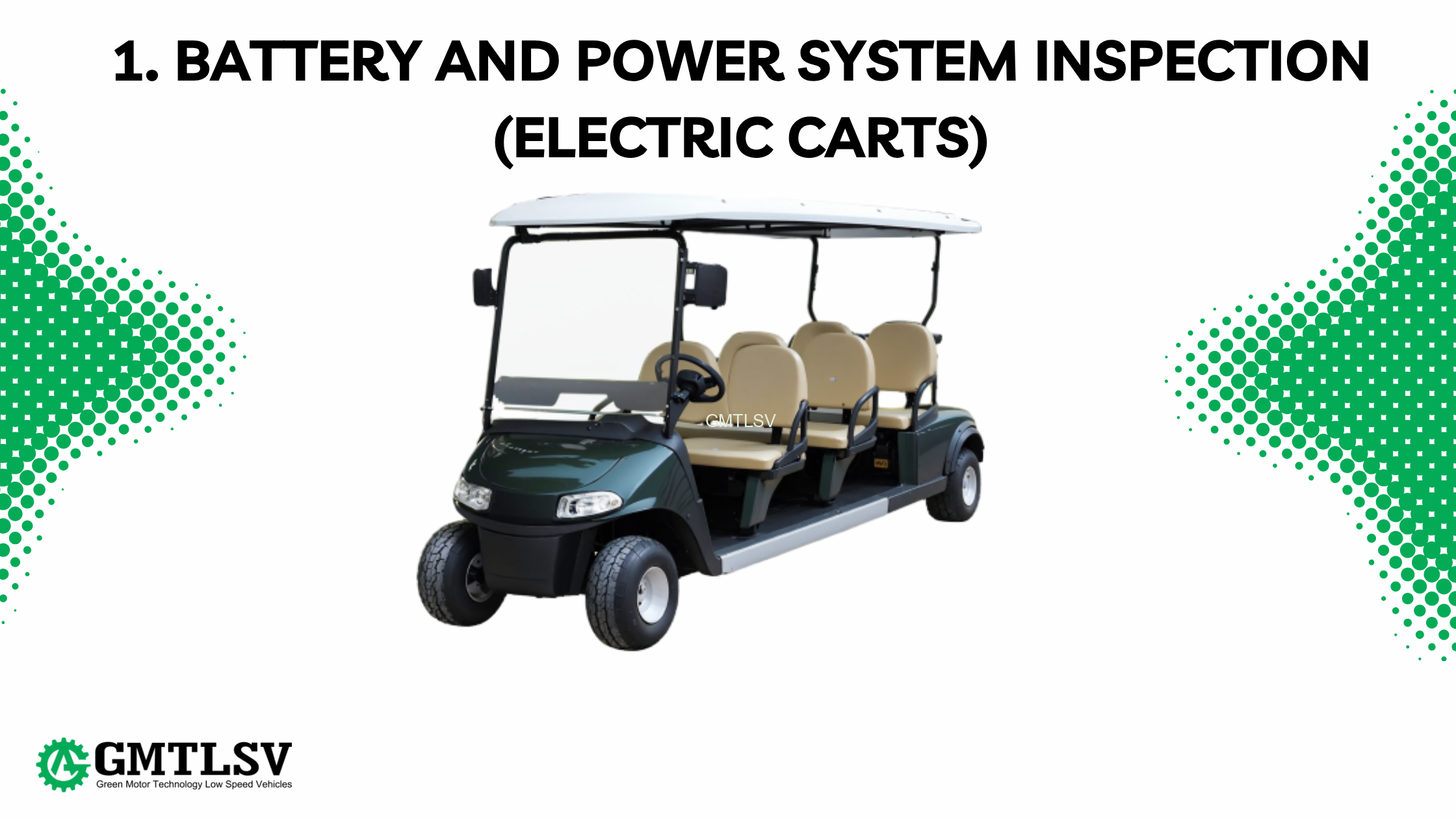
Start here. Batteries are the most expensive component on an electric cart.
Replacement costs run $800 to $2,500 depending on battery type, voltage system, and brand. That’s a significant chunk of many used cart prices.
Proper battery inspection can save you thousands. Or it can reveal that the “great deal” isn’t actually a deal at all.
Battery age and condition
Ask the seller when the batteries were manufactured. This date is usually stamped on the battery case or near the terminals. Look for date codes.
Calculate remaining life based on battery type:
Lead-acid batteries typically last 4 to 6 years with proper maintenance. Sometimes longer with excellent care, sometimes shorter with neglect.
Lithium batteries last 8 to 12 years typically. More expensive upfront but longer lifespan.
If batteries are 5 years old in a lead-acid system, budget for replacement soon. Factor that into your offer.
Physical inspection matters too. Look at each battery individually. Check for bulging cases. Cracks anywhere on the battery housing. Any signs of leakage or acid residue.
Most carts have 4, 6, or 8 batteries depending on the voltage system. Inspect all of them. One bad battery brings down the whole pack.
Battery terminal inspection
Corrosion tells a story.
White, blue, or green buildup on terminals indicates either poor maintenance or acid leakage. Some minor corrosion happens naturally. Heavy corrosion suggests neglect over time.
Check cable connections. They should be tight. Wiggle them. Loose connections cause problems.
Examine the cables themselves. Look for fraying, cracks, or exposed wire. Watch for amateur repairs like electrical tape holding things together.
Heavy corrosion covering multiple terminals? That cart wasn’t maintained properly. What else was neglected?
Ask to see the battery charger. A working charger should come with the cart. If the seller hesitates or refuses to show it, that’s a red flag. Maybe it doesn’t work. Maybe it doesn’t exist.
Battery water levels (lead-acid only)
This applies only to flooded lead-acid batteries. Sealed AGM batteries and lithium batteries don’t require water checks.
For flooded lead-acid, remove the caps on top of each battery. Look inside.
Electrolyte levels should cover the plates by about a quarter inch. The metal plates inside should not be exposed to air.
Low water levels indicate poor maintenance. Someone wasn’t checking batteries regularly. Exposed plates damage cells permanently.
Overfilling causes problems too. Electrolyte boils over during charging and corrodes surrounding components.
Proper water levels across all batteries suggest an owner who actually maintained things.
Battery performance testing
If you have access to a voltmeter, use it.
Fully charged 6-volt batteries should read approximately 6.3 volts each. Fully charged 12-volt batteries should read approximately 12.6 volts.
Significantly lower readings indicate tired batteries or charging problems.
A load test shows true capacity under stress. This requires equipment most buyers won’t have. But if you can arrange one, it reveals actual battery health better than voltage alone.
Ask about charging history and habits. How often did they charge? Did they follow proper charging procedures? Deep discharges damage lead-acid batteries over time.
Check the battery brands. Quality brands include Trojan, US Battery, and Crown for lead-acid. EVE is a respected lithium brand. Unknown generic brands might be fine but might not last.
2. Engine and Fuel System Inspection (Gas Carts)
For gas-powered carts, the engine determines everything. Its condition predicts reliability and future repair costs.
Engines can last a long time with maintenance. Or they can fail surprisingly fast without it.
Engine visual inspection
Start by just looking at the engine before starting it.
Oil leaks around the engine, gaskets, and seals. Fresh oil drips or old crusty buildup. Either indicates problems past or present.
Fuel leaks anywhere in the system. Smell for gas. Look for wet spots or staining.
General cleanliness matters. A filthy engine covered in grime and buildup suggests maintenance wasn’t a priority. Clean engines indicate owners who cared.
Check the oil level and condition. Pull the dipstick. Oil should be at proper level and amber colored. Dark black or gritty oil indicates overdue oil changes or internal engine problems.
Now start the engine. Listen carefully.
Knocking sounds? Problem. Rough idling that doesn’t smooth out? Problem. Difficulty starting or requiring multiple attempts? Problem.
Healthy engines start easily and idle smoothly.
Fuel system check
Inspect the fuel tank for rust or physical damage. Look inside if possible. Rusty tanks contaminate fuel systems.
Check fuel lines running from tank to engine. Look for cracks, brittleness, or any signs of leaks. Old rubber fuel lines harden and crack over time.
Test the fuel cap. It should seal properly.
Check if the fuel gauge works. Some sellers disconnect gauges to hide problems.
Ask when the engine was last serviced. When was the oil changed? Spark plugs replaced? Air filter changed? Fuel filter changed? Recent service suggests maintained equipment.
Look at the exhaust system. Check for leaks where components connect. Run the engine and watch for excessive smoke. Blue smoke means burning oil. Black smoke means fuel problems. White smoke on a warm engine could indicate coolant issues if water-cooled.
3. Frame, Chassis, and Body Inspection
Structural integrity affects both safety and longevity.
Frame damage can be expensive to repair. Sometimes impossible to repair properly. This is deal-breaker territory if severe.
Frame rust and corrosion assessment
Get underneath the cart. Use a flashlight.
Focus on frame rails, especially around welds and joints. These areas trap moisture and corrode first.
Understand the three types of rust you might find:
Surface rust: Just the top layer. Mostly cosmetic. Can be treated and isn’t structurally concerning.
Scale rust: Flaking and pitting. The corrosion is advancing into the metal. More serious but potentially manageable.
Penetrating rust: Holes through the metal. Structural integrity is compromised. Major concern.
Check the undercarriage thoroughly. Especially important if the cart was used near the coast or in wet climates. Salt air destroys metal.
Pay special attention to the battery tray and mounting brackets. Battery acid causes corrosion here even with otherwise good maintenance. Leaking batteries accelerate this significantly.
Extensive rust is a deal-breaker for me. Surface rust can be treated with proper work. But once rust penetrates through structural members, the cart’s integrity is questionable.
Body condition and damage
Walk around the cart slowly. Look at everything.
Check for dents and cracks in body panels. Fiberglass bodies crack. Plastic bodies can warp. Metal bodies dent and rust.
Look for mismatched paint or evidence of poor repair work. Different shades between panels. Orange peel texture from bad paint jobs. These suggest accident history someone tried to hide.
Inspect seats, canopy, and windshield. Replacements aren’t cheap. Cracked windshields, torn seats, faded or ripped canopy covers all add cost.
Examine all visible welds for cracks. Frame welds especially.
Look underneath for bent frame sections. Bends indicate impact. This cart was in an accident. How severe? Hard to know, but damaged frames affect handling and safety.
Test all doors and compartments. Do they open and close properly? Misaligned doors suggest frame twist or accident damage.
Bubbling paint usually means rust underneath. The metal is corroding from the inside out. That bubble will only get worse.
Structural integrity checks
Check frame alignment. The cart should sit level when parked on flat ground. Twisted or sagging frames indicate major problems.
Look at floor boards and panels. Rot or rust-through creates holes and weakens structure.
Check all mounting points for accessories and body panels. Stripped threads, cracked mounts, missing hardware.
Look for amateur modifications or poor quality repairs. Welding that doesn’t look professional. Brackets that don’t fit right. Someone tried to fix something without proper skills.
Any evidence of collision damage that wasn’t properly repaired should concern you. Frame damage affects everything else.
4. Tires and Suspension System
Tires affect safety, ride comfort, and operating costs. Worn tires need immediate replacement. Suspension problems make carts handle poorly and wear tires faster.
Tire inspection
Check each tire individually. Don’t just glance at them.
Tread depth matters. Smooth or heavily worn tires need replacement. Budget $30 to $85 per tire depending on type. Four tires adds up.
Look for uneven wear patterns. One side wearing faster than the other indicates alignment issues, bent frame, or worn steering components. These underlying problems need fixing before new tires will last.
Check for cracks and dry rot. Rubber degrades over time, especially sitting in sun. Sidewall cracking is common on older tires even with good tread.
Mixed tire brands suggest either piecemeal maintenance or excessive wear. Previous owner kept replacing individual tires as they failed. Why were they failing?
Use a pressure gauge to check PSI on all four tires. Typical range is 15 to 25 PSI depending on tire type. Check the sidewall for recommended pressure. Incorrect inflation causes wear and handling problems.
Look for flat spots from sitting. A cart parked in one spot for months develops flat spots on tires. They might round out with use. They might thump forever.
Suspension and steering components
Inspect springs and shocks. Look for wear, leaks, or physical damage. Oil leaking from shocks means they’re blown.
Test the ride. Does it feel bouncy? That’s worn shocks. Stiff and jarring? Could be seized suspension components.
Check suspension bushings and mounting points. Cracked or deteriorated rubber bushings need replacement.
Feel the wheel bearings. Grab each wheel and try to wiggle it. Excessive play indicates worn bearings. Spin the wheels and listen for grinding sounds.
Test the steering. Turn the wheel back and forth. Excessive play or looseness means worn steering components. Steering should feel direct and responsive.
Check tie rod ends and steering linkage. These wear over time and create sloppy steering.
Listen while driving. Any unusual clunking or rattling over bumps signals worn suspension components.
Steering should feel responsive without binding or tight spots.
5. Brake System Inspection
This is critical safety. Golf carts reach 15 to 25 MPH. At that speed, you need reliable brakes.
Don’t skip this section. Don’t trust the seller’s word. Test the brakes yourself.
Brake performance test
During the test drive, find a safe area and brake firmly from low speed. Maybe 5 to 10 MPH.
The cart should stop in a straight line. Pulling to either side indicates uneven brake wear, stuck caliper, or other problems.
Listen during braking. Squeaking might just be dust or light surface rust. Grinding is metal-on-metal contact and means brake material is gone. Unusual noises need investigation.
The brake pedal should feel firm. Spongy or soft pedal feel indicates air in the lines, worn pads, or other issues. You shouldn’t have to push the pedal to the floor to stop.
Test the parking brake. Engage it on a slight incline. The cart should hold position without rolling. Weak parking brake is common on older carts but needs attention.
Brake component inspection
Check brake pads or shoes. Look at the remaining material thickness. Even wear across both sides? Uneven wear indicates problems.
Inspect brake cables for fraying, corrosion, or stiffness. Cables that don’t move freely cause braking issues.
For gas carts with hydraulic brakes, check brake fluid levels. Low fluid might indicate a leak somewhere.
Look at brake drums or discs. Scoring, cracking, or excessive wear patterns mean replacement. These are wear items but they’re not cheap.
Check brake calipers for sticking or corrosion. Sticking calipers cause uneven wear and pulling.
Look for any visible leaks in the brake system. Wet spots around cylinders, lines, or fittings.
Some surface rust on drums is normal after a cart sits for a while. This usually clears after a few stops. Heavy rust or pitting is different and problematic.
6. Electrical System and Controls
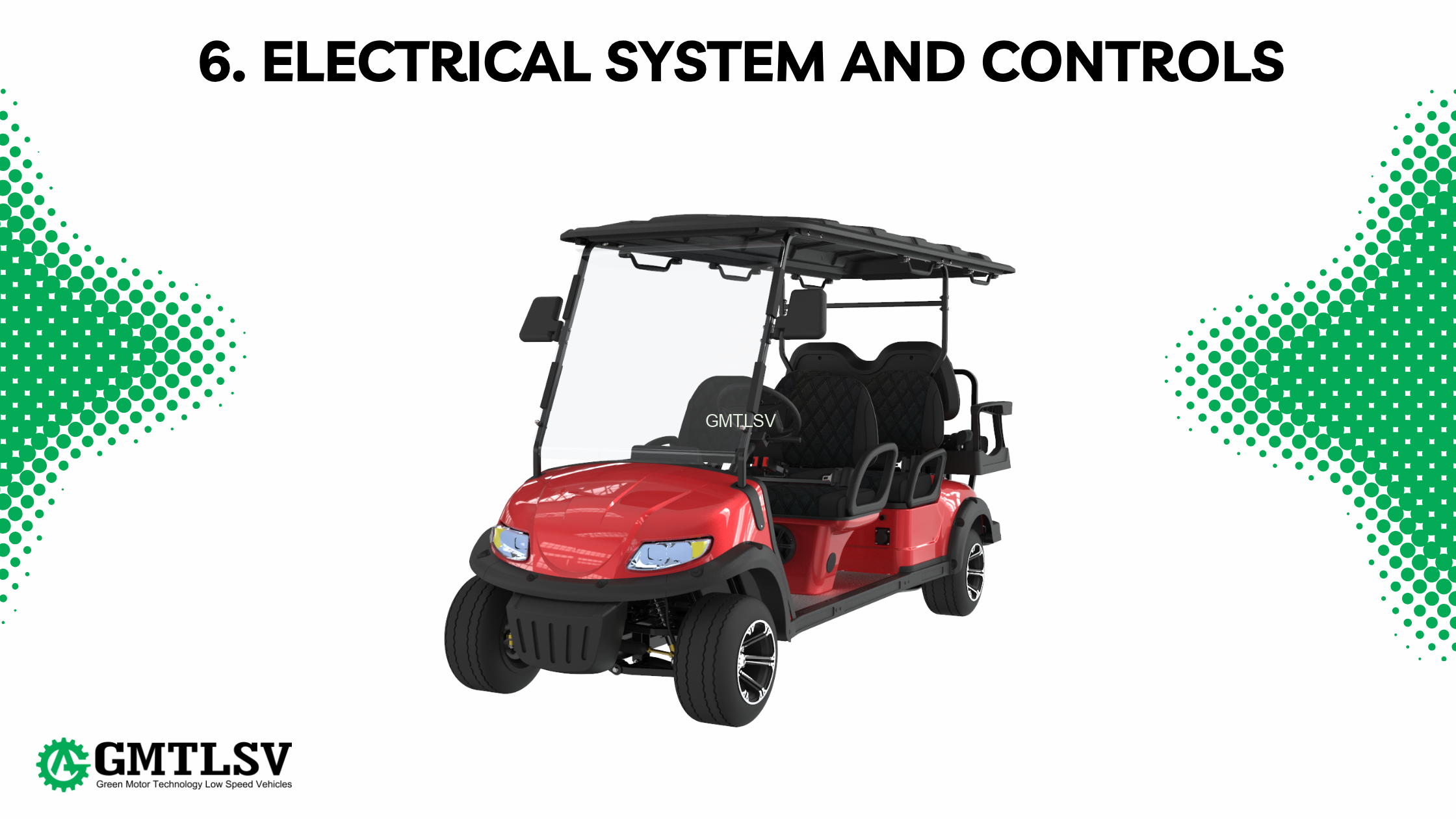
Electrical issues can be expensive and frustrating to diagnose. Intermittent problems are worst. Everything works during inspection, then fails after purchase.
Test everything. Multiple times if possible.
Lights and signals
Test all lights:
Headlights. Both low and high beam if equipped. Both should work at appropriate brightness.
Taillights. Do they illuminate when you turn on lights?
Brake lights. Have someone watch while you press the brake pedal. Both sides should light up.
Turn signals and hazard lights if equipped. Do they flash at correct rate on both sides?
Horn. Does it work? Is it loud enough to actually warn someone?
Any warning lights or indicators on the dash. Do they illuminate when first powering on and then go off?
Dim lights suggest electrical issues. Bad grounds, weak batteries, corroded connections. Something is limiting power delivery.
Control systems and gauges
Check the battery meter or charge indicator. Does it show full charge after charging? Does it drop appropriately during use? Inaccurate gauges make range management difficult.
Speedometer if equipped. Does it work and seem accurate?
Test the forward/reverse switch. Should engage smoothly in both directions without grinding or hesitation. Switch back and forth several times.
Key switch and ignition. Does it turn smoothly? Does the cart start reliably when switched on?
Throttle and accelerator response. Press gradually. Power should increase smoothly and proportionally. Jerky or delayed response indicates controller or throttle problems.
Check for any error codes or warning indicators. Some controllers display error codes. Know what they mean for the specific brand.
Wiring and connections
Look at visible wiring throughout the cart.
Check for damage, cuts, or exposed wire. Look for amateur splicing with electrical tape.
Is wiring properly routed and secured? Loose wires get caught, pinched, and damaged.
Look for corrosion at connection points. Green or white buildup on connectors causes intermittent problems.
Check for signs of rodent damage. Chewed insulation is common on carts stored in barns or garages. Rodents love wiring insulation.
Inspect the controller if accessible. Check for burnt smell, melting, or visible damage. Controllers are expensive to replace.
Listen for the solenoid click when switching to forward or reverse. A solid click indicates the solenoid is engaging properly. No click or a weak click suggests solenoid problems.
7. Test Drive and Performance Evaluation
Never buy a golf cart without test driving it. Period.
Inspection reveals many problems. But performance issues often only show up while actually driving. Weird noises under load. Handling quirks. Power delivery problems. You need seat time to find these.
Pre-drive preparations
Start in a flat, open area. Parking lot or driveway works.
Have the seller demonstrate operation first. Watch what they do. Note any hesitation or unusual procedures.
If the seller seems reluctant to let you drive or makes excuses about the cart not being ready, be suspicious. Working carts should be driveable.
Verify all safety features work before moving. Brakes engage. Lights function. Controls respond.
Acceleration and power delivery
Start from a stop. Accelerate gradually.
Acceleration should be smooth. No jerking or lurching forward. No hesitation when you press the pedal.
Power should feel consistent throughout the speed range. No dead spots or surging.
For electric carts, instant torque is normal and expected. Immediate response when you press the accelerator.
For gas carts, power builds more gradually but should still be smooth. No engine hesitation or stumbling.
Test on an incline if possible. How does the cart handle going uphill? Does it maintain speed or struggle? Power under load reveals a lot about condition.
A healthy cart shouldn’t struggle on mild hills.
Steering and handling
Pay attention to steering feel throughout the test drive.
Is steering responsive? It should turn when you want it to, with appropriate effort.
Is there excessive play or looseness? You shouldn’t have to turn the wheel significantly before the cart responds.
Does the cart track straight on flat ground? Let go of the wheel briefly on a flat surface. Does it drift to one side?
Test turning in both directions. Feel for binding, tightness, or unevenness between left and right turns.
Make some tight turns to check minimum turning radius. Listen for clicking, grinding, or binding sounds during turns.
Speed and range assessment
Check top speed. Most standard carts run 15 to 25 MPH. Does it reach expected speeds?
For electric carts, note the remaining charge indicator after your test drive. Does it seem appropriate for the distance traveled? Rapid battery drain indicates tired batteries.
For gas carts, note fuel consumption. Any smoke from exhaust during your drive?
Drive for at least 10 to 15 minutes if possible. Let all systems warm up to operating temperature. Some problems only appear after things get warm.
Monitor for unusual smells during the drive. Burning electrical smell is bad. Fuel smell in the cab is bad. Hot brake smell could indicate dragging brakes.
Listen for unusual sounds that develop during driving. Squeaks, rattles, grinding that wasn’t there at the start.
If something feels wrong, stop and investigate. Trust your instincts.
8. Features, Accessories, and Customization
Modern golf carts come with various features and accessories. Some add genuine value. Others are just cosmetic.
Assess what’s included and what condition it’s actually in.
Standard features check
Verify operation of standard equipment:
Windshield condition. Check for cracks, scratches, or hazing that limits visibility. Replacement windshields cost money.
Canopy or roof. Look for tears, fading, or damage. Check mounting points. A loose canopy is annoying at best, dangerous at worst.
Seats. Inspect for rips, excessive wear, or water damage. Check adjustment mechanisms if equipped. Seat covers can hide damage underneath.
Seat belts if equipped. Do they latch securely? Do they retract properly?
Storage compartments and cup holders. Do they open and close? Are they cracked?
Weather enclosures if present. Zippers work? Material intact? These deteriorate over time.
Mirrors. Properly mounted? Adjustable? Clear visibility?
Optional upgrades and accessories
Many used carts have aftermarket additions. Evaluate them.
Lift kit. How was it installed? Professional work or backyard job? Improper lift kits cause handling and drivetrain problems.
Custom wheels or upgraded tires. Nice visual touch. Check that tire sizes are appropriate for the cart.
Audio systems, Bluetooth, USB ports. Do they actually work? Turn them on and test.
LED light upgrades. Are connections proper? Do all lights function?
Rear seat kits or flip seats. Check mounting security. These should feel solid, not wobbly.
Storage boxes, cargo beds, or utility attachments. Proper installation? Secure mounting?
Quality of installations matters as much as the accessories themselves. Professional work adds value. Amateur installations can create problems and may need to be redone correctly.
9. Pricing and Value Assessment
After inspection, you need to determine whether the asking price reflects actual value.
This is where inspection findings become negotiation leverage.
Fair market value research
Compare the cart you’re considering to similar listings.
Match make, model, and year. A 2015 Club Car Precedent should be compared to other 2015 Club Car Precedents.
Condition matters significantly. Excellent condition carts command premiums. Fair condition carts should be priced accordingly.
Check local market prices. Golf cart values vary by region. Florida prices differ from Minnesota prices.
Factor in battery age for electric carts. If batteries are five years old, deduct replacement cost from the value. They’ll need replacing soon.
Account for repairs and upgrades needed. Don’t pay full price for a cart requiring significant work.
Typical used cart price range runs $2,000 to $10,000. Age, condition, brand, and features all affect where a specific cart falls in that range.
Negotiation factors
Use your inspection findings to negotiate fairly.
Battery replacement needed: Deduct $800 to $2,500 depending on battery type and quantity.
Tire replacement needed: Deduct $120 to $340 for a set of four, depending on tire type.
Maintenance items like brakes, fluids, or tune-up: Deduct $200 to $500 depending on what’s needed.
Cosmetic issues: Modest deductions. These don’t affect function but do affect value.
Major repairs needed like controller, motor, or frame damage: These are significant negotiation points. Major repairs can cost more than the cart is worth.
No service records available: Factor the unknown risk into your price. You’re taking on more uncertainty.
Be reasonable but be firm. Sellers sometimes get attached to their price regardless of condition. You have the inspection findings. Use them.
10. Where to Buy: Dealer vs. Private Seller
Where you buy affects price, warranty availability, and your risk level.
Both sources can work. But they’re different transactions with different expectations.
Buying from a dealer
Dealers typically offer advantages that private sellers can’t:
Many offer certified pre-owned programs with inspections completed before sale. You’re getting a cart someone already checked over.
Limited warranties are often available. Even 30 or 90 days of coverage protects against immediate failures.
Documented service history is more likely. Dealers often recondition carts and create service records.
You have recourse if problems arise. A dealer has a reputation to protect and a physical location.
Financing options may be available if needed.
Professional reconditioning means carts are often cleaned up, serviced, and ready to use.
The disadvantage: Higher prices than private sales. You’re paying for the convenience and protection.
GMT offers quality electric carts with warranty support. As a manufacturer and dealer, we stand behind what we sell and provide service after the sale.
Buying from private seller
Private sellers offer different advantages:
Lower prices. As-is sales from motivated sellers often price below dealer retail.
Direct negotiation with the person who actually used the cart. You can learn detailed history that paperwork doesn’t capture.
The disadvantages are significant though:
No warranty or guarantees. The cart is yours once money changes hands.
More risk without professional inspection. Private sellers don’t have mechanics reviewing carts before sale.
Less recourse if problems emerge. You can’t return a private party sale easily.
You must be extremely thorough with inspection. No one else is protecting your interests.
Verify ownership and clear title before purchase. Ask for the title. Confirm the name matches the seller. Check for liens if your state tracks them. Stolen carts and carts with outstanding loans create nightmares for buyers.
