

If you searched for “China chassis precedent club car manufacturer,” you’re probably not a casual golfer looking for a weekend cart.
You’re likely someone who knows the Club Car Precedent platform, understands what makes its chassis interesting, and now wants to know: can I source something similar—or compatible—from a Chinese manufacturer?
Maybe you’re a fleet operator looking for a more cost-effective platform. Maybe you’re a distributor exploring OEM options. Or maybe you’re a builder who wants to understand what’s actually available from China before committing to a supplier.
This guide will walk you through what the Precedent chassis actually is, why it became such a reference point in the industry, what Chinese manufacturers can realistically offer, and how to separate a real factory from a trading company.
What Is the Club Car Precedent?
The Precedent is one of Club Car’s flagship golf car models, released back in 2004. It replaced the long-running DS platform and was designed primarily as a fleet vehicle for golf courses.
But what made the Precedent stand out wasn’t just its styling. It was the chassis.
What Makes the Precedent Chassis Different?
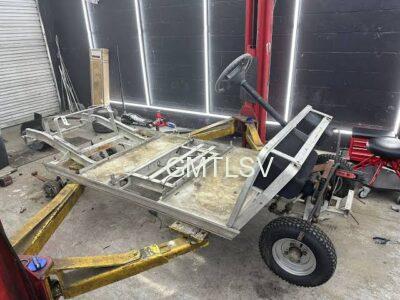
Club Car’s official specifications describe the Precedent frame as an “AlumiCore—ladder-style aluminum box beam”.
That’s a mouthful, but here’s what it actually means in practice:
-
Aluminum construction, not steel. The frame is built from aluminum rather than the more common welded steel. This matters because aluminum doesn’t rust.
-
Ladder-style box beam design. It’s a structural frame with two side rails connected by cross members—basically a ladder shape that provides rigidity while keeping weight down.
-
Aircraft-grade material. Industry listings describe it as “aircraft-grade, rust-proof aluminum frame,” which is why Precedent carts hold up so well in wet or snowy climates.
The manufacturing process is also worth noting. Back in 2007, Elixir Industries was producing the AlumiCore side rails at a facility in Douglas, Georgia. The side rails went through five successive bending operations before aging, then further processing to complete the platform frame for the Precedent.
So this wasn’t just a marketing name slapped on a standard steel frame. It was a genuinely different approach to golf cart chassis construction.
Why does this matter for buyers? Because if you’re looking for a “Precedent-style” chassis from a Chinese manufacturer, you need to know what you’re actually comparing. An aluminum ladder frame is not the same as a welded steel tube frame. Both can work well—but they have different weight, corrosion resistance, repairability, and cost profiles.
Why the Precedent Became a Reference Platform
Here’s something you’ll notice if you spend any time in the golf cart world: the Precedent platform comes up again and again—not just as a Club Car model, but as a benchmark.
Why?
First, it’s been on the market for two decades. That’s a long production run by any standard. Fleets have replaced entire generations of carts with Precedents. Parts are everywhere. Aftermarket accessories are abundant. Mechanics know the platform.
Second, the aluminum frame solved a real problem. Steel frames rust. In coastal areas, in humid climates, anywhere with salt or moisture—steel golf cart frames eventually corrode. Aluminum doesn’t. That’s not a minor detail when you’re managing a fleet that needs to last 8-10 years in Florida or Southeast Asia.
Third, it was designed for fleet use from the start. The Precedent wasn’t a luxury cart with commercial aspirations. It was built for golf courses that needed durable, serviceable, easy-to-maintain vehicles. That design philosophy made it a natural reference point for anyone building carts for similar applications.
Fourth, the aftermarket ecosystem is massive. When a platform has been around this long and sold this many units, an entire industry grows around it—replacement parts, upgrade kits, accessories, refurbishment services. That ecosystem makes the platform more valuable to everyone.
So when someone searches for “China chassis Precedent Club Car manufacturer,” they’re not just looking for a random chassis. They’re looking for something that fits into this ecosystem—or something that could serve the same role.
Are Club Car Precedents Actually Made in China?
This is where things get interesting, and it’s something a lot of people don’t know.
Club Car’s official FAQ states that most vehicles are assembled at their Evans, Georgia headquarters, but some vehicles are manufactured in Wujiang, China, for the Asia-Pacific market.
And the Precedent specifically has a documented history in China.
In January 2017, Club Car held a ceremony at its Wujiang factory to mark the launch of an independent production line for the Precedent series. According to the announcement, the line produced two models: the two-seat electric Precedent i2 and the four-seat Precedent Villager 4.
Here’s the detail that matters: major components were imported from the United States, and final assembly happened in China. The stated goal was to ensure quality identical to fully imported carts while achieving faster delivery and better cost efficiency for the region.
So Club Car itself has already demonstrated that the Precedent platform can be assembled in China to original specifications. That’s not a rumor or a guess—it’s documented.
This is important context for anyone evaluating Chinese manufacturers today. The question isn’t “can Precedent-style carts be built in China?” The question is “what level of quality and capability does a specific Chinese factory actually bring?”
Can Chinese Manufacturers Produce Precedent-Style Chassis?
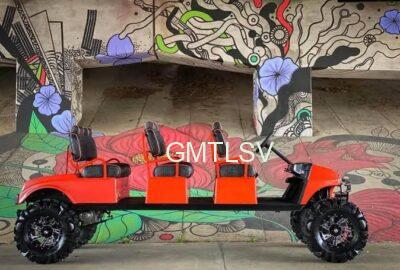
Yes—but let’s be precise about what that means.
Chinese manufacturers can produce:
-
Aluminum chassis frames for golf carts and low-speed vehicles
-
Steel chassis frames with various anti-corrosion treatments (electrophoretic coating, galvanizing, powder coating)
-
Custom wheelbases and frame geometries for different applications
-
Complete rolling chassis (frame, suspension, steering, brakes, transaxle)
-
Full vehicles built on those chassis
-
OEM/ODM configurations including custom branding, colors, seating, and powertrain options
A quick look at Chinese B2B platforms shows aluminum chassis options, steel chassis with 3mm thickness and electrophoresis anti-rust treatment, and high-strength rectangular steel tube frames with integrated bending and dual anti-rust processing.
What Chinese manufacturers generally do not do is produce genuine Club Car OEM replacement parts. If you need an exact Club Car part number, you buy from Club Car or a Club Car dealer. That’s a different supply chain entirely.
What they can do is produce application-compatible platforms—vehicles designed for the same use cases (golf fleets, resorts, communities, commercial transport) with similar or equivalent engineering approaches.
The key distinction: “Precedent-style” doesn’t mean “Precedent OEM.” It means a cart designed for similar applications, possibly with similar chassis architecture, but built by a different manufacturer with its own engineering, branding, and quality standards.
Club Car OEM Chassis vs. China-Made Golf Cart Chassis
Here’s a side-by-side that might help clarify the differences:
| Factor | Club Car OEM | China Manufacturer |
|---|---|---|
| Brand | Club Car | Manufacturer’s own brand or OEM label |
| Chassis design | Proprietary AlumiCore platform | Proprietary design, often steel or aluminum depending on model |
| Frame material | Aluminum (AlumiCore) | Aluminum, steel, or steel with anti-rust treatment |
| Customization | Model-specific, limited | Usually higher OEM/ODM flexibility |
| Sales channel | Dealer and fleet channels | Factory direct, wholesale, export |
| Parts | OEM + extensive aftermarket | Factory replacement parts |
| Application | Golf, commercial, personal | Golf, resort, utility, community, fleet |
| Pricing structure | Brand + dealer markup | Factory/OEM quotation |
The point here isn’t to say one is “better.” They serve different buyers with different needs.
If you want a genuine Club Car with dealer support and factory warranty, buy a Club Car. If you’re sourcing for a fleet, a resort, or a distribution business and you need flexibility, volume pricing, or custom configurations, a Chinese manufacturer may be a better fit.
How to Evaluate a China Golf Cart Chassis Manufacturer
This is the part that actually matters if you’re serious about sourcing.
Chinese manufacturers range from highly capable, export-oriented factories with real engineering teams to trading companies that resell whatever they can source from local workshops. The difference in quality, consistency, and support is enormous.
Here’s what to check before you commit:
1. Do they actually own a factory?
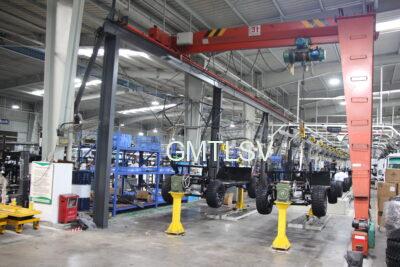
Ask for a live video tour. Not a pre-recorded marketing video—a real-time walkthrough where you can see the production floor, the equipment, and the people working. A trading company will dodge this request or show you someone else’s facility.
2. What’s their chassis fabrication capability?
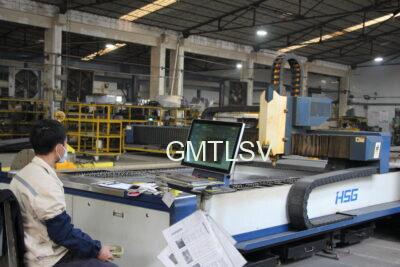
If they’re building frames in-house, they should have the equipment to prove it: tube bending machines, welding stations, jigs and fixtures, coating lines. If they’re outsourcing frames, that’s not necessarily bad—but you should know it.
3. What material are they using?
Aluminum or steel? What grade? What thickness? How is corrosion protection handled? For aluminum: is it extruded, welded, or both? For steel: is there electrophoretic coating, galvanizing, or powder coating? Ask for material certificates if needed.
4. What does their QC process look like?
Incoming material inspection. In-process checks during fabrication and assembly. End-of-line road testing. Ask for their inspection checklist. A serious factory will have one.
5. What components go into the vehicle?
Motor, controller, battery, charger, transaxle, brakes. Brand names or generic? A factory that’s proud of its component choices will tell you exactly what’s inside. One that’s evasive probably has something to hide.
6. Can they customize?
Custom wheelbase? Different seating configurations? Lithium vs. lead-acid? OEM branding? If they can’t handle basic customization, they’re probably not a real manufacturer.
7. What certifications do they have?
CE, DOT, EEC, EPA—depending on your destination market. A factory exporting to North America or Europe should have relevant certifications and documentation ready.
8. What about spare parts and after-sales?
This is where cheap suppliers fall apart. Can they supply replacement frames, controllers, and batteries in two weeks? Do they have English-speaking technical support? Will they still stock parts for the model you bought three years from now?
9. Do they have export experience?
Shipping golf carts across oceans requires proper packaging, documentation, and logistics coordination. A factory that regularly exports to your region will understand crating, container loading, customs paperwork, and delivery timelines.
What About Chinese Golf Cart Manufacturers?
China has become a major manufacturing base for golf carts and low-speed electric vehicles. The country has built one of the world’s most complete EV supply chains—motors, controllers, batteries, frames, and electronics are all available within a mature industrial ecosystem.
This means shorter production cycles, broader customization options, and competitive pricing. Many Chinese manufacturers are now export-oriented, serving markets in North America, Europe, Southeast Asia, and the Middle East.
But scale alone doesn’t guarantee quality. The key is finding a factory that actually invests in engineering, quality control, and after-sales support—not just one that churns out the cheapest possible cart.
GMTLSV: A China-Based Golf Cart and Low-Speed EV Manufacturer
This is where we come in. GMTLSV is a China-based manufacturer of golf carts, low-speed electric vehicles, and utility vehicles. We’ve been building electric vehicles since 1995, and we serve buyers ranging from individual purchasers to fleet operators and distributors.
Here’s what we actually offer:
Wheelchair-accessible electric vehicles with rear wheelchair compartments, integrated securement systems, and low-floor access for ADA-compliant transportation.
Enclosed low-speed electric vehicles for community transport, resort shuttle service, and commercial applications—with heating and air conditioning options for all-weather operation.
Utility and off-road EVs including flatbed and dump-bed models for campus, agricultural, and industrial use.
OEM/ODM services. Custom branding, colors, seating, battery configurations, and accessory packages. If you need a specific specification, we can build to it.
Global export. We ship worldwide and handle documentation, packaging, and logistics coordination. CE and DOT certification options are available depending on your market.
We’re not Club Car. We don’t claim to be. What we are is a real factory that builds electric vehicles for buyers who need flexibility, competitive pricing, and a manufacturing partner they can work with directly.
What Should Buyers Compare?
If you’re evaluating a Chinese manufacturer against a Club Car OEM platform—or comparing multiple Chinese manufacturers—here’s a practical comparison checklist:
| What to Compare | Why It Matters |
|---|---|
| Chassis material | Aluminum vs. steel affects weight, corrosion resistance, and repair approach |
| Frame construction | Welded, bolted, extruded—different methods have different durability profiles |
| Vehicle weight | Affects range, payload capacity, and shipping cost |
| Payload capacity | How much can it actually carry? |
| Motor power | AC vs. DC, rated vs. peak output |
| Battery system | Lead-acid vs. lithium, capacity, brand, BMS quality |
| Suspension | Independent vs. solid axle, shock quality |
| Braking system | Drum vs. disc, hydraulic vs. mechanical |
| Range | Real-world range under load, not just spec sheet numbers |
| Warranty | What’s covered, for how long, and who handles claims |
| Spare parts availability | Can you get parts in weeks, not months? |
| Customization flexibility | Can they build what you actually need? |
| MOQ | What’s the minimum order? |
| After-sales support | Who do you call when something breaks? |
| Total landed cost | Vehicle + shipping + duties + port fees + delivery |
| Certifications | Does it meet your market’s requirements? |
This isn’t a “who wins” comparison. It’s a framework for asking the right questions so you can make an informed decision for your specific situation.
The Bottom Line
The Club Car Precedent is a well-engineered platform with a genuinely interesting chassis—an aluminum ladder frame that solved real corrosion and weight problems for fleet operators. It’s been on the market for two decades, built an enormous ecosystem, and even had a dedicated assembly line in China at one point.
If you’re looking for a Precedent-style chassis from a Chinese manufacturer, you have options. Aluminum frames, steel frames, custom wheelbases, complete rolling chassis, and full vehicles are all available. The range of quality and capability among Chinese factories is wide, though—so the real work is in evaluating who you’re actually dealing with.
A real factory will show you the production line, explain their QC process, tell you exactly what components they use, and support you after the sale. A trading company will give you a catalog and a price list.
Ask the right questions. Get the video tour. Check the certifications. And if you’re comparing specs, compare the things that actually matter—chassis material, component quality, and after-sales support.

