
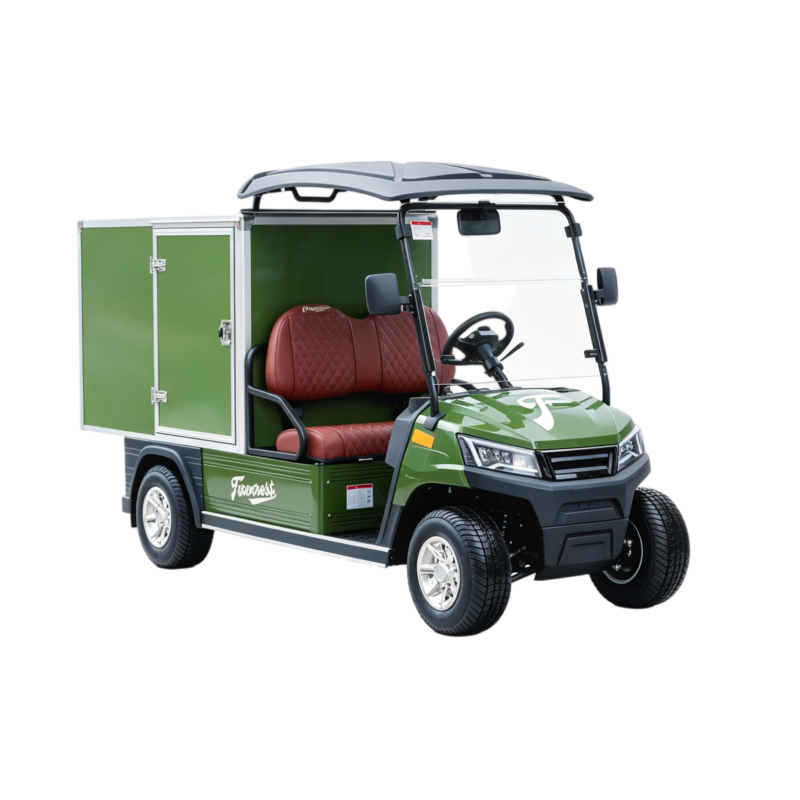
Custom Golf Carts in Canada: Pricing, Factory-Direct Options and OEM Orders
Custom golf carts are becoming an option for more than golf courses in Canada. Resorts, hotels, campgrounds, residential communities, industrial parks, last mile delivery, commercial properties and tourism operators use them for short-distance transportation, guest services and daily operations.
But what does a custom golf cart cost in Canada? Is it better to buy from a Canadian dealer or order factory-direct from an overseas manufacturer? And what should buyers know about import duties, winter battery performance and vehicle compliance before placing an order?
This guide explains the main pricing factors, customization options and purchasing considerations for Canadian buyers, including individual customers, fleet operators and businesses looking for OEM or private-label solutions.
1. How Much Does a Custom Golf Cart Cost in Canada?
The price of a custom golf cart depends on its seating capacity, battery system, motor, accessories, body design and intended application. A cart with a few appearance upgrades will cost considerably less than a purpose-built commercial vehicle or an OEM fleet order.
The following ranges are indicative budgeting estimates, not official Canadian market averages or supplier quotations.
| Type of custom golf cart | Indicative budget in CAD | Typical scope |
|---|---|---|
| Accessory and appearance upgrades | $500–$5,000+ | Seats, wheels, lighting, body colors, enclosures and accessories |
| Configured passenger golf cart | $10,000–$21,000+ | Seating, battery and drivetrain options, comfort features and styling |
| Commercial utility or specialty vehicle | $18,000–$30,000+ | Cargo configurations, utility equipment, enclosures or application-specific features |
| OEM/ODM or private-label project | Project-based | Custom branding, specifications, production quantities and vehicle development |
Actual prices vary by supplier, vehicle configuration, taxes, freight and the scope of customization. Confirm whether a quotation includes delivery, accessories, battery upgrades, warranty coverage and applicable taxes.
Examples of published Canadian prices
Canadian manufacturer Simolo Customs lists NXT vehicles at starting prices of approximately CA$20,995 and CA$21,995 for certain models on its inventory website. These are useful public reference points for buyers comparing premium, customized vehicles. The exact model, configuration and current price should be confirmed directly with the supplier.
See Simolo Customs’ current inventory.
What affects the final price?
Before comparing quotations, check these five areas:
- Battery: Lead-acid and lithium battery systems have different purchase costs, maintenance requirements and operating characteristics.
- Motor and controller: Power, torque, controller capacity and performance requirements affect the specification.
- Seating and body: Two-, four-, six- and larger passenger configurations require different chassis and body arrangements.
- Utility application: The product is customized to serve a specific application.
- Accessories: Enclosures, doors, lighting, cargo boxes, upgraded seats and other options add cost.
- Order quantity: A single custom cart, a fleet order and a private-label production project may have different pricing structures.
For a broader overview of purchasing costs, see our golf cart product range.
2. Buying from a Canadian Dealer vs. Ordering Factory-Direct
Both purchasing channels can make sense. The better choice depends on order size, customization requirements, after-sales expectations and how quickly the vehicle is needed.
| Factor | Canadian dealer or distributor | Factory-direct order |
|---|---|---|
| Initial purchase | Local retail pricing and available inventory | Quotation based on specifications and order quantity |
| Customization | Depends on the dealer’s options and supplier | May support broader specification or OEM customization |
| Delivery | Potentially faster for in-stock vehicles | Depends on production, shipping and customs clearance |
| Communication | Local sales and service contact | Direct contact with the manufacturer |
| Spare parts and service | May be available locally | Local support arrangements should be confirmed |
| Best suited for | Individual buyers and buyers needing local support | Fleet operators, distributors and businesses with defined requirements |
When does factory-direct purchasing make sense?
Factory-direct purchasing is worth evaluating when you need multiple vehicles, a consistent fleet specification, private-label branding or features that are not available in standard retail inventory.
However, the factory price alone does not determine the total cost. International freight, insurance, customs brokerage, duties, taxes, inland delivery, parts availability and warranty arrangements all matter.
For a small order, a locally stocked cart may offer better overall value. For a larger order, factory-direct sourcing may provide more control over the specifications and purchasing process.
The most useful comparison is therefore the total landed cost per vehicle, rather than the ex-factory price alone.
3. What Can You Customize on a Golf Cart?
Customization can range from simple appearance changes to a vehicle designed for a specific commercial task. Define the intended use first, then select the components and features that support it.
Appearance and comfort
Common options include:
- Custom body colors and decals
- Upholstery colors and upgraded seats
- Wheels and tires suited to the intended surface
- LED headlights, indicators and other lighting
- Windshields, roofs, weather enclosures and doors
- Storage compartments and accessories
For resorts and hospitality businesses, a consistent fleet appearance can help reinforce the property’s brand. For private owners, comfort and styling may be the main priorities.
Seating and layout
Two- and four-passenger carts are common choices, while larger passenger configurations may suit tourism, resort or commercial transportation operations.
Before choosing a larger layout, check the vehicle’s rated passenger capacity, chassis configuration, braking system and intended operating environment. More seats do not automatically make a vehicle suitable for public-road use.
Battery and powertrain
The battery and drivetrain should match the distance, terrain, load and daily duty cycle.
When comparing electric golf carts, ask suppliers to specify:
- Battery chemistry, nominal voltage and capacity
- Motor type and rated power
- Controller model and rating
- Expected operating range and the conditions used to estimate it
- Charging requirements and cold-weather restrictions
- Battery and vehicle warranty terms
Range estimates are not directly comparable unless the test conditions are similar. Passenger load, hills, speed, temperature, tire selection and accessory use can all affect real-world performance.
4. Custom Golf Carts for Commercial and Specialty Applications
A standard golf cart may be suitable for passenger transportation, but commercial buyers often need a configuration built around a particular workflow.
| Application | Possible configuration priorities |
|---|---|
| Golf courses | Comfortable seating, smooth ride, reliable daily operation and easy cleaning |
| Hotels and resorts | Passenger capacity, luggage space, branding and weather protection |
| Campgrounds and residential communities | Seating, storage, visibility and suitability for private roads |
| Commercial properties | Utility boxes, cargo capacity and maintenance access |
| Tourism operations | Passenger layout, weather protection and operating range |
| Warehouses and facilities | Cargo or towing configuration, maneuverability and duty cycle |
| Enclosed transport | Doors, enclosed bodywork, heating or air-conditioning options where supported |
Some applications require a utility cart rather than a conventional golf cart. If the vehicle must carry equipment, tow loads or operate in demanding conditions, the chassis, brakes, tires, motor and drivetrain should be selected accordingly.
For commercial buyers, start by documenting the vehicle’s daily route, passenger or cargo load, terrain, operating hours and charging opportunities. These details make supplier quotations more accurate and help avoid paying for features that are not needed.
Explore utility golf carts or enclosed electric vehicles for other vehicle configurations.
5. A Canadian Fleet Example: Predator Ridge and Simolo Customs
Predator Ridge in British Columbia provides a useful example of how customization can be tied to a specific operating environment.
In September 2025, Simolo Customs and Predator Ridge announced a partnership for a fleet of 200 golf carts, with the resort describing the project as the first time a Canadian golf resort would have its entire fleet supplied by a Canadian manufacturer.
In 2026, Predator Ridge reported that its new fleet had arrived. The carts were built locally by Simolo Customs in the Okanagan region, with attention to course suitability, terrain, ride quality and guest comfort. The project also included dedicated on-site service support.
Read the partnership announcement from Simolo Customs and Predator Ridge’s fleet build report.
The takeaway for fleet buyers is not that every fleet must be locally manufactured. It is that vehicle specifications should reflect the actual operating environment, and service arrangements should be considered alongside the initial purchase.
For a resort, that may mean prioritizing passenger comfort, terrain suitability and rapid maintenance. For a commercial property, it may mean cargo capacity, easy cleaning and dependable parts supply.
6. Importing Golf Carts into Canada: Duties, Taxes and Permits
Importing directly can be an option for Canadian businesses, but the landed cost and import requirements must be checked before the order is confirmed.
Customs duty and GST
The applicable customs duty depends on the vehicle’s tariff classification, country of origin and eligibility for a particular tariff treatment.
For example, Canada’s 2026 Customs Tariff lists a 6.1% Most-Favoured-Nation (MFN) duty rate for electric golf carts classified under tariff item 8703.10.90.11. The actual rate for a particular shipment may differ depending on its origin and applicable tariff treatment. Confirm the correct classification and rate with a qualified customs broker using the 2026 CBSA Customs Tariff.
GST is generally 5% at the federal level, while provincial sales tax or harmonized sales tax treatment depends on the province and the circumstances of the import.
Illustrative calculation only
Suppose a shipment has a customs value of CA$20,000 and a 6.1% customs duty applies:
| Item | Example amount |
|---|---|
| Customs value | CA$20,000 |
| Illustrative duty at 6.1% | CA$1,220 |
| Subtotal before GST | CA$21,220 |
| Illustrative GST at 5% | CA$1,061 |
| Subtotal after duty and GST | CA$22,281 |
This simplified example excludes freight, insurance, customs brokerage, port charges, inland delivery and other potentially applicable costs. It also does not account for provincial tax treatment or any tariff relief that may apply. It is not a final landed-cost quotation.
Do Chinese-made golf carts require a GAC import permit?
Canada introduced an import quota and permit system in 2026 for certain electric vehicles originating in China. However, the permit requirement does not automatically apply to every electric vehicle or every golf cart.
Global Affairs Canada’s import notice specifically states that electric golf carts and certain other non-passenger vehicles classified under tariff items 8703.80.00, 8703.90.00 or 8704.90.00 are excluded from the EV import controls and quota. A conventional electric golf cart may instead fall under a different tariff item, such as 8703.10.90.11, so the correct classification matters.
Before shipment, confirm the vehicle’s tariff classification and whether a GAC permit is required for the exact product. Do not assume that a permit is required—or that it is unnecessary—solely because the vehicle is electric or manufactured in China.
Check the latest Government of Canada guidance on electric vehicle imports from China and the applicable import notice before arranging shipment.
Documents to confirm before importing
The document requirements depend on the vehicle classification, the importer’s role and the intended use. Before paying the balance or booking freight, discuss the following with your supplier and customs broker:
- Commercial invoice and packing list
- Bill of lading or other shipping documents
- Country-of-origin and manufacturer information
- Vehicle specifications, serial or identification details, and product photographs where needed
- Battery shipping documents, where applicable
- Correct customs tariff classification and duty treatment
- Any applicable import permits
- Transport Canada and provincial requirements, where relevant
A Vehicle Import Form (Form 1), compliance labels or other Transport Canada documentation may be relevant for some vehicles and import circumstances, but they should not be treated as universal requirements for every golf cart. Transport Canada distinguishes regulated and non-regulated vehicles, and non-regulated status does not automatically mean a vehicle can be registered for public-road use.
See Transport Canada’s guidance on importing non-regulated vehicles. If the vehicle will be used on public roads, confirm federal vehicle classification and provincial or territorial requirements before ordering.
7. Winter Use and Lithium Battery Care in Canada
Cold weather is an important consideration for electric golf carts in Canada. Low temperatures can reduce available battery performance and range, and charging restrictions may apply even when a battery can still discharge.
Check the battery’s temperature limits
Lithium battery charging and storage limits vary by battery chemistry, cell selection, battery management system and manufacturer. Some lithium iron phosphate (LFP) battery manuals, for example, prohibit charging below 0°C unless the battery is specifically designed with a suitable low-temperature charging solution.
Before ordering a cart for winter operation, ask the supplier:
- What are the permitted charging, discharging and storage temperatures?
- Does the battery have a self-heating system, and under what conditions does it operate?
- Is the charger compatible with the battery management system?
- Can the vehicle be stored outdoors, and what precautions are required?
- What maintenance or charging procedure is recommended during extended storage?
Never assume that all lithium batteries have the same temperature limits. Follow the manual for the exact battery model.
Prepare for seasonal storage
If the cart will not be used regularly during winter, follow the manufacturer’s recommended storage state of charge and inspection schedule. Some manufacturers recommend storing lithium batteries at a partial state of charge, often around 40–60%, but the correct value depends on the specific battery.
Keep the battery dry and within its specified temperature range. Do not charge a battery that is below its permitted charging temperature, and do not bypass the battery management system to force charging.
For year-round fleet operations, consider covered storage, a suitable charging area and a written winter maintenance procedure. These preparations can be as important as the battery capacity selected at purchase.
8. How to Choose a Factory-Direct Golf Cart Manufacturer
For OEM buyers, importers and fleet operators, the manufacturer should be evaluated on more than price and product photos.
Manufacturing and quality control
Ask about the manufacturer’s production capabilities, component sourcing, assembly process, inspection procedures and quality records. If the supplier claims to manufacture key components in-house, clarify which components are actually produced internally and which are purchased from third parties.
A practical supplier assessment should cover:
- Production capacity and experience with the requested vehicle type
- Motor, controller, battery and drivetrain specifications
- Assembly inspection and pre-shipment testing
- Spare-parts availability and warranty process
- Packaging, shipping arrangements and export experience
- Ability to support repeat orders with consistent specifications
Certifications and compliance documents
Ask for copies of the relevant documents and check their scope, validity and applicability to the exact model.
ISO 9001 relates to a quality management system; it does not, by itself, certify that every vehicle is approved for road use in Canada. A World Manufacturer Identifier (WMI) identifies a manufacturer for vehicle identification purposes and is not a guarantee of Canadian road eligibility.
Likewise, CE, DOT, EEC/CoC and battery transport documents are not interchangeable. Their relevance depends on the product, market and intended use. Do not assume that a supplier’s general certification claim applies to every model or satisfies Canadian requirements.
For lithium battery shipments, ask which safety and transport documents are available for the exact battery pack, such as applicable UN 38.3 test documentation and the safety data sheet. Confirm the carrier’s requirements before shipment.
Minimum order quantity and lead time
OEM orders may involve custom colors, branding, battery specifications, seating layouts or other changes. These can affect production planning and delivery.
There is no single lead time that applies to all custom carts. A stocked vehicle, a customized standard model and a newly developed OEM vehicle may have very different schedules. Ask the manufacturer to confirm the production lead time, sample approval process, shipping estimate and the point at which the delivery schedule becomes firm.
For smaller commercial orders, clarify whether the supplier can support a limited quantity and whether the price changes with order volume.
9. Factory-Direct Golf Cart Solutions from GMTLSV
GMTLSV is part of the Green Motor Tech group, whose manufacturing history began with electric motors in 1995. The group has experience across electric motors and related drivetrain components, alongside electric vehicle assembly and export.
For buyers evaluating factory-direct supply, GMTLSV can discuss golf carts and other low-speed electric vehicle configurations, including passenger vehicles, utility carts, UTV and enclosed vehicles. Depending on the project, specifications can be reviewed for battery systems, motor and controller selection, vehicle layout, branding and other application requirements.
The group reports export experience across more than 140 countries and regions. Manufacturing and quality credentials, including ISO 9001 and WMI-related documentation, should be checked against the relevant entity, current validity and intended vehicle model. Any market-specific certification or road-use approval should be confirmed separately.
For OEM or fleet inquiries, prepare the following information before requesting a quotation:
- Application: Golf course, resort, campground, commercial property, utility work or another use.
- Quantity: Sample order, small fleet or recurring production order.
- Vehicle layout: Number of seats, cargo requirements, doors and enclosure needs.
- Technical requirements: Battery chemistry and capacity, motor power, target range, terrain and daily operating hours.
- Market and use: Destination province or territory, private-property use or intended public-road use.
- Branding: Body color, logo, decals and any private-label requirements.
- Delivery: Required delivery location and target date.
With this information, a manufacturer can assess the suitable configuration and clarify pricing, MOQ, production timing, documentation and after-sales support.
Explore the GMTLSV golf cart range or contact the team for an OEM quotation.
10. Frequently Asked Questions
How much does a custom golf cart cost in Canada?
An indicative budget may range from a few hundred or several thousand Canadian dollars for accessory upgrades to around CA$10,000–$21,000 or more for a configured passenger cart. Commercial vehicles and OEM projects may cost more. These figures are budgeting estimates, not guaranteed market prices; request a quotation based on the exact configuration.
Is it cheaper to import a golf cart directly from a factory?
It can be, particularly for fleet orders or vehicles requiring specific configurations. However, compare the total landed cost, including freight, customs duty, taxes, brokerage, inland delivery, warranty and spare parts. For a single cart, a locally stocked model may be more economical once all costs are included.
What import duty applies to an electric golf cart in Canada?
The duty depends on the correct tariff classification, origin and applicable tariff treatment. Canada’s 2026 tariff lists a 6.1% MFN rate for electric golf carts under tariff item 8703.10.90.11, but the rate for a specific shipment should be confirmed with a customs broker.
Do all Chinese-made electric golf carts require a GAC import permit?
No. Canada’s 2026 EV import controls cover specified tariff classifications, and the official notice excludes certain electric golf carts and other non-passenger vehicles classified under designated tariff items. The importer should verify the exact classification and current requirements before shipment.
Can a golf cart be driven on public roads in Canada?
Not automatically. A golf cart intended for golf-course or private-property use is not necessarily a road-legal low-speed vehicle. Federal vehicle requirements, the vehicle’s classification and provincial or territorial rules may all matter. Confirm eligibility before purchasing a vehicle for public-road use.
Are lithium batteries suitable for Canadian winters?
They can be suitable, but performance and charging limits depend on the battery design. Cold weather may reduce range, and some batteries must not be charged below a specified temperature. Ask whether the vehicle has battery heating and follow the manufacturer’s exact operating and storage instructions.
Can I order custom golf carts with my own brand?
Some manufacturers offer OEM or private-label options, subject to minimum quantities, design feasibility and production arrangements. Confirm the available branding options, sample process, MOQ, tooling or setup charges, lead time and warranty terms before placing an order.
Conclusion
Choosing a custom golf cart in Canada means balancing the vehicle’s purchase price with its configuration, operating environment, import costs and long-term support.
For individual buyers, a locally available model may offer convenience and faster delivery. For resorts, fleet operators and distributors, factory-direct sourcing can be worth considering when it provides the right specifications, consistent supply and a clear service plan.
Before committing to an order, confirm the full landed cost, tariff classification, applicable import and vehicle requirements, battery temperature limits, warranty coverage and delivery schedule. A detailed specification and a transparent quotation are the best starting points for a successful purchase.


