
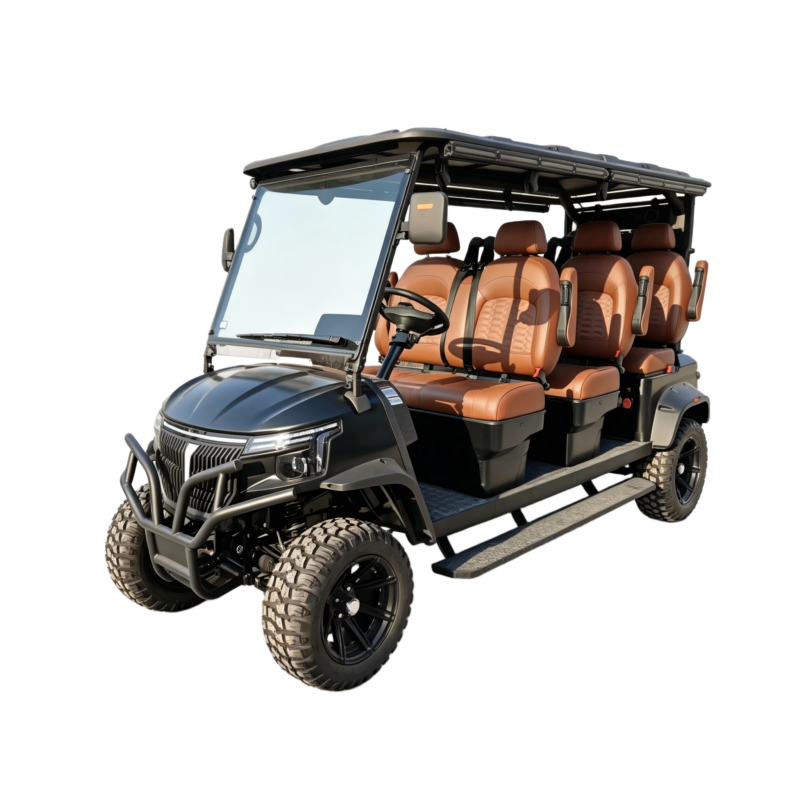
A six-passenger electric vehicle with a raised roof sits in an awkward category if you approach it from the golf side of the market. It is too big for a foursome, too slow for a road trip, and too specialised for casual private ownership. But approach it from the hospitality side, and the logic becomes immediately clear: this is not a golf cart with extra seats. It is a guest-movement asset built around a different set of constraints — group size, arrival experience, staff efficiency, and the visual language a property uses to signal what kind of place it is.
The global electric shuttle market was valued at USD 1.48 billion in 2024 and is projected to reach USD 2.82 billion by 2030, growing at a CAGR of 11.3%. The commercial services segment — resorts, hotels, airports, theme parks, campuses — is identified as the fastest-growing application category, driven by “increasing demand for sustainable and efficient transport solutions” in exactly these environments. A raised-roof 6-passenger shuttle is one of the most direct expressions of that demand.
The Capacity Math: Why Six, and Why Forward-Facing
A four-seat golf cart is built around the golf foursome. A resort shuttle is built around the family unit, the couples travelling together, the small tour group, and the luggage-heavy arrival. Six forward-facing seats change the operational math in ways that are easy to underestimate.
A single six-passenger shuttle can move a group that would otherwise require two separate four-seat trips. That halving of trip count compounds across a day of arrivals, restaurant transfers, beach runs, and spa appointments. For a property where staff time and vehicle availability are the binding constraints — not road speed — the capacity gain is the primary economic argument. The 4-seater segment currently holds the larger share of the electric shuttle market precisely because it balances capacity and compactness for many applications. The 6-seater is the step up when group movement becomes frequent enough that doubling trips is no longer acceptable.
The forward-facing configuration matters beyond comfort. It is the standard in hospitality shuttles because guests arriving at a resort expect to face forward, see where they are going, and be seen arriving in a posture that feels intentional rather than improvised. A rear-facing bench is a golf-course solution. A forward-facing row is a guest-experience solution.
The Raised Roof Is Not a Styling Choice
The raised roof is the most visible differentiator of this vehicle, and it is the one most likely to be dismissed as aesthetic. That would be a misreading. A raised roof does three operational things that matter in hospitality use.
Headroom for boarding and alighting. Resort guests are not golfers in caps. They are travellers with carry-on bags, elderly guests who need to move carefully, and parents lifting children into seats. A raised roof increases the vertical clearance in the passenger cabin, reducing the crouch-and-duck that a standard golf cart roof line imposes. Over hundreds of boardings a day, that difference is a comfort and safety variable, not a luxury flourish.
Sightlines and a sense of occasion. A raised roof lifts the passenger cabin visually, giving guests a clearer view of the property as they move through it. In a resort context, the shuttle ride is often the first sustained impression of the grounds. A vehicle that feels open and elevated turns a transfer into a brief tour. A vehicle that feels low and utilitarian turns it into a wait that happened to be moving.
Brand and fleet identity. The raised-roof silhouette is distinctive at a distance. For a property running multiple shuttles across a large footprint, that silhouette becomes a wayfinding cue — guests recognise the vehicle that is coming to collect them without reading a livery. It also gives the property a surface for brand expression that a standard golf-cart profile does not offer as generously.
What the 6-Seater Is Not: The LSV Question
A recurring source of confusion in this category is the relationship between “golf cart,” “shuttle cart,” and “low-speed vehicle.” They are not interchangeable, and the distinction determines where a vehicle can legally go.
Under U.S. federal standards, a Low-Speed Vehicle (LSV) is a four-wheeled motor vehicle capable of more than 20 mph (32 km/h), subject to specific equipment and safety requirements, and intended for use on public roads with a speed limit of 35 mph or less in many jurisdictions. A conventional golf cart operating only inside a resort or golf course is a different regulatory animal entirely — it generally does not require DMV registration when used strictly on private property. A “street-legal golf cart” is a third category that some jurisdictions explicitly exclude from LSV status.
The practical implication for a luxury property is this: a raised-roof 6-passenger shuttle is optimised for private-property movement — lobby to villa, reception to beach, clubhouse to parking, guest to restaurant. That is the dominant use case in resort hospitality, and it is the use case this vehicle is built around. If a property needs to send the same vehicle onto public roads, the compliance profile changes, and the vehicle must be evaluated against the LSV framework of the relevant jurisdiction rather than assumed to qualify. For most resort buyers, the private-property envelope is not a limitation. It is the operating environment the shuttle was designed for.
The Market Signal: Hospitality Is Electrifying Guest Movement
The shift toward electric shuttles in premium hospitality is not speculative. Laguna Phuket, one of Southeast Asia’s largest integrated resort complexes, launched eight fully electric shuttles in late 2025, explicitly framed as part of a low-carbon transition and a “cleaner transport network” for the destination. The luxury shuttle bus market, a broader category that includes premium guest transport, was valued at USD 4.9 billion in 2025 and is projected to reach USD 9.5 billion by 2033, with fleet electrification and tightening emissions regulations cited as structural drivers.
The luxury segment of this market is moving toward what industry analysis describes as “premium shuttle services to guests seeking privacy, exclusivity, and convenience,” with high-end resorts, golf clubs, and cruise terminals driving investment in branded shuttle experiences. A raised-roof 6-seater sits directly in that current. It is not competing on price against a base fleet golf cart. It is competing on the quality of the guest’s first and last five minutes on property — the arrival and the departure, where impressions are formed and reviews are shaped.
Who This Vehicle Is Actually For
The clearest buyer is not an individual. It is a property operations decision-maker — a resort general manager, a hospitality group’s procurement lead, a private club’s facilities director — evaluating how guests move across a footprint that is too large to walk comfortably and too small to justify a full shuttle bus.
That buyer’s criteria are different from a golf course’s. The golf course asks about turf-friendly tyres and hill-climb torque. The hospitality buyer asks: How many guests per trip? How quickly can a guest board with luggage? Does the vehicle look like it belongs at this property? Can it operate all day on a charge, and who maintains it? A 6-passenger raised-roof shuttle answers those questions in a way a standard cart does not, because it was specified around them rather than adapted toward them.
The electric shuttle market’s growth is concentrated in exactly the environments where this vehicle makes sense: resorts, hotels, gated communities, and premium destinations where quiet, zero-emission movement is part of the product being sold. A raised-roof 6-seater is not the cheapest way to move six people a few hundred metres. It is the version of that job that treats the movement itself as part of the guest experience — and in premium hospitality, that is the only version that survives a procurement review.


