

4/6/8-Seater Golf Carts for Resorts, Hotels and Guest Transfers: A South Africa Selection Guide
Prepared by the GMTLSV Application Engineering Team
Reviewed for the Southern Africa hospitality market
Last updated:2026-11-10
The last 500 metres of a guest’s journey — from the car park to the villa, from the lobby to the safari departure point, or from the conference centre to the garden suite — can have a significant impact on the guest experience. In South Africa’s resort and hotel sector, that journey is rarely limited to smooth, paved roads. Coastal humidity, Highveld winter mornings, bushveld dust, gravel vineyard tracks and afternoon thunderstorms all influence which electric shuttle is suitable for a property.
A golf cart that performs well on a flat golf course may not be the right choice for a safari lodge or a large coastal resort. The number of seats is only one part of the decision. Terrain, passenger flow, luggage requirements, operating hours and weather protection all matter.
This guide focuses on 4-, 6- and 8-seater golf carts for South African resorts, hotels and guest transfers. Rather than treating them as three sizes of the same vehicle, we look at the different operational roles they serve and the specifications that should be considered before selecting a fleet.
Contents
-
4-Seater vs 6-Seater vs 8-Seater Golf Carts: Which Capacity Fits Your Property?
-
South African Property Conditions: What Should Your Golf Cart Be Equipped With?
-
Safety and Operational Requirements Before Your First Guest Boards
-
Battery, Range and Charging: Can the Vehicle Complete Your Daily Routes?
-
How to Choose a 4/6/8-Seater Fleet Mix
-
What to Prepare Before Requesting a Golf Cart Recommendation
-
Frequently Asked Questions
-
Looking for a Golf Cart Manufacturer for Your South African Property?
4-Seater vs 6-Seater vs 8-Seater Golf Carts: Which Capacity Fits Your Property?
The first mistake in selecting a hotel shuttle is assuming that more seats automatically mean better value. A 6-seater is not necessarily a better investment than a 4-seater, and an 8-seater is not always the most efficient way to move groups.
Each configuration serves a different purpose.
| Selection factor | 4-Seater | 6-Seater | 8-Seater (6+2) |
|---|---|---|---|
| Main application | VIP transfers, couples, small families and luggage transfers | Daily guest circulation and general hotel transportation | Group transfers, activity departures and peak passenger demand |
| Typical routes | Narrow internal roads, villas and short transfers | Lobby-to-villa, parking-to-reception and resort circulation | Safari departures, conference groups and larger properties |
| Turning radius | ≤5 m | ≤6.5 m | Same as the 6-seater platform: ≤6.5 m |
| Seating flexibility | Compact and easy to manoeuvre | More passenger capacity for regular operations | Additional two seats when required |
| Luggage handling | Depends on seating and luggage arrangement | Moderate, depending on passenger load | Rear flip seat converts into a load deck |
| Best fleet role | Flexible supporting vehicle | Mainline workhorse | Additional capacity for peak periods |
Turning-radius figures refer to GMTLSV’s designed golf cart series, rather than general industry averages.
Quick answer: Most South African hospitality properties need a mixed fleet rather than a single-capacity purchase. A 6-seater covers mainline circulation, a 4-seater handles narrow routes and VIP transfers, and a 6+2 (8-seater) provides surge capacity for occasional group departures. The right mix depends on peak concurrent guest movement, not on total room count.
4-Seater Golf Cart: Flexibility for VIP Transfers and Smaller Properties
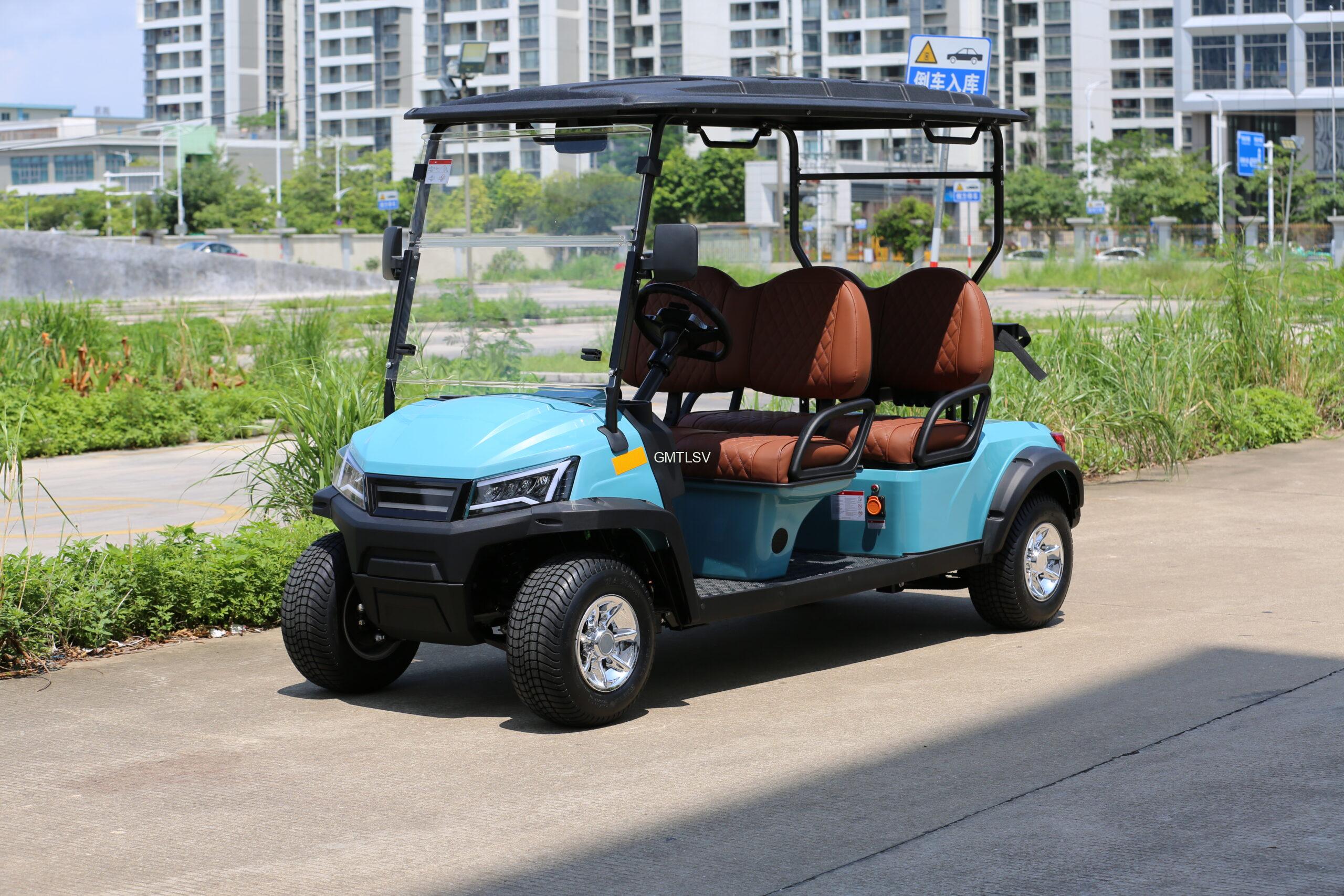
A 4-seater golf cart is often the most practical choice for boutique hotels, villa resorts and properties with narrow internal roads.
It works particularly well for:
-
Couples and small families travelling between accommodation and reception.
-
VIP guest transfers where comfort and privacy matter.
-
Luggage movements between reception, parking areas and guest villas.
-
Night-time transportation where a compact vehicle is easier to manoeuvre.
Its turning radius of no more than 5 metres gives it an advantage on tighter internal routes. For properties with narrow pathways, landscaped gardens and limited turning space, this can make daily operations easier.
A smaller vehicle can also be useful when passenger demand is low. Instead of operating a larger shuttle with several unused seats, the property can deploy a 4-seater for individual transfers and routine circulation.
Configuration reference: [4-seat enclosed shuttle product page]
6-Seater Golf Cart: The Mainline Vehicle for Resort Operations
For many medium-sized and large hospitality properties, the 6-seater golf cart is the most versatile configuration.
It can accommodate a family, a small guest group or several passengers travelling together between the lobby, villas, restaurants and recreational facilities.
Its main advantages include:
-
Higher passenger capacity than a standard 4-seater.
-
Practical capacity for recurring hotel shuttle routes.
-
Suitability for reception, checkout and breakfast traffic.
-
Compatibility with enclosed and open-body configurations, depending on the operating environment.
GMTLSV’s designed 6-seater golf cart series has a turning radius of no more than 6.5 metres. This is an important measurement for properties where vehicles regularly navigate reception areas, villa entrances and internal junctions.
Before ordering, hotel operators should compare this figure with their actual route layout. A vehicle that carries more passengers but cannot comfortably turn around at a villa entrance may create more operational problems than it solves.
Configuration reference: [6-seat resort shuttle product page]
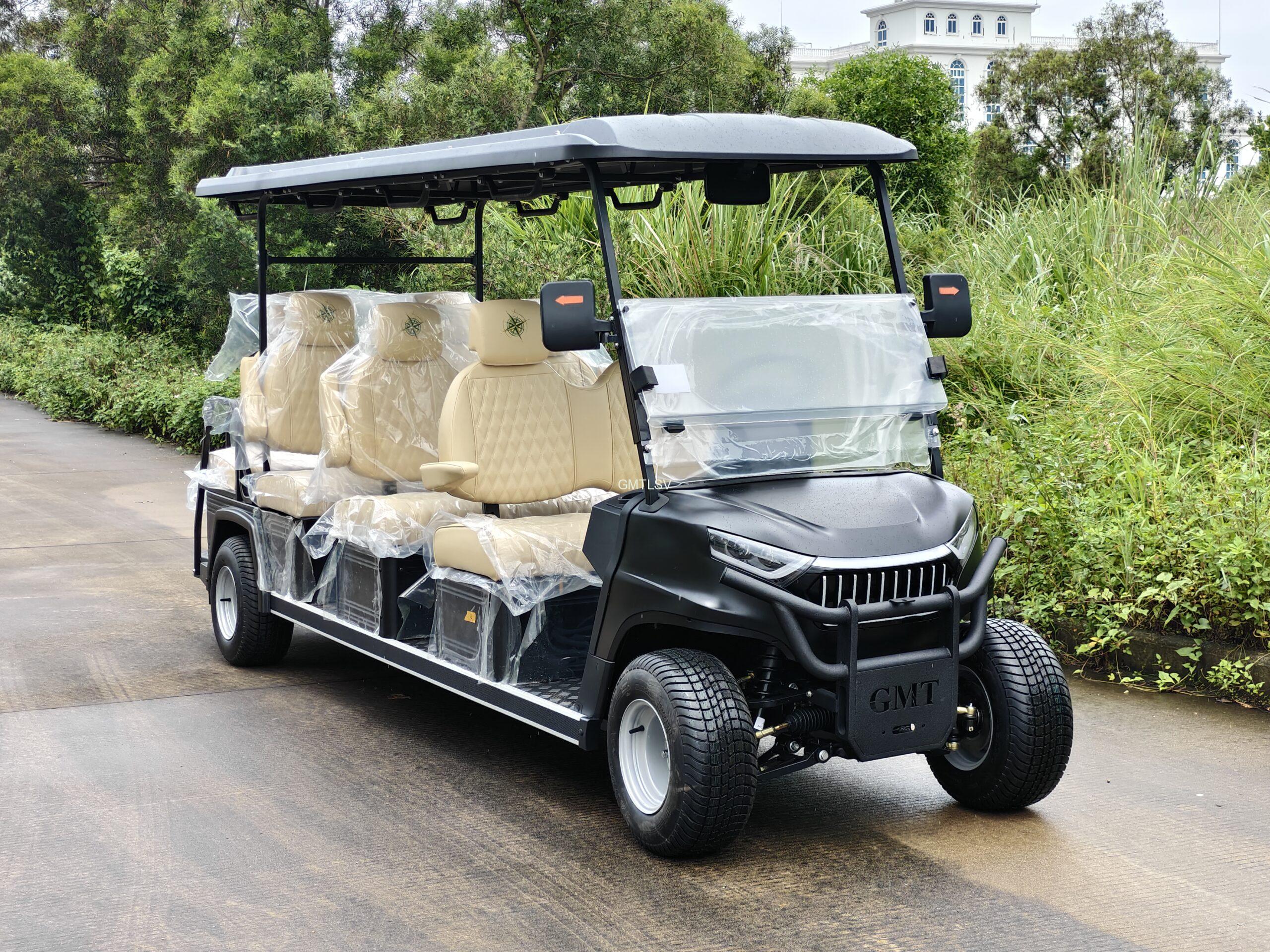
8-Seater Golf Cart: A 6+2 Configuration for Occasional Group Demand
An 8-seater golf cart is best understood as a 6+2 vehicle rather than a completely different vehicle platform.
The configuration uses the 6-seater chassis and wheelbase, with an additional rear-facing flip seat. When the rear seat is used, the vehicle can accommodate two additional passengers. When it is folded, the space becomes a flat load deck for luggage, golf bags or supplies.
This gives the vehicle two operating modes:
-
Passenger mode: Transport up to eight occupants.
-
Cargo mode: Fold the rear seat to create additional luggage or load space.
Because the 8-seater uses the same chassis and wheelbase as the corresponding 6-seater, its turning radius remains within the same designed limit of 6.5 metres.
For a safari lodge, conference hotel or resort with occasional group departures, this flexibility can be useful. However, 8-seat demand is less common than 4- and 6-seat demand in many hospitality operations.
If most daily transfers involve four to six passengers, a standard 6-seater may provide better utilisation. The 8-seater makes more sense when the property regularly needs to move larger groups or wants the option of converting passenger capacity into luggage space.
Configuration reference: [6+2 flip-seat configuration page]
South African Property Conditions: What Should Your Golf Cart Be Equipped With?
South Africa has several distinct hospitality environments. A coastal resort, a wine estate and a safari lodge may all need guest transportation, but their operating requirements are different.
The following table provides a practical starting point for specification selection.
| Property type | Typical operating conditions | Recommended specification considerations |
|---|---|---|
| Coastal resort | Humidity, salt-laden air, heat and occasional heavy rain | Enclosed cabin with AC, corrosion protection and weather-resistant electrical connections |
| Wine estate | Gravel tracks, moderate gradients and changing weather | Suitable motor torque, all-terrain tyres and upgraded suspension where necessary |
| Safari lodge | Sand, dirt roads, dust and uneven surfaces | Traction capability, dust protection, suitable ground clearance and suspension |
| Golf estate | Paved paths, fairway edges and noise-sensitive surroundings | Quiet drivetrain, comfortable suspension and open or semi-enclosed body |
| Conference hotel | Paved roads, frequent stops and short transfer loops | Enclosed AC cabin, convenient passenger access and reliable braking |
Traction: Motor Power Alone Does Not Guarantee Performance
On sand, loose gravel or a steep unpaved road, a vehicle may have sufficient motor torque but still struggle because the driven wheels cannot maintain traction.
This is particularly relevant to safari lodges and wine estates.
Before selecting a drivetrain, operators should identify:
-
The steepest gradient on regular routes.
-
Whether the surface is compacted gravel, loose sand or mud.
-
Whether vehicles need to travel on wet or uneven ground.
-
Whether the route includes sections where wheel slip is likely.
For properties operating mainly on paved roads, a conventional two-wheel-drive configuration may be sufficient. For more demanding surfaces, a suitable traction solution should be considered.
The operational benefit is straightforward: fewer interruptions, more reliable guest transfers and less dependence on alternative transportation when road conditions change.
Enclosed Cabins: Comfort and Weather Protection for Daily Operations
An enclosed golf cart with air conditioning and heating can make a meaningful difference to guest transportation.
South African properties experience very different weather conditions. Coastal humidity, cold Highveld mornings and dusty bushveld environments can all affect passenger comfort.
For hotels and resorts operating throughout the year, an enclosed cabin can help maintain a more consistent guest experience.
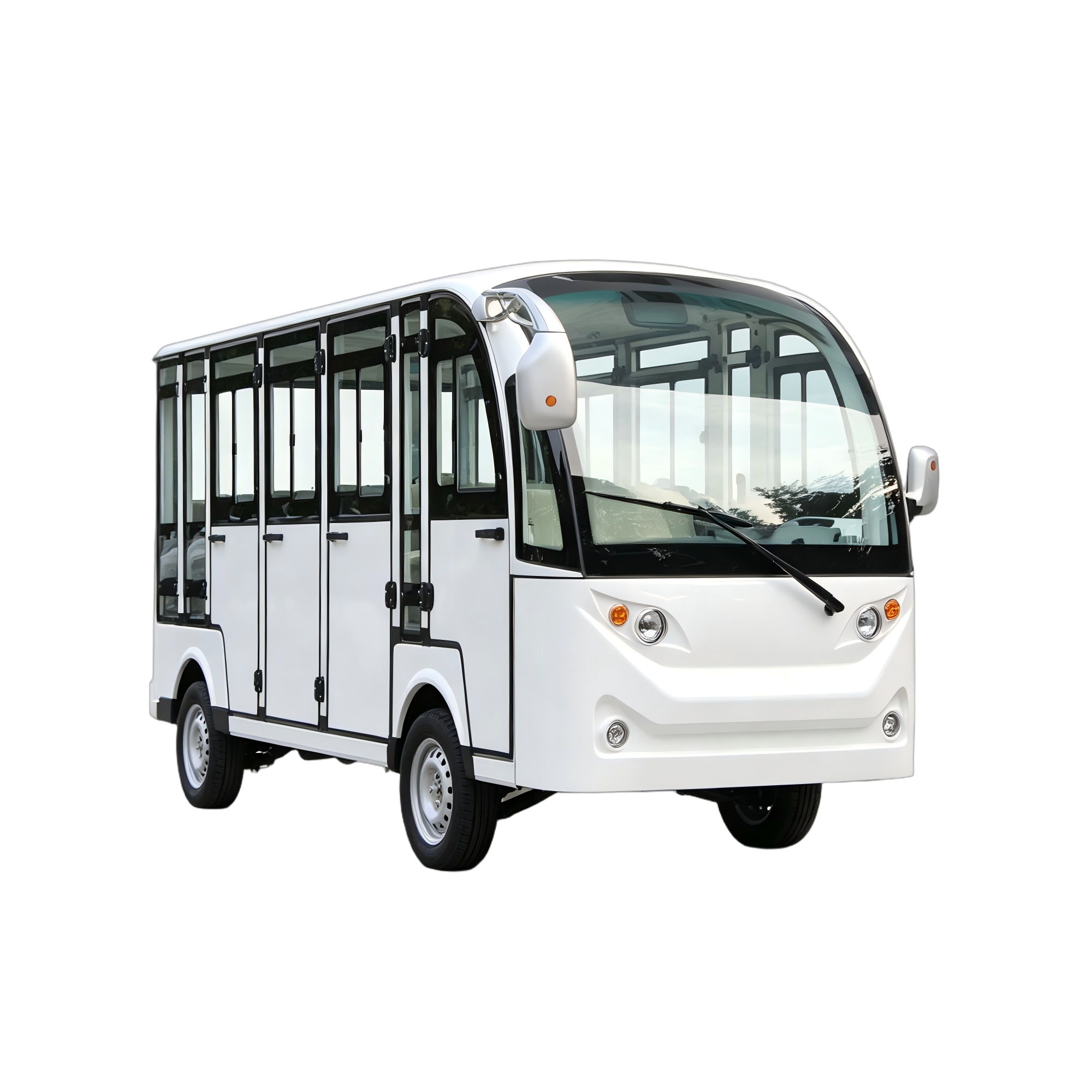
GMTLSV’s enclosed 4- and 6-seat models can be configured with:
-
Vehicle-mounted electric air conditioning with cooling and heating.
-
Full doors.
-
Laminated glass windshields.
-
Three-point seat belts.
-
Integrated lighting and vehicle controls.
For a resort where guests regularly travel between reception and accommodation, climate protection can be more important than additional seating capacity.
However, an enclosed cabin also adds vehicle weight and increases energy demand. On a short, fully paved golf estate route, an open or semi-enclosed vehicle may be more economical to operate.
The right decision depends on how frequently the vehicle is used, the climate and the expectations of the property’s guests.
Tyres, Suspension and Ground Clearance: Match the Vehicle to the Route
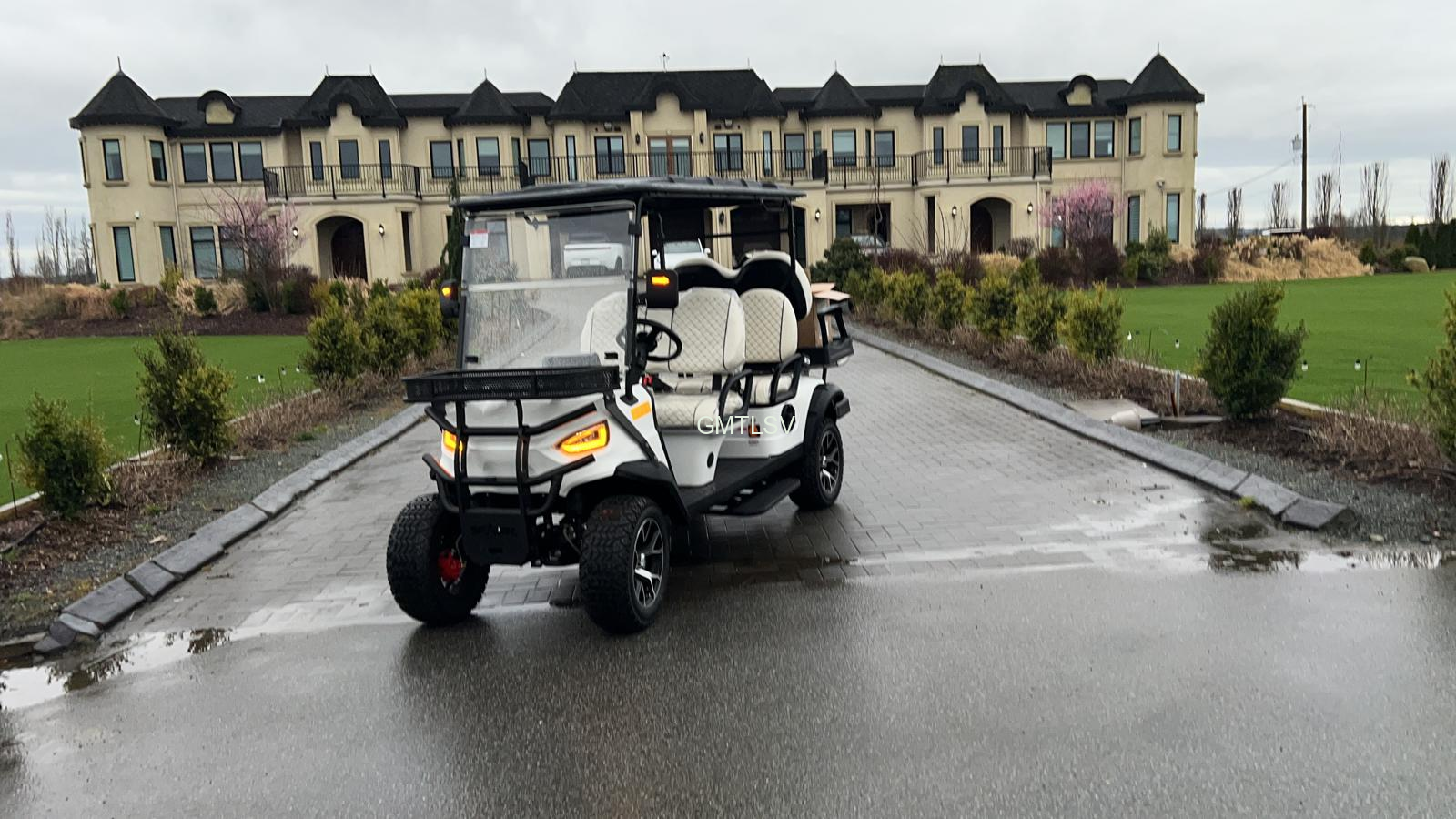
Larger tyres and upgraded suspension can improve the vehicle’s ability to handle uneven surfaces, but they should not be selected simply because an off-road appearance looks more suitable for a safari lodge.
A higher ground clearance may improve performance on rough roads, while an unsuitable tyre or suspension combination can affect handling, ride comfort and vehicle dimensions.
Before confirming the specification, measure:
-
The narrowest turning point on the route.
-
The steepest gradient.
-
The height and width restrictions at entrances.
-
The available space in parking and charging areas.
This is particularly important when choosing an 8-seater. Although it shares the 6-seater platform’s turning characteristics, the complete vehicle still needs to be assessed with its actual tyre and suspension configuration.
Safety and Operational Requirements Before Your First Guest Boards
A hotel shuttle carries passengers, often on a daily basis. Safety should therefore be considered during vehicle selection rather than treated as a final inspection item.
For vehicles operating within private property, the applicable requirements may differ from those for vehicles using public roads. In practice, low-speed vehicles used entirely within private compounds are usually treated differently from road-registered vehicles. Operators should confirm the relevant vehicle classification, permitted operating environment and any applicable requirements with local authorities and their insurers.
Several practical points deserve attention.
| Verification item | What to check |
|---|---|
| Braking system | Confirm the braking configuration and request loaded braking performance information |
| Seat belts | Verify the restraint system for every seating position, including the rear-facing 8-seat bench |
| Lighting | Check headlights, indicators, brake lights and reversing alarms |
| Passenger access | Ensure passengers can enter and exit comfortably and safely |
| Driver training | Establish operating rules, driver responsibilities and permitted routes |
| Night operation | Consider visibility, low-speed drivetrain noise and reversing alarm behaviour |
The rear flip seat on an 8-seater deserves particular attention. GMTLSV has experience assembling this configuration with seat belts, but buyers should confirm the actual restraint arrangement and seating specifications of the vehicle being ordered.
For hospitality operators, the objective is not simply to purchase a vehicle that can carry the rated number of passengers. It is to establish a safe, consistent transportation service for guests and staff.
Battery, Range and Charging: Can the Vehicle Complete Your Daily Routes?
Vehicle capacity and battery capacity should be considered together.
A 4-seater carrying two guests on short transfers has a different energy requirement from an 8-seater carrying a full group over uneven terrain.
GMTLSV’s golf cart series can be configured with different battery platforms, including:
-
48V 150Ah lead-acid batteries
-
51.2V 105Ah lithium batteries
For reference, the following are GMTLSV’s stated range figures for the corresponding seating configurations.
| Configuration | Reference range |
|---|---|
| 4-seater | Approximately 80 km |
| 4+2 configuration | Approximately 80 km |
| 6-seater | Approximately 70 km |
| 6+2 (8-seater) | Approximately 70 km |
These figures are based on flat-ground, fully loaded operation at a test speed of 20 km/h. Actual operating range will vary with battery condition, temperature, terrain, gradients, driving style and passenger load.
For hotel operators, the important question is not simply how far a vehicle can travel on one charge. It is whether the available range comfortably covers the planned daily duty cycle.
For example, a resort operating several short transfer loops may require less energy than a safari lodge covering longer distances over sandy or uneven roads.
A practical selection process should therefore consider:
-
The longest single transfer route.
-
The number of expected trips per shift.
-
The total daily distance.
-
The available overnight charging window.
-
Whether vehicles need to remain available during peak guest movement periods.
Charging infrastructure should be planned around the actual fleet and its working schedule. A vehicle that has sufficient theoretical range may still become unavailable if it cannot be recharged before the next busy period. If the property’s charging circuit is affected by load-shedding, the practical range of every vehicle in the fleet shrinks — a factor that should be checked before confirming the capacity mix.
This section covers vehicle-level range and battery selection. For fleet-level charging layout, load-shedding resilience, storage planning and maintenance staffing, see our upcoming South African Resort & Lodge Electric Fleet Planning Guide: Vehicles, Charging and Operating Costs.
How to Choose a 4/6/8-Seater Fleet Mix
Most hospitality properties do not need a fleet made up entirely of one vehicle configuration.
A combination of capacities can provide better flexibility.
| Property requirement | Possible fleet approach |
|---|---|
| Boutique hotel with narrow internal roads | Mainly 4-seaters |
| Medium-sized coastal resort | 4-seaters for private transfers and 6-seaters for daily circulation |
| Large resort with frequent guest movements | Primarily 6-seaters, supported by 4-seaters |
| Safari lodge with occasional group departures | 6-seaters with selected 6+2 vehicles |
| Conference and event property | 6-seaters for routine service and 6+2 vehicles for peak demand |
These are starting points, not fixed fleet formulas.
The final mix should be based on peak concurrent passenger demand rather than the property’s total guest capacity.
For example, a property with 100 rooms does not necessarily need to transport 100 guests simultaneously. What matters is how many people need transportation during the busiest 30-minute period, how many carry luggage and how many trips each vehicle can complete.
This is also why purchasing several identical vehicles is not always the most efficient approach. A mixed fleet can reduce unnecessary passenger capacity during quieter periods while retaining the ability to handle group movements.
Not sure which capacity mix fits your property? Send us your route profile and peak guest flow — we will respond with a capacity recommendation, not a price list. Contact our team by sending email to here: maggie@greenmotortech.com
What to Prepare Before Requesting a Golf Cart Recommendation
A useful recommendation starts with the property and its operating conditions, not simply the number of seats.
If you are evaluating 4-, 6- or 8-seat golf carts for a South African hotel, resort, estate or safari lodge, the following information will help establish the appropriate configuration.
1. Property type
Coastal resort, wine estate, safari lodge, golf estate, conference hotel or mixed-use property.
2. Internal road conditions
Paved roads, gravel, sand, gradients, narrow turning points and any access restrictions.
3. Passenger demand
Typical passengers per transfer, peak guest movements and the proportion of journeys involving large luggage.
4. Daily operating distance
The longest single route, estimated daily kilometres and expected operating hours.
5. Weather protection
Whether an open, semi-enclosed or fully enclosed cabin with AC and heating is appropriate.
6. Charging availability
Available charging time, power supply and whether the charging circuit remains operational during load-shedding.
7. Maintenance arrangements
In-house technical staff, local service partners or a combination of both.
With this information, GMTLSV can evaluate the appropriate vehicle capacity, battery configuration, cabin design and optional equipment for the property.
Frequently Asked Questions
What is the difference between a 6-seater and an 8-seater golf cart?
An 8-seater golf cart is typically built on the same chassis and wheelbase as the 6-seater, with a rear-facing flip seat added at the back. In passenger mode it carries up to eight occupants; when the rear seat is folded, the space becomes a flat load deck for luggage. Because the platform is unchanged, the turning radius remains the same as the 6-seater.
Can an 8-seater golf cart carry luggage?
Yes. The rear flip seat can be folded down to create a flat load deck, so the vehicle can switch between passenger mode and cargo mode. The practical limitation is that it cannot carry eight passengers and full luggage at the same time — the property needs to decide which mode matters more on a given route.
Do resort golf carts need to be road-legal in South Africa?
Vehicles used entirely within private property are generally treated differently from road-registered vehicles. If a shuttle route crosses or uses a public road, the applicable requirements change, and operators should confirm the vehicle classification and permitted operating environment with local authorities and their insurer before service begins.
How far can a 6-seater electric golf cart travel on one charge?
GMTLSV’s stated reference range for the 6-seater is approximately 70 km, based on flat-ground, fully loaded operation at a test speed of 20 km/h. Actual range varies with battery condition, temperature, terrain, gradients, driving style and passenger load, so the daily duty cycle should be checked against the real route rather than the brochure figure alone.
Is an enclosed golf cart with AC necessary for South African resorts?
Not always. Coastal humidity, cold Highveld mornings and dusty bushveld conditions make an enclosed AC cabin an operational tool for many properties, but on a short, fully paved golf estate or conference route an open or semi-enclosed vehicle may be more economical. The decision depends on climate, route length and guest expectations.
Reference Configuration Data
The following table summarises GMTLSV’s reference design data for the 4-, 6- and 8-seat configurations discussed in this guide. Figures are based on GMTLSV design specifications and are subject to final configuration, battery selection and optional equipment.
| Parameter | 4-seater | 6-seater | 8-seater (6+2) |
|---|---|---|---|
| Turning radius (designed limit) | ≤5 m | ≤6.5 m | ≤6.5 m |
| Reference range (flat ground, full load, 20 km/h) | ≈80 km | ≈70 km | ≈70 km |
| Battery options | 48V 150Ah lead-acid / 51.2V 105Ah lithium | 48V 150Ah lead-acid / 51.2V 105Ah lithium | 48V 150Ah lead-acid / 51.2V 105Ah lithium |
| Typical fleet role | VIP, narrow routes, night duty | Mainline circulation | Peak group demand, luggage mode |
| Luggage mode | Limited | Moderate | Rear flip seat converts to load deck |
For dimensional drawings, loaded braking data and current configuration sheets, contact the GMTLSV application engineering team.
Looking for a Golf Cart Manufacturer for Your South African Property?
Selecting a suitable vehicle is only one part of a successful fleet investment. The manufacturer should also be able to support the required seating configurations, drivetrain options, battery systems, body designs and after-sales parts supply.
GMTLSV manufactures electric golf carts and low-speed vehicles for hospitality, commercial and recreational applications, with 4- and 6-seat configurations and optional 6+2 seating arrangements.
If you are still comparing suppliers, product ranges and sourcing options, read our guide to Sourcing Golf Carts from China for South Africa: A Dealer & Fleet Buyer Guide.
For a property-specific recommendation, share your route conditions, passenger requirements and expected daily operating distance with our team. We can help identify a practical vehicle combination and provide the corresponding configuration details for evaluation. [Request a configuration review]([contact / quotation page])


