
One-Stop Low-Speed Electric Vehicle Manufacturer: From Electric Drivetrain to Complete Vehicles
When looking for a low-speed electric vehicle manufacturer, it is easy to focus on the vehicle itself: the body design, seating capacity, battery size, motor power, or available options.
But for commercial, industrial, hospitality, agricultural, and customized electric vehicles, there is another question worth asking:
How much does the manufacturer actually understand about the electric system behind the vehicle?
A complete low-speed electric vehicle is more than a frame, battery, motor, controller, and body assembled together. The motor, controller, drive axle, battery, BMS, vehicle control system, chassis, braking system, and software all need to work together under real operating conditions.
This is where the concept of a one-stop low-speed electric vehicle manufacturer becomes different from simply buying a complete vehicle from one supplier.
For GREEN MOTOR TECH, one-stop manufacturing means combining long-term electric motor manufacturing experience, drive axle expertise, electric drivetrain development, battery system knowledge, and complete low-speed electric vehicle manufacturing within one group.
What Does “One-Stop” Mean for a Low-Speed Electric Vehicle Manufacturer?
“One-stop” does not simply mean that a factory purchases different components and assembles them into a complete vehicle.
A typical vehicle assembly factory can already source motors, controllers, batteries, chargers, axles, brakes, suspension systems, and other components from different suppliers.
The more important question is:
Does the manufacturer understand how these systems work together?
For a low-speed electric vehicle manufacturer, one-stop capability can be understood through several connected levels:
Electric Motor → Drive Axle → Electric Drivetrain → Battery & BMS → Vehicle Control → Complete Vehicle → Testing → OEM/ODM
The advantage is not necessarily that every component is manufactured by the same factory. Instead, it is the ability to connect component technology, drivetrain engineering, vehicle integration, and complete vehicle manufacturing within one manufacturing group.
This is the approach developed by GREEN MOTOR TECH through decades of experience in electric motors, drive systems, and low-speed electric vehicles.
From Electric Motor Manufacturing to Low-Speed Electric Vehicles
GREEN MOTOR TECH was established in 1995.
The company’s original business was not golf carts or low-speed vehicles. It started with the independent design, manufacturing, and sales of electric motors for applications including household appliances, new energy equipment, woodworking machinery, and other industrial uses.
This history is important because an electric vehicle manufacturer does not start with the vehicle body.
The electric drivetrain starts with the motor.
Understanding motor characteristics such as torque, speed, efficiency, cooling, operating conditions, and load requirements provides a technical foundation for developing electric drive systems.
Over the years, GREEN MOTOR TECH expanded its capabilities from individual electric motors toward electric vehicle powertrain and vehicle applications.
Today, GMTLSV focuses on complete low-speed electric vehicles, while CMVTE focuses on electric drive systems and vehicle electrification solutions within the same group.
GMTLSV’s vehicle portfolio covers much more than traditional golf carts. Its low-speed electric vehicles include golf carts, sightseeing vehicles, utility vehicles, enclosed electric vehicles, patrol vehicles, cargo vehicles, UTVs, vintage-style electric vehicles, and customized vehicles.
Drive Axle Expertise: An Important Part of the Drivetrain
The motor is only one part of an electric drivetrain.
The way motor power reaches the wheels is equally important.
GREEN MOTOR TECH has manufacturing and assembly capabilities for electric vehicle drive axles. Its core technical team has nearly 20 years of experience in the R&D and manufacturing of drive axles and gear transmissions.
The group’s drive axle products are primarily developed for:
- Electric utility and site vehicles
- Electric logistics vehicles
- Electric commercial vehicles
- Other low-speed electric applications
For these applications, important considerations include:
- Noise control
- Reliability
- Product consistency
- Gear ratio
- Load capacity
- Fatigue performance
- Static torsional strength
- Compatibility with the electric motor
Key reliability indicators, including fatigue and static torsional testing, have also been verified through third-party testing by the National Automobile Quality Supervision and Inspection Center.
This experience matters because a drive axle cannot be selected only by its physical dimensions.
The motor’s torque characteristics, vehicle weight, tire size, target speed, climbing requirements, gear ratio, and operating environment all influence the appropriate axle configuration.
That is why drivetrain development requires more than simply purchasing a motor and an axle separately.
Electric Drivetrain Development Since 2016
Since 2016, GREEN MOTOR TECH has been developing and matching electric drive systems for customers.
This marked an important transition from individual components toward integrated electric powertrain solutions.
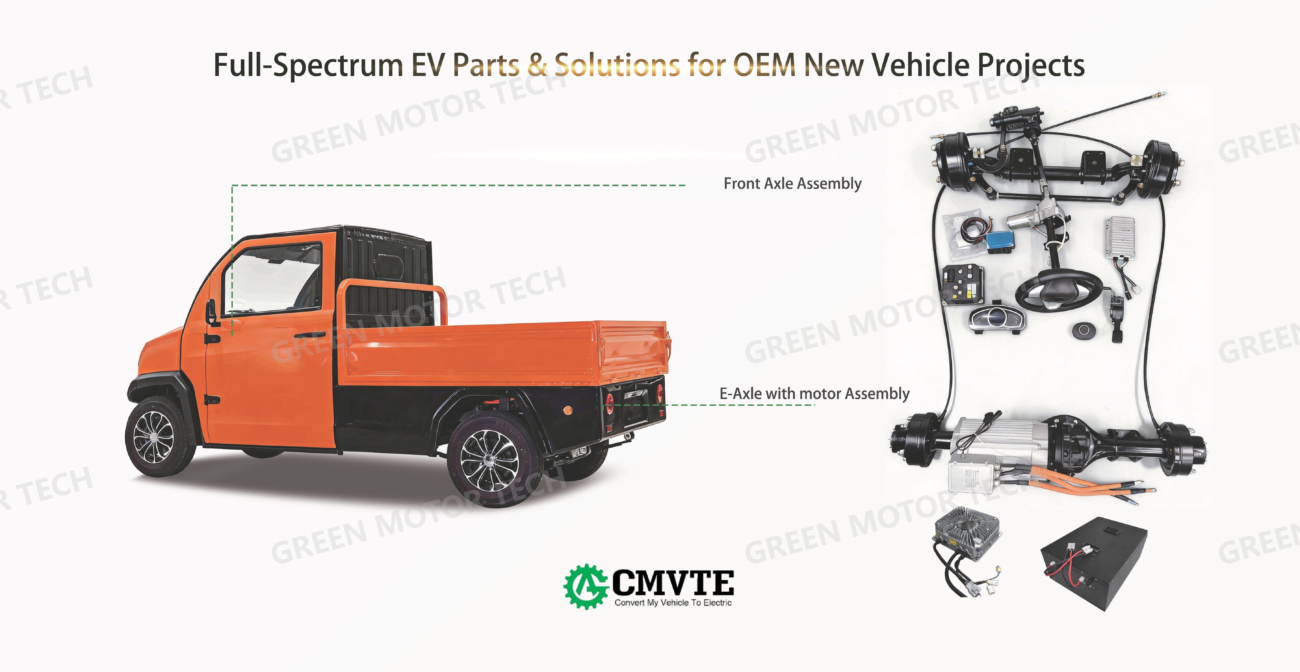
A typical low-speed electric drivetrain may include:
- Electric motor
- Motor controller
- Drive axle or gearbox
- Battery pack
- Battery Management System (BMS)
- Charger
- DC-DC converter
- Vehicle Control Unit (VCU)
- Dashboard and communication system
- Wiring and related electrical components
The challenge is not simply selecting each component independently.
The components need to be matched according to the actual vehicle.
For example, changing the motor may require changes to the controller calibration, battery output requirements, axle ratio, acceleration characteristics, regenerative braking strategy, and vehicle control software.
Similarly, increasing vehicle weight or payload may require a different motor, controller, battery capacity, axle ratio, or thermal management strategy.
This is why system integration becomes important.
For customers who need deeper information about electric powertrain engineering, CMVTE is the electric drive system and vehicle electrification division of GREEN MOTOR TECH. Its solutions cover electric motors, controllers, VCUs, BMS, battery packs, charging systems, communication protocols, and electric drive axles.
The relationship is straightforward:
CMVTE develops and matches the electric drive system.
GMTLSV integrates the system into complete low-speed electric vehicles.
Why Drivetrain Integration Matters
A low-speed electric vehicle may operate at relatively low speeds, but that does not mean its electric system is simple.
Different applications place very different demands on the vehicle.
A golf cart used on relatively flat terrain has different requirements from:
- A 4WD UTV working on farms
- A cargo vehicle carrying heavy loads
- A sightseeing bus operating continuously in a resort
- A patrol vehicle making frequent stop-and-go trips
- A utility vehicle working inside a factory or warehouse
The same motor or battery configuration cannot necessarily be optimized for all of these applications.
An integrated manufacturer can evaluate the vehicle as a complete system rather than treating each component separately.
This can help improve:
System Consistency
Motor, controller, battery, axle, and vehicle control parameters can be matched according to the intended application.
Performance Matching
Motor torque, controller current, battery output, axle ratio, vehicle weight, and target speed can be considered together.
Software Calibration
Electric drive systems require software calibration for acceleration, current limits, regenerative braking, speed control, and other operating parameters.
Compatibility
Better understanding of the complete system can help identify potential compatibility issues between the drivetrain, battery, controller, communication systems, and vehicle.
Faster Troubleshooting
When a problem occurs, the manufacturer can investigate at multiple levels—from the component to the drivetrain and finally to the complete vehicle.
This is particularly important for OEM customers developing customized low-speed electric vehicles.
More Than 10 Years of Lithium Battery System Experience
Since beginning electric drivetrain development in 2016, GREEN MOTOR TECH has also continued to study lithium battery technologies and battery solutions as part of its vehicle system development.
For an electric vehicle manufacturer, battery technology is not simply about choosing a battery capacity such as 105 Ah, 150 Ah, or 230 Ah.
The battery needs to match the rest of the vehicle.
Important considerations can include:
- Battery voltage
- Capacity
- Cell chemistry
- BMS configuration
- Continuous and peak current
- Charging requirements
- Communication protocols
- Motor and controller requirements
- Vehicle operating conditions
- Available installation space
- Weight distribution
- Expected range
- Charging environment
For customers comparing different battery technologies for low-speed electric vehicles, the LSV battery guide provides a useful starting point for understanding battery voltage, capacity, lithium battery systems, and other considerations.
The battery is effectively part of the drivetrain.
For this reason, experience in battery systems can be just as important as understanding the motor and controller.
The objective is not simply to install a larger battery, but to develop a battery solution that works appropriately with the vehicle’s electric drive system.
One Manufacturer, Multiple Low-Speed Electric Vehicle Applications
Another important part of the one-stop concept is vehicle diversity.
Many manufacturers in the low-speed EV market specialize primarily in golf carts.
GMTLSV, however, manufactures a broader range of low-speed electric vehicles for different applications.
These include:
- Golf carts
- Utility vehicles
- Sightseeing buses
- Enclosed electric vehicles
- Patrol vehicles
- Cargo and logistics vehicles
- UTVs
- Vintage-style electric vehicles
- Community transportation vehicles
- Customized low-speed electric vehicles
For example, customers looking for passenger transportation can explore electric sightseeing buses, while agricultural, utility, and off-road applications may require electric UTVs.
For enclosed passenger or community transportation applications, enclosed electric vehicles provide another type of low-speed EV configuration.
This diversity is important because different applications create different engineering requirements.
A hotel may need passenger shuttle vehicles.
A factory may need utility or cargo vehicles.
A resort may need sightseeing buses.
An agricultural customer may need an electric UTV.
A municipal or industrial customer may require a customized special-purpose vehicle.
All of these can fall within the broader category of low-speed electric vehicles.
From Drivetrain Engineering to Complete Vehicle Manufacturing
The other half of one-stop manufacturing is complete vehicle production.
A low-speed electric vehicle manufacturer still needs to integrate the electric drivetrain into a complete vehicle.
This includes systems such as:
- Chassis
- Body
- Suspension
- Steering
- Braking
- Electrical system
- Lighting
- Dashboard
- Battery installation
- Motor and drivetrain installation
- Interior
- Vehicle control system
- Final inspection and testing
The result is not simply an electric powertrain and not simply an assembled body.
It is a complete vehicle designed around a specific application.
For customers who are comparing different electric golf cart models, for example, the drivetrain is only one part of the final vehicle. Seating, chassis design, suspension, braking, battery layout, body configuration, and intended operating environment also need to be considered together.
GMTLSV’s manufacturing business therefore focuses on the complete low-speed electric vehicle, while CMVTE provides the group’s electric drivetrain and vehicle electrification expertise.
Together, the two business divisions connect electric powertrain engineering with complete low-speed vehicle manufacturing.
One Group, Two Specialized Business Divisions
GREEN MOTOR TECH GROUP operates two complementary business divisions.
CMVTE — Electric Drive System and Vehicle Electrification
CMVTE focuses on:
- Electric motor and controller matching
- Electric drivetrain development
- Drive axle solutions
- Battery system solutions
- Vehicle electrification
- EV conversion engineering
- Customized electric powertrain systems
Its role is to develop and match the electric drive system according to the vehicle and application.
GMTLSV — Complete Low-Speed Electric Vehicles
GMTLSV focuses on:
- Low-speed electric vehicle manufacturing
- Complete vehicle assembly
- Vehicle customization
- OEM and ODM projects
- Golf carts
- Utility vehicles
- Sightseeing vehicles
- Enclosed EVs
- UTVs
- Special-purpose and customized vehicles
For customers developing a new vehicle or adapting an existing platform, the group’s OEM and ODM capabilities can connect the drivetrain side with the complete vehicle side.
This division structure allows the group to approach an electric vehicle project from both sides:
the electric drivetrain and the complete vehicle.
When Does a One-Stop LSV Manufacturer Make Sense?
Not every buyer needs this level of manufacturing capability.
If you simply need a standard golf cart in a standard configuration, a traditional assembly supplier may be sufficient.
A deeper one-stop manufacturing capability becomes more relevant when you need:
Multiple Vehicle Types
For example, golf carts, utility vehicles, UTVs, sightseeing vehicles, and cargo vehicles from the same manufacturing group.
Customized Drivetrains
When motor power, battery voltage, axle ratio, payload, speed, range, or operating conditions require a customized configuration.
OEM or ODM Development
When the customer needs more than a standard catalog vehicle and requires changes to the drivetrain, body, battery, software, or vehicle configuration.
Long-Term Technical Support
When the supplier needs to understand not only the vehicle assembly but also the underlying electric drivetrain.
Application-Specific Solutions
When the vehicle will be used in industrial, agricultural, tourism, hospitality, logistics, campus, resort, municipal, or other specialized environments.
How to Evaluate a One-Stop Low-Speed Electric Vehicle Manufacturer
When comparing LSV manufacturers, “one-stop” should not be judged only by the number of components a supplier can provide.
Instead, consider these questions:
1. Does the manufacturer have real electric motor experience?
Find out whether the company has a history of motor manufacturing or only purchases motors for vehicle assembly.
2. Does it understand the drive axle and drivetrain?
Check whether the manufacturer has engineering experience with axle ratios, torque transmission, load requirements, and drivetrain matching.
3. Can it develop an integrated electric drive system?
Ask how the motor, controller, battery, BMS, axle, and vehicle control system are matched.
4. Does it have experience with lithium battery systems?
Look beyond battery capacity. Ask about BMS, communication, current requirements, charging, and system integration.
5. Can it manufacture different types of low-speed electric vehicles?
A broader product portfolio can indicate experience with different vehicle structures and operating conditions.
6. Can it support OEM and customized projects?
A manufacturing partner should be able to work beyond standard catalog configurations when the application requires it.
7. Can it troubleshoot problems at the system level?
This is one of the most important questions.
When a vehicle has an acceleration, charging, communication, overheating, range, or drivetrain problem, can the manufacturer identify whether the root cause is the battery, controller, motor, axle, software, or vehicle integration?
What One-Stop Means at GREEN MOTOR TECH
For GREEN MOTOR TECH, the meaning of One-Stop Low-Speed Electric Vehicle Manufacturing can be summarized in one chain:
1995 — Electric Motor Manufacturing
↓
Drive Axle & Gear Transmission Experience
↓
2016 — Electric Drivetrain Development
↓
Motor + Controller + Drive Axle + Battery + BMS + Vehicle Control
↓
Complete Low-Speed Electric Vehicle Manufacturing
↓
Testing + OEM / ODM + Customized Solutions
This is the foundation behind the group’s approach to low-speed electric mobility.
The goal is not simply to put more components under one roof.
It is to connect component knowledge, electric drivetrain engineering, system integration, and complete vehicle manufacturing within one manufacturing group.
A One-Stop Partner for Low-Speed Electric Vehicles
The low-speed electric vehicle market is becoming increasingly diverse.
Golf carts remain an important application, but today’s LSV market also includes utility transportation, tourism, hospitality, logistics, agriculture, industrial mobility, community transportation, patrol vehicles, and other specialized applications.
As applications become more specialized, the manufacturer’s technical depth becomes increasingly important.
GREEN MOTOR TECH brings together nearly three decades of electric motor manufacturing experience with drive axle expertise, electric drivetrain development since 2016, lithium battery system experience, and complete low-speed electric vehicle manufacturing.
Through its two business divisions—CMVTE for electric drivetrain and vehicle electrification solutions, and GMTLSV for complete low-speed electric vehicles—the group provides a connection between the electric powertrain and the vehicle itself.
That is what One-Stop Low-Speed Electric Vehicle Manufacturing means at GREEN MOTOR TECH:
not simply one supplier for every component, but one manufacturing group with the experience and engineering capability to connect the electric drivetrain with the complete vehicle.
For customers developing, sourcing, or customizing low-speed electric vehicles, this provides an integrated starting point—from the first drivetrain specification to the finished vehicle.


