

For those of us in the low-speed electric vehicle (LSEV) industry, there’s a recurring theme during vehicle commissioning and customer handover: the parking brake. While top speed and range dominate spec sheets, the parking system is the single most frequent point of contact between the user and the vehicle’s core safety architecture. It dictates not only safety but also ergonomics, NVH (Noise, Vibration, and Harshness), and long-term durability.
As an engineer, I’ve spent considerable time analyzing four distinct architectures currently deployed across our product lines: mechanical cable, foot-operated hydraulic, electromagnetic axle-mounted, and electronic caliper (EPB). Here is a technical breakdown of how these systems differ in structure, operation, and user perception.
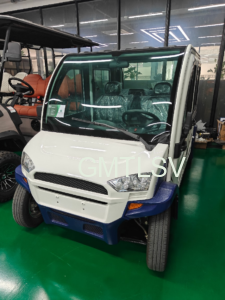
1. Mechanical Handbrake Cable: The Baseline Standard
Applications: Sightseeing shuttles, patrol vehicles.
Structural Overview
This is a purely mechanical system. A driver-activated lever multiplies input force via a ratchet mechanism, transmitting tension through a stranded steel cable to actuate brake shoes inside rear drum assemblies. There is no dependency on electrical power or hydraulic pressure.
Operational Dynamics
The force transmission is linear but suffers from parasitic losses. Cable bend radius, housing friction, and thermal expansion introduce hysteresis. Over the service life, the cable stretches, increasing free-play and requiring higher input force to achieve the same brake shoe clearance.
User Perception & Engineering Trade-offs
- Pros: High fault tolerance. The system remains functional even under complete electrical failure—a critical redundancy for industrial patrol applications. Serviceability is straightforward; adjustment involves simple tensioning.
- Cons: Ergonomically, the required input force (often exceeding 150N) is a barrier for users with limited grip strength. The mechanical “click” and lever travel provide tactile feedback, but the system lacks self-compensation for wear.
Engineering Verdict: High reliability, low complexity. Best suited for fleet environments where maintainability outweighs ergonomic refinement.
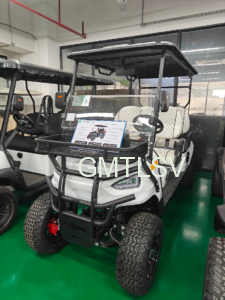
2. Foot-Operated Hydraulic Parking: Ergonomic Redistribution
Applications: G4+2 / GA1S 4+2 / GW 2+2.
Structural Overview
This system decouples the parking function from hand operation, utilizing a foot pedal connected to a hydraulic master cylinder. Pressure is distributed through brake lines to rear wheel cylinders or calipers. It effectively merges the parking and service brake circuits or utilizes a dedicated hydraulic circuit.
Operational Dynamics
Hydraulic systems offer superior force multiplication (typical mechanical advantage ratio of 30:1 to 50:1) compared to cable systems. The pedal feel is progressive—modulating pressure until the shoes/pads contact the friction surface. However, the system is susceptible to fluid compressibility and temperature-induced fade if not properly spec’d.
User Perception & Engineering Trade-offs
- Pros: Lower input force requirement (< 80N at pedal) compared to handbrake cables. Frees the driver’s hands for steering or assisting passengers. The center console remains uncluttered.
- Cons: The release mechanism (often a secondary pull-handle or lift-pedal) can be non-intuitive for first-time users. Seal degradation over time can lead to pressure loss and reduced holding capacity.
Engineering Verdict: A mature technology offering a good balance of ergonomics and performance. Requires periodic fluid maintenance and bleed procedures—acceptable for automotive-adjacent platforms but an added service item for pure utility carts.
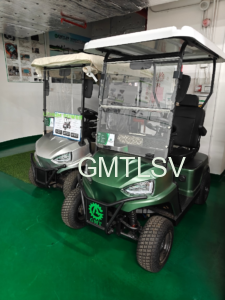
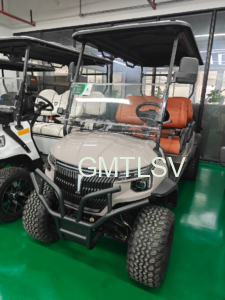
3. Electromagnetic Parking Brake: Actuator-Driven Automation
Applications: GD043 / GS023 / G1A / G1P.
Structural Overview
This is where LSEVs begin to diverge from traditional automotive architectures. An electromagnetic actuator is integrated into the rear axle assembly, typically acting on the drum brake shoes via a solenoid-driven cam. The system is controlled by the vehicle’s main ECU, which monitors vehicle speed, accelerator position, and gear selector state.
Operational Dynamics
The engagement is near-instantaneous (typically < 0.5s response time). When the controller detects a “stop” state (vehicle speed < 0.5 km/h, accelerator released, gear in neutral/park), it energizes the actuator coil, driving a plunger that mechanically spreads the brake shoes. Release occurs upon detecting a drive command (throttle input > threshold).
User Perception & Engineering Trade-offs
- Pros: Eliminates driver error—no forgotten parking brakes. The automatic hill-hold function prevents rollback without driver intervention. Force application is consistent regardless of user strength.
- Cons: Dependent on 12V auxiliary system integrity. If the actuator jams due to water ingress or mechanical seizure, the vehicle becomes immobilized. Diagnostics require electronic troubleshooting rather than mechanical inspection.
Engineering Verdict: The highest convenience factor. Ideal for applications with elderly users or high-turnover rental fleets where training consistency cannot be guaranteed. Requires robust IP67-rated actuator sealing and controlled calibration of engagement force to prevent premature wear.
4. Electronic Caliper Parking (EPB): Passenger-Car Architecture
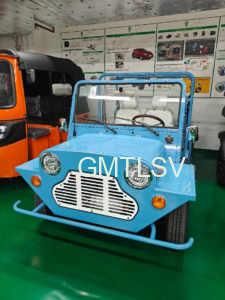
Applications: MORK.
Structural Overview
This is a true automotive-grade EPB system. An electric motor (typically a DC brushed or brushless motor with a reduction gearbox) is integrated into a rear disc brake caliper. Pressing the “P” button sends a signal to the EPB control module, which drives the motor to actuate the caliper piston, clamping the brake pads onto the rotor.
Operational Dynamics
The system operates as a “smart” actuator. It monitors clamp force via current sensing or position feedback. If the vehicle is on an incline, the system can automatically apply the brake when the vehicle comes to a stop (Auto Hold). Release is triggered by throttle input (with seatbelt and door-state interlocks for safety).
User Perception & Engineering Trade-offs
- Pros: Minimal input force (< 5N button press). Clear visual confirmation via dashboard telltale. Disc brakes offer superior heat dissipation and fade resistance. The system can integrate with vehicle stability functions and remote diagnostics.
- Cons: Highest system cost. Requires CAN bus integration and sophisticated software calibration. Service procedures involve specialized scan tools for caliper retraction. Motor durability in high-moisture environments (golf courses, coastal resorts) must be validated through accelerated life testing.
Engineering Verdict: The benchmark for premium LSEVs. Provides the closest parity to passenger car behavior. The complexity is justified in markets with stringent safety expectations and higher price tolerance.
5. Comparative Analysis Summary
| Parameter | Handbrake Cable | Foot Hydraulic | Electromagnetic | Electronic Caliper |
| Actuation Force | High (>150N) | Medium (<80N) | Low (Automatic) | Very Low (<5N) |
| Response Time | Driver-dependent | Driver-dependent | <0.5s | <0.3s |
| Electrical Dependency | None | None | 12V system | 12V + CAN |
| Maintenance Interval | Cable tension adj. | Fluid bleed | Actuator inspection | Software/calibration |
| Failure Mode | Gradual fade | Pressure loss | Actuator lock/jam | Electrical fault |
| Integration Potential | None | Limited | Hill-hold, Auto Hold | Hill-hold, Auto Hold, Stability |
Closing Thoughts
The evolution from mechanical cable to electronic caliper mirrors the broader transition of the LSEV industry: from utility vehicles to lifestyle products. Each architecture serves a distinct market segment, and the “best” system is always application-dependent.
For engineers, the challenge isn’t just selecting a braking mechanism—it’s balancing cost, serviceability, user capability, and safety margin. A parking brake that users don’t understand is a liability. One they don’t have to think about is an achievement.


