

If you’re running a senior living community, or you care about how your parents get around in their retirement community, you’ve probably noticed one thing: different people in a senior community have different needs, and those needs call for different vehicles.
When we talk about vehicles for senior communities, we’re not just talking about transportation—we’re talking about safety, health, and the freedom to stay independent. Aging brings natural changes: slower reaction times, reduced joint flexibility, diminished vision and hearing, and increased fragility. A simple fall, a jarring ride, or a confusing dashboard can have serious consequences. That’s why choosing the right vehicle for a senior community isn’t like buying a car for a typical family. Every feature—from step‑in height and seat comfort to blind‑spot cameras, automatic emergency braking, and clear, simple controls—directly impacts residents’ wellbeing and quality of life.
And because senior communities are vibrant ecosystems where residents, staff, and visitors move between homes, activity centers, medical appointments, and off‑site errands, no single vehicle can meet every need. The reality is, different people and different tasks require different vehicles—and that’s exactly what this guide is about. Whether it’s a resident’s personal car, a campus shuttle, an on‑site low‑speed vehicle, or a staff utility cart, the choice must start with safety and health, then fit the specific job at hand.
Why Senior Communities Are Going Electric
The numbers tell a compelling story. Electric vehicles can cut daily operating costs by 30% to 50% compared to gas-powered vehicles, and maintenance costs drop by about 40%—no oil changes, far fewer moving parts. For community budgets, that’s real money.
Beyond the financials, EVs are exceptionally well-suited to older drivers. They’re quiet, smooth, and free of the jerky gear shifts that can be uncomfortable. Most new EVs come loaded with advanced safety features—automatic emergency braking, blind-spot monitoring, lane-keeping assist—that serve as an extra layer of protection for drivers whose reaction times may have slowed with age.
And here’s the kicker: retirement is actually a perfect use case for EVs. Daily mileage often drops, but trip frequency goes up—more runs to the store, more visits to the doctor, more social outings. EVs thrive in exactly this kind of short-trip, high-frequency pattern.
Four EV Types for Four Senior Community Scenarios
Let’s break this down by use case.
Scenario 1: Resident Personal Vehicles – Sedans & Small SUVs
These are the cars residents drive themselves. The priority isn’t horsepower or 0–60 times—it’s ease of entry, visibility, and simplicity.
Step-in height matters more than you’d think. Look for vehicles with a higher seating position that lets residents slide in rather than drop down or climb up. Visibility is equally critical—large windows, thin A-pillars, and clear backup cameras with 360° views make a huge difference in driving confidence.
The interface is a dealbreaker. Some new cars bury everything—even climate control—in a touchscreen menu. For older users who aren’t digital natives, that’s a nightmare. Prioritize models with physical buttons, large readable fonts, and plain-language menus.
Top EV picks for senior drivers:
- Nissan Leaf: Starting around $29,900, with 149–212 miles of range. It’s one of the older EV models still on the market but remains popular because of its conventional, non-futuristic interior.
- Chevrolet Bolt EV/EUV: Around 247–259 miles of range, with upright seating and great visibility.
- Hyundai Kona Electric: Under $42,600, with 220–260 miles of real-world range. The interior keeps physical buttons rather than touch-sensitive pads, making it easy to find functions without distraction.
- Hyundai Ioniq 5: Starting at $43,795, with up to 318 miles of range and 10%–80% fast charging in about 20 minutes. Kelley Blue Book ranked it one of the best cars for seniors because it packs large-SUV safety features into a more manageable size.
Scenario 2: Community Shuttles – Electric Shuttles & Trolleys
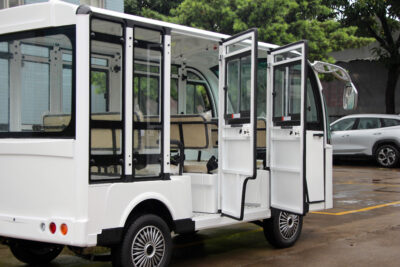
This is the fleet side of the equation. From retirement homes to shopping malls, from the community to the clinic, from the apartment building to the activity center—fixed-route group transport calls for dedicated electric shuttles.
Real-world examples are already out there. Woodbridge Township, New Jersey, deployed three fully electric, zero-emission shuttle buses for its senior transportation program. Each 24-foot shuttle seats up to 14 passengers, runs on a 127-kWh lithium-ion battery, and has a range of up to 105 miles. Fixed routes plus overnight charging keep operating costs low.
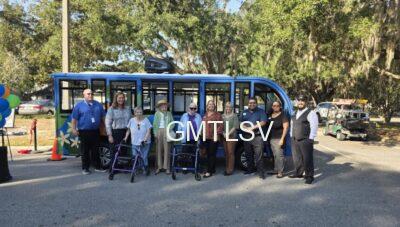
The Village at Gainesville in Florida took a different approach—an electric trolley designed by Moto Electric Vehicles. It features two rows of facing seats so residents can walk up the ramp, sit facing one another, and keep their walkers right in front of them. Executive Director Kim Giberti said the trolley gave residents “a sense of safety and security that they have control over” their walkers. The community even handed out “golden tickets” (à la Willy Wonka) for the maiden voyage to build excitement and resident buy-in.
Rossmoor in Walnut Creek, California, is testing fully electric autonomous shuttles that carry up to seven passengers every 20 minutes on a preprogrammed loop.
Shuttle options range from 9-passenger to 46-passenger electric trolleys, depending on community size and route length.

Scenario 3: On-Campus Short-Haul – Golf Carts vs. LSVs (Low-Speed Vehicles)
For getting around inside the community—from home to clubhouse, apartment to dining hall, parking lot to activity center—short-distance, low-speed transport is a daily necessity. Two main options exist: golf carts and LSVs.
What’s the difference?
- Golf Carts: Top speed of 12–15 mph, typically used on private property or golf courses. Not federally regulated as motor vehicles.
- LSVs (Low-Speed Vehicles): Top speed of 20–25 mph, regulated under federal safety standards (FMVSS 500), and legal on roads with speed limits of 35 mph or below.
LSVs are increasingly becoming the preferred choice for senior communities. By 2026, 42 states have relaxed LSV regulations, allowing compliant vehicles to operate on public roads.
Safety is where LSVs clearly outperform golf carts. A lower center of gravity, front-wheel drive, and car-like suspension give LSVs better stability and maneuverability, especially in turns. Federal safety standards require LSVs to have windshields, side mirrors, seat belts, and lights—features golf carts often lack.
Scenario 4: Staff Vehicles – Utility EVs
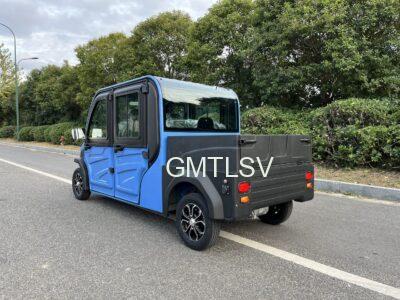
Community staff—security patrol, maintenance, housekeeping, food service—need durable utility EVs that can haul tools and equipment. These don’t need fancy interiors, but they do need strong payload capacity, reliable range, and rugged construction. Many manufacturers offer electric utility carts with customizable cargo beds and tool racks.
Wheelchair Accessibility: A Growing Priority
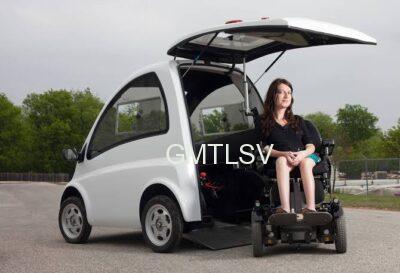
For residents with mobility challenges, wheelchair-accessible EVs are becoming more available. The Kia PV5 WAV (Wheelchair Accessible Vehicle), unveiled in May 2025, features a side-entry system that allows wheelchair users to board safely from the sidewalk. It includes a third-row tip-up seat so caregivers can assist from the side, along with a 300kg-rated ramp and a specially developed wheelchair belt fastening system.
Many electric shuttles and trolleys can also be equipped with ADA-compliant ramps and lifts.
EV Buying Guide for Senior Communities: At a Glance
| Use Case | Recommended Vehicle Type | Key Considerations |
|---|---|---|
| Resident personal driving | Sedan / Small SUV | Step-in height, visibility, simple controls, safety assist features |
| Community-to-destination shuttling | Electric shuttle bus (10–28 seats) | Range ≥100 miles, fast-charging capability, wheelchair access |
| On-campus short-haul | LSV (Low-Speed Vehicle) | 20–25 mph, FMVSS 500 compliant, legal on 35 mph roads |
| Golf cart replacement | LSV (better safety & stability) | Superior handling and federally required safety equipment |
| Wheelchair-accessible transport | Electric WAV / ADA shuttle | Side-entry or rear-entry ramp, wheelchair securement systems |
| Staff & maintenance | Electric utility cart | Payload capacity, durability, customizable cargo options |
Case Study: Woodbridge, New Jersey
Woodbridge Township offers a practical blueprint for senior community electrification.
According to 2010 census data, 12.6% of Woodbridge’s 99,585 residents—about 12,547 people—were 65 or older. To serve this growing population, the township runs the Senior Transportation of Woodbridge (STOW) program, a curb-to-curb, reservation-based shared ride service.
In November 2024, Woodbridge deployed three fully electric, zero-emission shuttle buses. Each bus has a 127-kWh lithium-ion battery with 105 miles of range. The New Jersey Department of Environmental Protection funded the purchase through Regional Greenhouse Gas Initiative grants.
Woodbridge Mayor John E. McCormac put it simply: “Helping senior citizens get out and about is so important to emotional and physical health”.

The Bottom Line
There’s no single “best” EV for a senior community. The right vehicle depends entirely on the job it needs to do:
- For residents driving themselves: choose easy-entry, high-visibility, simple-to-operate sedans or SUVs
- For community-to-destination group transport: choose electric shuttles with adequate range and wheelchair access
- For on-campus short trips: LSVs beat golf carts on safety, stability, and legal compliance
- For staff: choose durable utility EVs
Compared to gas vehicles, EVs cost less to run, require less maintenance, and offer a quieter, smoother ride—exactly what senior communities value most. With more states and cities offering electrification grants, now is an excellent time to start the transition.
Start with one vehicle, learn from the experience, and scale from there. That’s the path many communities are taking. Is yours ready to make the move?

