

If you’re searching for “what is the average cost of a golf cart,” you’re probably not just looking for a single number. You’re trying to figure out: How much should I actually budget? Why do some carts cost a few thousand dollars while others cost $20,000 or more?
You’re in the right place. This guide gives you the real answer—not just an average, but a complete breakdown of what drives golf cart prices, so you can make a smart buying decision.
The Short Answer: How Much Does a Golf Cart Cost?
A golf cart can cost anywhere from $2,000 to $25,000 or more. That’s a huge range, and here’s why: golf carts aren’t one-size-fits-all anymore. You’ve got gas carts, electric carts, street-legal LSVs, lifted utility models, and fully customized builds.
At a glance:
- New golf carts: $5,000 – $23,000
- Used golf carts: $2,000 – $8,000
- Most common sweet spot: A quality new 4-passenger electric cart runs $9,000–$14,000
But the sticker price is only part of the story. Let’s break it down by type, feature, and what you actually get for your money.

Average Golf Cart Cost by Type
| Golf Cart Type | Typical Price Range | Best For |
|---|---|---|
| Entry-Level / Basic 2-Passenger | $2,000 – $5,000 (used) / $5,500 – $8,500 (new) | Personal use, light recreation |
| Mid-Range 4-Passenger | $8,000 – $14,000 | Families, neighborhoods, communities |
| Premium 4-Passenger (Lithium) | $12,000 – $16,000 | Buyers wanting modern tech and low maintenance |
| 6-Passenger | $13,000 – $17,000+ | Resorts, large families, group transport |
| Street-Legal LSV / NEV | $14,000 – $22,000+ | Communities where road use is permitted |
| Luxury / Custom Build | $15,000 – $25,000+ | Premium finishes, custom paint, sound systems |
Electric models now make up roughly 95% of new golf cart sales, and for good reason—they’re quieter, cleaner, and cheaper to maintain than gas carts.
What Determines Golf Cart Prices?
Why do two carts that look similar have wildly different price tags? Here are the major factors:
1. Seating Capacity
More seats = more money. Here’s what you’ll typically pay:
| Seating | Typical Price Range |
|---|---|
| 2-Passenger | $5,000 – $10,500+ new |
| 4-Passenger | $8,000 – $14,000 new |
| 6-Passenger | $13,000 – $17,000+ new |
A 4-seater with a fold-down rear seat adds roughly $1,500 to $2,000 compared to a 2-seater.
2. Battery Type: Lithium vs. Lead-Acid
This is one of the biggest price drivers—and one of the most misunderstood.
| Battery Type | Upfront Cost | Lifespan | Maintenance |
|---|---|---|---|
| Lead-Acid | $800 – $1,200 to replace | 4–6 years | Requires regular watering, maintenance |
| Lithium-Ion | $2,000 – $4,000 upfront | 8–12+ years | Nearly zero maintenance, lighter weight |
Example: A Club Car Onward with lithium costs about $12,499 vs. $9,999 for the lead-acid version. That’s a $2,500 difference upfront—but lithium lasts twice as long and saves you money on maintenance over time.

3. Brand Reputation
Premium brands like Club Car, E-Z-GO, and Yamaha command higher prices—and hold their value better.
2026 verified MSRPs:
- Club Car Onward 2-Passenger: Starting at $9,957
- Club Car Onward 4-Passenger: Starting at $14,097
- Club Car Onward 4-Passenger LSV (street-legal): Starting at $15,349
- Club Car Onward 6-Passenger: Starting at $15,558
E-Z-GO models range from about $9,500 to $12,000 in base trims, while Yamaha carts run $9,899 to over $22,000 depending on configuration.
Lesser-known brands can save you 20% to 30% upfront but may have limited parts availability and long-term support. A well-maintained cart from a major brand can still hold 50–70% of its original value at the five-year mark.
4. New vs. Used
| New | Used | |
|---|---|---|
| Price | $5,000 – $23,000 | $2,000 – $8,000 |
| Warranty | Full manufacturer warranty | Limited or none |
| Condition | Brand new | Variable—depends on age and battery life |
| Depreciation | Fastest in first 2–3 years | Already depreciated |
| Maintenance Risk | Low initially | Higher—battery replacement can add $800–$2,000 |
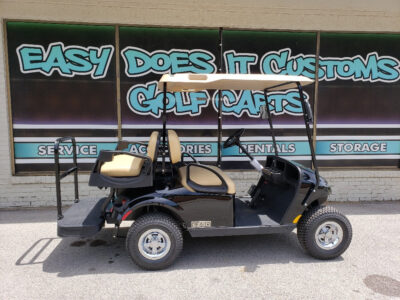
Used carts can be 30–50% cheaper than new ones, but battery age is the biggest risk. A replacement pack can cost $800 to $2,000 on an electric E-Z-GO or Club Car.
5. Street-Legal / LSV Equipment
Making a golf cart street-legal adds significant cost—typically $2,000 to $4,000 for DOT-approved lights, mirrors, seat belts, windshield, VIN, and registration-ready equipment.
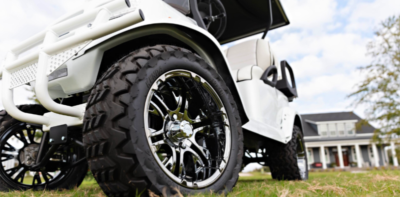
6. Customization and Accessories
Custom paint, upgraded seats, lift kits, sound systems, and premium wheels can add thousands to the final price. High-traction upgrades like lithium batteries or lifted suspensions can boost resale value by 15–30%.
New vs. Used: Which Offers Better Value?
A new golf cart gives you peace of mind—manufacturer warranty, modern technology, updated safety features, and batteries that should provide years of dependable performance. You also know exactly how the cart has been maintained because you’re the first owner.
A pre-owned cart reduces your upfront investment, but the overall condition—especially the battery pack—can significantly affect future ownership costs. Two carts that look nearly identical can have very different values if one has a battery nearing the end of its service life.
Bottom line: Buy new if you want reliability and a warranty. Buy used if you’re on a tight budget and willing to do your homework on battery condition.
Total Cost of Ownership: What You’ll Really Pay
Purchase price ≠ total cost. Here’s what to budget beyond the sticker price:
| Cost Category | Electric Cart | Gas Cart |
|---|---|---|
| Annual electricity/fuel | $50 – $150 | $200 – $400 |
| Annual maintenance | $100 – $300 | $300 – $700 |
| Annual insurance | $100 – $400 (if street-legal) | $100 – $400 |
| Battery replacement | $800 – $4,000 (every 4–15 years) | N/A |
5-year total cost comparison:
| Scenario | Purchase | 5-yr Fuel | 5-yr Maint. | 5-yr Battery | 5-yr Total |
|---|---|---|---|---|---|
| Used ($6,000) + lead-acid | $6,000 | $600 | $1,500 | $1,500 | $9,600 |
| New lead-acid ($10,000) | $10,000 | $600 | $1,000 | $500 | $12,100 |
| New lithium ($12,500) | $12,500 | $600 | $600 | $0 | $13,700 |
| New gas ($8,500) | $8,500 | $2,000 | $2,500 | N/A | $13,000 |
The gap between new lithium and used lead-acid is smaller than it appears—and lithium still has 5–10+ years of useful life at the 5-year mark.
Dealer vs. Manufacturer: Where Should You Buy?
Here’s something most price guides don’t tell you: where you buy matters almost as much as what you buy.
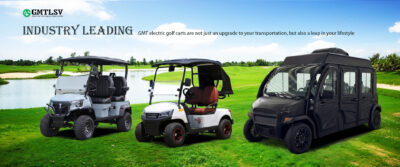
Dealers in the US often charge $15,000 to $18,000 for carts that cost factories roughly $6,000 to $8,000 to manufacture. That markup covers shipping, inventory, showroom costs, and dealer profit.
Buying directly from a manufacturer—especially from overseas manufacturers like those in China—can save you significantly. Factory-direct prices for a quality 4-passenger electric golf cart can be $3,500–$4,500 EXW (ex-works, before shipping), compared to $9,000–$13,000 retail in the US.
What you get with a manufacturer:
-
Factory-direct pricing (no dealer markup)
-
OEM customization options
-
Bulk order discounts (starting from 5+ units)
-
Direct communication with the production team
What you get with a dealer:
-
Local support and service
-
Easier test drives
-
Faster delivery (if inventory is local)
-
Higher prices
If you’re buying a single cart for personal use, a local dealer might be worth the premium for convenience and service. If you’re buying for a community, resort, or fleet—or if you’re willing to wait for shipping—factory-direct can save you thousands.
What Golf Cart Can You Get for Your Budget?
| Budget | What You Can Get |
|---|---|
| Under $5,000 | Used, older models; basic 2-passenger; likely needs battery work soon |
| $5,000 – $10,000 | Entry-level new 2-passenger; decent used 4-passenger; base models |
| $10,000 – $15,000 | Quality new 4-passenger electric; some lithium options; mild customization |
| $15,000 – $20,000+ | Premium lithium 4-6 passenger; street-legal LSV; lifted; custom builds |
So what is the average cost of a golf cart? If you want one number: most buyers spend between $8,000 and $14,000 for a quality new 4-passenger electric cart.
But the real answer depends on what you need:
- Just getting around the neighborhood? A basic 2-passenger or used 4-passenger will do.
- Hauling the family or friends? Budget $10,000–$15,000 for a 4- or 6-passenger.
- Want street-legal? Add $2,000–$4,000 for LSV equipment.
- Hate maintenance? Pay more upfront for lithium—it’ll save you money in the long run.
- Buying for a fleet or community? Go factory-direct and save thousands.
The key takeaway: don’t just look at the sticker price. Factor in battery type, maintenance costs, and where you’re buying from. A cart that costs $2,000 more upfront with lithium batteries could save you $3,000 over five years.
Now you know what to expect. Happy shopping!


