

If you’ve read my last post, you already know that not all golf cart parking brakes are created equal. But today I want to zoom in on two of the more modern systems we build into our vehicles: electromagnetic parking (found on models like the GD043, GS023, G1A, and G1P) and electronic caliper parking (the star of the MORK).
To the eye, both look similar. There’s no hand lever. No foot pedal. You stop the cart, and it stays put. You press the gas, and it goes. Simple, right?
Well, yes—but the “magic” happening behind the scenes is completely different. And as a customer, understanding how your cart decides to hold still can explain a lot about why one model feels smoother, safer, or more “car-like” than another.
Let me break it down for you in plain English.
Electromagnetic Parking: The Cart That Locks Its Own Axle
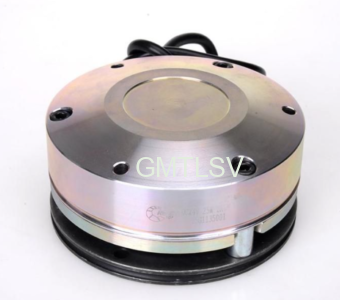
Here’s something that surprises a lot of people: electromagnetic brakes on golf carts are designed to be “fail-safe.” That means they work exactly the opposite of what you’d expect. The brake engages when there’s NO power. It only releases when you give it electricity.
Think of it like a spring-loaded clamp. When the cart is turned off or the battery dies, a strong spring pushes a steel plate against a friction surface inside the rear axle or motor. The axle is locked. The cart isn’t going anywhere. This is why, even if everything else fails, the cart stays put. Safety first.
When you turn the key on and press the accelerator, electricity flows to an electromagnet. The magnetic force pulls the steel plate away from the friction surface, fighting against that spring. The axle is free to spin. You drive away smoothly.
Now, here’s where the “brain” comes in. The controller doesn’t just slam the brake on the moment you lift your foot. It watches the speed. As the cart slows down, the controller knows: “OK, we’re almost stopped.” At around half a mile per hour, it cuts power to the electromagnet. The spring takes over instantly, and the axle locks. You feel a firm, confident stop.
On a hill, the timing gets tricky. If the controller cuts power too early, the cart might roll back a couple of inches before the spring fully engages. If it cuts too late, you’ll feel a jerk. Good calibration means the cart holds steady without you even noticing. Bad calibration? Your coffee sloshes.
The beauty of this system is its simplicity and reliability. No buttons to press. No pedals to pump. The cart locks itself the moment you stop—and it stays locked even if the battery dies. For a golf course or a resort where guests just want to hop on and go, that peace of mind is hard to beat.
Electronic Caliper Parking (EPB): The Cart That Squeezes Its Own Brakes
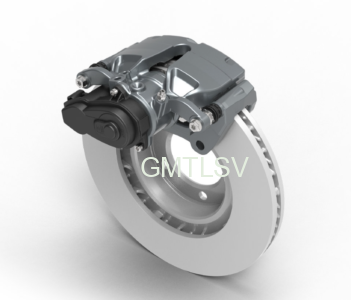
Now, the MORK and similar premium models do something very different. Instead of locking the axle, they lock the wheels directly—just like a modern car with an Electric Parking Brake (EPB). And unlike the electromagnetic system, these calipers need power to both engage AND release. They don’t rely on a spring to do the work.
Look at the rear wheels. Behind each wheel is a disc brake—a metal rotor spinning with the wheel, and a caliper sitting over it. Inside that caliper is a small electric motor. When you press the “P” button, that motor turns a screw, which pushes the brake pads against the rotor. Tight. The wheel can’t turn.
No springs. No magnets doing the heavy lifting. Just an electric motor that knows exactly how hard to squeeze.
You pull up to the clubhouse. Press “P.” A light comes on the dashboard. That’s it. You can get out, walk away, and the cart isn’t going anywhere. When you come back, press the accelerator and the motor inside the caliper backs off. The pads release. You’re on your way.
Here’s where it gets interesting. The electronic caliper system has a tiny sensor inside that tells the controller, “I’m squeezing this hard.” On a hot day, after you’ve been driving downhill and the brakes are warm, the system knows the pads have expanded slightly and adjusts the squeeze. On a cold morning, it gives a little extra push. It also knows if your brake pads are wearing down. Every time you press “P,” the motor has to push a tiny bit further to close the gap. Over thousands of stops, it learns that the pads are getting thin—and can warn you it’s time for service.
On a slope, the MORK’s brain does a neat trick. It remembers the angle. When you press the gas to drive away, it holds the brakes for a split second—just long enough for the motor to build up power—then releases. The cart doesn’t roll backward an inch. It just moves forward, like it’s being handed off from one hand to another.
The one thing to remember? Because the caliper needs electricity to release the pads, if your 12-volt battery is completely dead, the cart is staying put. Unlike the electromagnetic system, there’s no spring to take over. A technician needs to plug in a power source or use a manual release tool. That’s the trade-off for all that sophistication.
So Which One Is Right for You?
Choose electromagnetic parking if you want zero thinking. You have older guests or staff who shouldn’t have to remember buttons. You’re on a golf course, a large property, or a resort where the cart is a tool, not a status symbol. And you want the peace of mind that the cart will lock itself—battery dead or not.
Choose electronic caliper parking if you want the premium experience. Your guests notice details—the clean dashboard, the button press, the “car-like” feel. You’re in a private community, a high-end resort, or exporting to markets where customers compare your cart to a Tesla, not a tractor. Just remember: keep that 12-volt battery charged.
Both systems exist because customers asked for the same thing: “I don’t want to think about the parking brake.”
Electromagnetic parking answers that by removing the brake from your hands entirely—a spring does the work, power just gets out of the way. Electronic caliper parking answers it by giving you one button that controls a system smart enough to handle the rest.
One is a loyal old sheepdog. The other is a trained valet.
Your cart won’t tell you which one it has. But now you know what to look for.


